Skip to content
Patterned Concrete Driveway Cost UK: A Comprehensive Guide for 2026
- by Scott Patterned Concrete
The "cheapest" quote for your home's exterior often proves to be the most expensive mistake you can make when it results in a crumbling surface just a few seasons later. It's frustrating to find such conflicting information regarding the patterned concrete driveway cost uk, especially when you're trying to balance a desire for kerb appeal with a sensible budget. You likely want a finish that remains vibrant and weed-free, but the fear of hidden structural issues or the concrete fading over time is a common concern for many homeowners across the North East and the wider UK.
We understand that a driveway is more than just a place to park; it's a significant investment in your property's heritage. This guide will provide you with a clear understanding of the price-to-quality ratio and the technical factors that truly dictate the final cost. You'll learn how to secure a high-end finish that adds lasting value, whilst ensuring your project remains compliant with the latest 2026 SUDS drainage regulations and planning permission rules. We'll walk you through the essential groundwork and specialist techniques that separate a standard installation from a master-crafted entrance that stands the test of time.
Key Takeaways
- Learn why the initial patterned concrete driveway cost uk is a long-term investment in durability, offering a 30-year lifespan that far exceeds cheaper alternatives like tarmac.
- Understand how the 2026 SUDS drainage regulations and planning permission requirements affect your installation and how to ensure your property remains fully compliant.
- Discover the specific factors that influence your quote, from the total surface area and economies of scale to the intricacy of bespoke borders and woodplank effects.
- Compare the maintenance requirements and structural integrity of imprinted concrete against block paving to see why a solid, weed-free surface adds superior value to your home.
- Identify the critical "point of no return" in a concrete pour and why choosing a specialist installer with decades of experience is essential for a flawless, high-end finish.
Understanding Patterned Concrete Driveway Costs in 2026
When you're researching the What is Patterned Concrete? question, you'll find it's a specialised method where wet concrete is textured and coloured to mimic high-end materials like slate, Yorkstone, or even wood planks. In 2026, it remains a premium choice across the UK because it offers a unique blend of aesthetic versatility and unmatched structural integrity. However, calculating the patterned concrete driveway cost uk involves more than just looking at a price per square metre. While raw material prices for cement and pigments have stabilised, modern environmental standards and the demand for higher-grade, fibre-reinforced mixes have shifted how specialists structure their quotes.
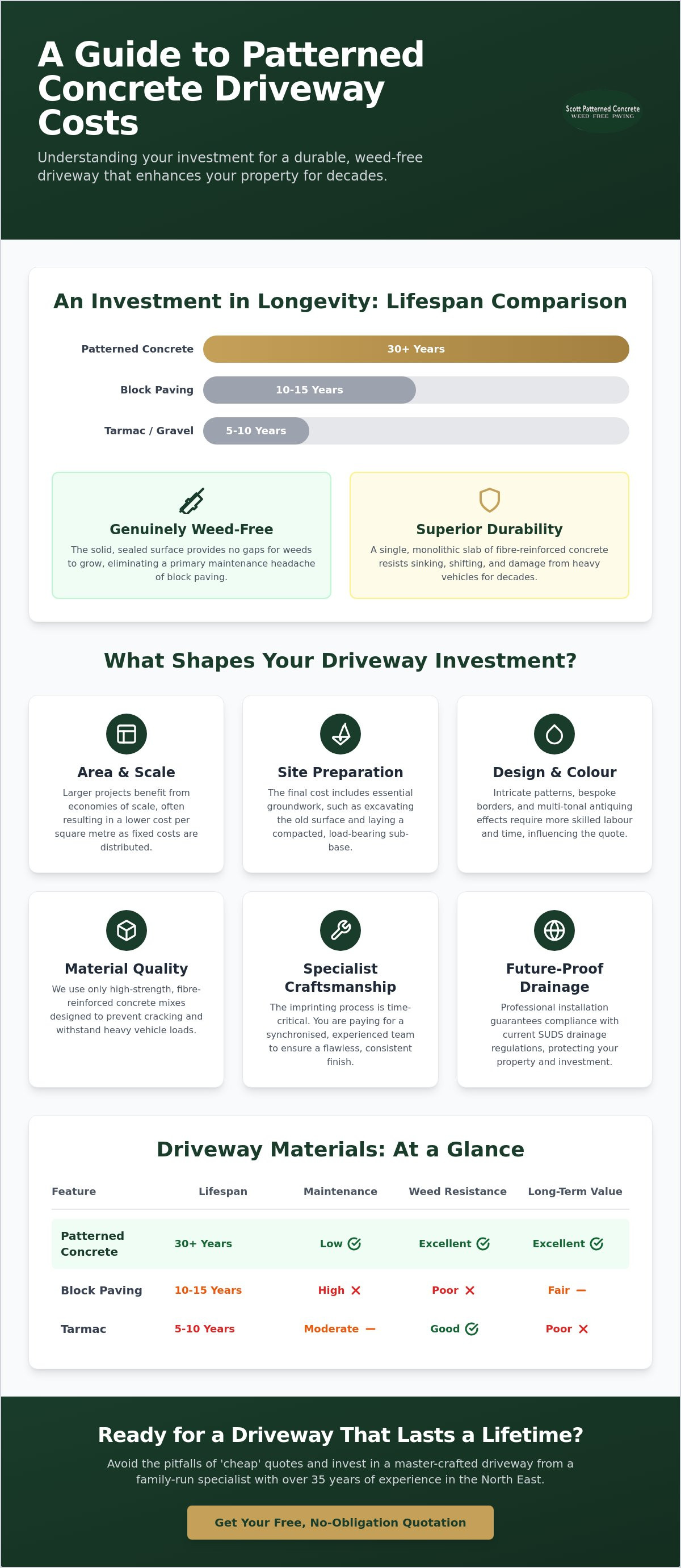
A "per square metre" figure is often just a baseline. Every property from Stockton-on-Tees to Middlesbrough has unique challenges, such as varying soil types or the need for extensive excavation of old tarmac. You aren't just buying a surface; you're investing in a multi-layered engineering project. The trade-off for a slightly higher initial investment compared to basic surfaces is a 30-year lifespan. When you spread the cost over three decades, the value becomes clear, especially when you factor in the lack of repairs required over that period.
What Exactly Are You Paying For?
A professional quote from a family-run specialist with 35 years of experience covers three main pillars. First is preparation, which includes the removal of your existing driveway and the installation of a compacted sub-base. Second is the material quality; we use high-strength, fibre-reinforced concrete designed to withstand heavy vehicle traffic without the structural failures seen in DIY attempts. Finally, you're paying for craftsmanship. The "imprinting" phase has a very narrow window of time before the concrete sets, requiring a synchronised team of experts to ensure a consistent pattern and depth across the entire concrete driveway.
Patterned Concrete vs. The 'Cheap' Alternatives
It's tempting to look at gravel or basic tarmac for immediate savings, but those "savings" often vanish within five years due to weed growth, sinking, or oil staining. Patterned concrete is a monolithic pour that eliminates the shifting issues common in block paving. This "weed-free" premium is one of the most significant benefits for homeowners. Because the surface is a solid, sealed slab, there are no gaps for seeds to take root. For a detailed look at the process, our printed concrete guide explains how this seamless finish creates a durable, low-maintenance entrance that enhances your home's kerb appeal for decades.
Key Factors That Influence Your Driveway Investment
While the total surface area is the most obvious variable, the patterned concrete driveway cost uk is shaped by several nuanced factors that go beyond simple measurements. Large driveways often benefit from economies of scale. This is because fixed costs, such as the transport of heavy machinery and skip hire, are spread across a greater area. Conversely, a very small project might have a higher cost per square metre because the logistical effort and setup time remain the same regardless of the pour size.
The Impact of Design and Aesthetic Choices
The visual complexity you choose will directly affect the labour hours required. A simple woodplank effect or a uniform slate texture is relatively straightforward to apply. However, adding bespoke borders or contrasting "soldier courses" involves intricate hand-tooling and often requires the team to work with different mat sets simultaneously. High-definition texture skins provide a more realistic, natural stone finish than standard mats, but they require a more experienced hand to avoid visible "repeats" in the pattern.
Your colour palette also plays a role in the final quote. A single-tone finish is the most economical option. If you desire a multi-tonal, weathered look, we use a process called antiquing. This involves throwing a secondary colour release agent over the primary colour hardener. This technique requires significant specialist skill to achieve a balanced, natural appearance that doesn't look blotchy or artificial. If you have a specific vision for your home's exterior, you can speak with our team to discuss which colour combinations work best for your property's style.
Technical Specifications and Reinforcement
Sub-surface engineering is where the real longevity of your driveway is decided. We often see quotes that skip on internal reinforcement to lower the price, but this is a false economy. High-grade poly-fibres are standard in our mixes to provide three-dimensional reinforcement, though certain ground conditions or commercial applications might require traditional steel mesh. The thickness of the concrete must be matched to the expected weight-bearing load of the property. While 100mm is standard for most cars, a 150mm depth is essential for multi-vehicle households or properties where delivery vans and heavier SUVs frequently turn.
Finally, your site's existing conditions can influence the complexity of the build. Sloped driveways require a specific concrete "slump" to ensure the material doesn't migrate before it sets. We also have to account for existing manhole covers, which we replace with recessed "tray" lids that are filled with concrete and patterned to match the rest of the surface. Most importantly, every installation must comply with UK Drainage Regulations. This may involve installing linear drains or soakaways to ensure surface water is managed on your own land, preventing runoff into the public highway.
Comparing Patterned Concrete to Block Paving and Tarmac
Selecting the right material for your home's entrance is a balance between immediate expenditure and lifetime performance. While a basic tarmac surface might appear cost-effective initially, its typical 10 to 15-year lifespan means you could be replacing it twice in the time a single concrete installation remains pristine. For larger projects, the installation speed of a patterned concrete driveway cost uk often outperforms traditional block paving. Instead of laying thousands of individual bricks by hand, a specialised team can pour and pattern a significant area in a fraction of the time, reducing the disruption to your daily life.
Aesthetic flexibility is another area where concrete excels. Block paving is often limited by the shapes and colours available from manufacturers. In contrast, our bespoke approach allows for total customisation. Whether you want the rustic charm of a cobblestone path or the sleek lines of modern slate, the versatility of concrete patios and driveways ensures your property stands out for the right reasons.
The Weed and Subsidence Factor
One of the most significant drawbacks of block paving is its susceptibility to shifting and weed growth. Because blocks are individual units, they rely on the sand between them for stability. Over time, heavy SUV usage or heavy rainfall can wash away this sand, leading to rutting and subsidence. Patterned concrete is a monolithic pour; it's a single, continuous slab of reinforced material. This structural unity prevents individual sections from sinking, ensuring the surface remains perfectly level for decades.
There's also a clear financial benefit to a surface that literally cannot grow weeds. Unlike block paving, which requires regular pressure washing and re-sanding to keep moss and grass at bay, a sealed concrete surface offers no gaps for seeds to take root. This reduces your long-term maintenance costs to almost zero, requiring only a simple reseal every few years to keep the colours looking as vibrant as the day they were poured.
Long-Term Value and Property ROI
In the UK's competitive housing market, first impressions are everything. A premium driveway finish can significantly impact the overall valuation of a home, often providing a return on investment that exceeds the initial cost. Potential buyers view a high-quality driveway as a sign of a well-maintained property, offering them peace of mind that they won't face surfacing repairs for years to come.
We've noticed a growing 2026 trend for luxury homes moving towards Stonecrete and exposed aggregate finishes. These options provide a sophisticated, high-end texture that pairs beautifully with both contemporary and traditional architecture. By choosing a specialist finish, you aren't just paving a space; you're creating a durable architectural feature that enhances the kerb appeal of your home across the North East.
Planning for Longevity: Drainage and Maintenance Costs
A beautiful finish is only as good as the engineering beneath it. When calculating the patterned concrete driveway cost uk, you must account for the technical features that protect your home from the elements. In 2026, SUDS (Sustainable Drainage Systems) compliance is a non-negotiable factor for any professional installation. Because imprinted concrete is a non-permeable surface, the law requires that surface water is managed within the boundaries of your property rather than running off into public sewers. This is achieved through the strategic placement of linear drains and soakaways, which are essential for preventing structural dampness and local flooding.
Expansion joints are another critical, yet often overlooked, component of a high-quality pour. These are engineered stress-relief points cut into the slab at specific intervals. They allow the concrete to expand and contract with the North East's fluctuating temperatures without resulting in unsightly structural cracks. Skipping these or placing them incorrectly is a hallmark of an inexperienced builder and can lead to expensive repairs just a few years down the line.
Staying Legal: Drainage and Planning Permission
You may be surprised to learn that you generally don't need planning permission for a new driveway if you use a specialist who understands UK drainage laws. The current regulations state that any new or replacement driveway over five square metres must either be permeable or have a system that directs water to a permeable area, such as a lawn or a dedicated soakaway. If your installer ignores these requirements, you could face significant fines from your local council in Stockton-on-Tees or County Durham, or be forced to dig up the surface entirely. We ensure every project is fully compliant, saving you the time and expense of formal planning applications.
The Resealing Schedule: Protecting Your Investment
The first 12 months are vital for the curing and protection of your new surface. We apply a high-solids acrylic sealer immediately after the pour to lock in the colour and provide a barrier against UV rays and oil spills. However, the maintenance doesn't stop there. To keep your driveway looking its best, we recommend a professional reseal every three to five years. This prevents the "blown" or "blooming" effect, a common issue where moisture gets trapped under a sub-standard sealer, causing white, cloudy patches that obscure the pattern.
Investing in a high-quality sealer now prevents the pigment from fading and keeps the surface completely weed-free. If you're unsure about the current state of your driveway or need advice on a new installation, you can contact our specialist team for expert guidance. Taking a proactive approach to maintenance ensures your home's entrance remains a source of pride for decades to come.
Securing Value: Why Specialist Installation Outperforms DIY
Securing value in a home improvement project means looking past the initial invoice. Our family-run team brings the "Master Craftsman" approach to every site, ensuring that the patterned concrete driveway cost uk represents a one-time investment rather than a recurring expense. We treat every project in Stockton-on-Tees, Middlesbrough, and the surrounding areas with the same level of care we would give our own homes. From the first shovel in the ground to the final application of UV-resistant sealer, we focus on the meticulous details that general builders often overlook.
Choosing a specialist installer isn't just about getting the job done; it's about managing the "point of no return". Unlike laying a patio with individual stones, imprinted concrete has a very narrow window of opportunity. Once the concrete is poured and the colouring agents are applied, the team must work with absolute precision to stamp the pattern before the surface hardens. Concrete sets fast. If the timing is off, or the weather turns unexpectedly, there's no way to reset the project without a total and expensive excavation. This is why patterned concrete is never a suitable DIY task for the inexperienced.
The Risks of 'Cheap' Quotes
It's a common story across the North East, from Darlington to Sunderland. A contractor offers a quote that is significantly lower than the market average. Usually, these savings come from cutting corners where you can't see them. They might use a lower grade of concrete without the necessary fibre reinforcement, or they might skimp on the depth of the sub-base. When structural cracks inevitably appear six months later, these "ghost" contractors are often impossible to reach. A 35-year reputation is the best guarantee a homeowner can have; it means we take personal responsibility for every project, from Hartlepool to North Yorkshire.
Next Steps for Your Project
To get the most out of your professional consultation, it's helpful to have a rough idea of your preferred textures and colours. When reviewing a written contract, always look for specific details regarding the concrete depth, the grade of the mix, and the planned drainage solutions. A transparent specialist will always be happy to explain how they intend to meet installation standards. Whether you're in Yarm, Billingham, or Redcar, we pride ourselves on straightforward, honest communication. You can Request a bespoke quote from the experts at Scott Patterned Concrete to begin your journey toward a beautiful, durable entrance that stands the test of time.
Transform Your Home with Lasting Craftsmanship
Choosing the right surface for your home involves looking beyond the initial quote and considering the decades of performance ahead. A high-quality installation provides more than just a place to park; it offers a weed-free, structurally sound entrance that enhances your property's long-term value. By prioritising proper drainage compliance and high-grade materials, you avoid the common pitfalls of subsidence and fading that often plague cheaper, less durable alternatives.
Understanding the true patterned concrete driveway cost uk means valuing the expertise that goes into every single pour. As a family-run business with over 35 years of specialist experience, we bring a "Master Craftsman" approach to every project across the North East. Whether you're interested in the sophisticated texture of Stonecrete or a bespoke decorative finish, our team ensures your investment is protected by meticulous attention to detail and industry-leading standards.
Ready to elevate your home's kerb appeal with a specialist finish? Book a professional site survey and quote with Scott Patterned Concrete today. We look forward to helping you create a lasting first impression for your property.
Frequently Asked Questions
Is patterned concrete cheaper than block paving in the UK?
Patterned concrete often proves more cost-effective than block paving for medium to large driveways because the installation process is significantly faster. While material costs are comparable, the labour hours required to lay thousands of individual blocks one by one drive up the price of paving. Choosing a single pour also eliminates the future costs of re-sanding and weed removal, which are common maintenance burdens for block paving owners.
Do I need planning permission for a patterned concrete driveway in 2026?
You don't usually need planning permission for a patterned concrete driveway if you incorporate a compliant drainage system. Current UK regulations state that as long as surface water is directed to a permeable area within your property, such as a lawn or soakaway, formal approval isn't required. We handle all the necessary technical calculations to ensure your project remains fully compliant with SUDS legislation, saving you from potential council fines.
How long does a patterned concrete driveway take to install?
A typical installation usually takes between three and five working days, depending on the size of the area and the complexity of the pattern. The process begins with excavation and sub-base preparation, followed by the concrete pour and imprinting phase. After the concrete has cured sufficiently, we return to wash the surface and apply a high-solids sealer, ensuring your new entrance is ready for vehicle traffic shortly after.
Does patterned concrete crack easily in the UK winter?
High-quality installations are specifically designed to withstand the UK's fluctuating winter temperatures without structural failure. The secret lies in the correct placement of expansion joints and the use of fibre-reinforced concrete mixes. These features allow the slab to expand and contract naturally as the ground freezes and thaws. When installed by a specialist with 35 years of experience, your driveway will remain solid and crack-free for decades.
Is imprinted concrete slippery when wet or icy?
Imprinted concrete is no more slippery than other hard surfaces when wet, provided it has been finished correctly. We use high-definition texture mats that create natural grip, and we can incorporate a specialist anti-slip additive into the final sealing coat. This fine aggregate provides extra traction underfoot during frosty mornings or heavy rain, ensuring the surface is safe for both pedestrians and vehicles throughout the year across the North East.
Can I change the colour of my patterned concrete driveway later?
It is possible to refresh or slightly alter the shade of your driveway during the maintenance cycle by using a tinted sealer. While you can't turn a charcoal driveway into a light sandstone, you can certainly deepen the existing tones or add a fresh tint to restore vibrancy. This is a popular option during the resealing process, allowing you to update the look of your home without the need for a full replacement.
How much does it cost to reseal a patterned concrete driveway?
The cost of resealing depends on the total surface area and the specific type of high-solids acrylic sealer required for your finish. While we don't provide fixed industry prices, we always recommend using premium materials that offer UV protection and oil resistance. Investing in a professional reseal every three to five years is the most effective way to maintain the patterned concrete driveway cost uk value over its long lifespan.
What is the best time of year to install a concrete driveway in the UK?
The ideal time for installation is typically between late spring and early autumn when the weather is drier and temperatures are consistently above freezing. While we can install throughout most of the year in areas like Middlesbrough and Stockton-on-Tees, avoiding periods of deep frost or torrential rain ensures the concrete cures at the correct rate. This climate control is essential for achieving the perfect imprint depth and ensuring the colour pigments bond correctly.