Skip to content
Restoring Old Imprinted Concrete Driveways: A Guide to Professional Sealing Services
- by Scott Patterned Concrete
Is your driveway truly beyond saving, or is it just crying out for the right technical treatment? You might look at your faded, peeling surface and assume the only option is to rip it up and start again. It's frustrating to see what was once a premium feature turn into a dull, grey expanse riddled with hairline cracks and stubborn weeds. Many homeowners believe they must replace old imprinted concrete driveway installations once the original sealer begins to flake, but that's often a costly and unnecessary mistake.
We've spent 35 years refining the art of restoration, and we've seen first-hand how professional-grade materials can transform a tired space. In this guide, you'll discover how a specialist restoration and sealing process can return your driveway to its original lustre and durability without the upheaval of a full replacement. We'll explain the science behind high-solids acrylic sealers, the importance of expert colour matching, and how to ensure your home benefits from long-term protection against the unpredictable British weather.
Key Takeaways
- Learn why you often don't need to replace old imprinted concrete driveway installations, as professional restoration can return the surface to its original lustre for a fraction of the cost.
- Understand the 4-step professional process, from industrial-grade deep cleaning to structural repairs using colour-matched polymer mortars for a seamless finish.
- Discover the technical advantages of trade-only high-solids sealers over standard DIY kits, which often lack the chemical concentration needed for long-term durability.
- Identify the common pitfalls of home maintenance, such as moisture entrapment and "blooming," and how expert application prevents these issues.
- Get expert advice on the ideal resealing frequency and simple cleaning routines to protect your investment against the harsh British weather.
What is Imprinted Concrete Restoration?
Restoration is far more than a cosmetic facelift. It's a technical, systematic process that addresses both the chemical and structural integrity of the slab. At Scott Patterned Concrete, we view this as a master craft. We combine deep-cleaning, precision repairs, and advanced recolouring to breathe new life into aged surfaces. While a standard pressure wash might clear away loose dirt, our professional chemical deep-clean uses industrial rotary equipment to strip away years of ground-in grime, lichen, and oil without damaging the concrete's delicate texture. Many homeowners think they must replace old imprinted concrete driveway areas when they see the first signs of flaking, but our 35 years of experience proves that restoration is usually the superior path. The ultimate goal is to restore the original aesthetic whilst significantly improving the driveway's resistance to future wear.
Restoration vs. Replacement: The Cost-Benefit Analysis
Choosing to restore rather than replace old imprinted concrete driveway surfaces represents a significant saving for the property owner. A full excavation and new pour is a substantial capital investment that involves heavy machinery and considerable upheaval. By contrast, a professional restoration costs a fraction of that amount but can add another 10 to 15 years to the driveway's lifespan. Beyond the financial benefits, it's also the more sustainable choice. Retaining the existing concrete slab reduces the environmental impact of site clearance and prevents tonnes of material from ending up in landfill. It's a smart way to protect your property's value without the high-street price tag of a complete overhaul.
Why Imprinted Concrete Fades and Wear Patterns
To understand why restoration is necessary, it helps to know what is stamped concrete? and how it's constructed. The surface relies on a colour hardener that, over time, suffers from UV degradation, causing the vibrant pigments to fade into a dull grey. In the UK, our harsh freeze-thaw cycles also play a major role. When water enters unsealed hairline cracks and expands as ice, it forces the concrete apart, causing the surface to flake or "spall." You'll also likely notice "traffic lanes" where vehicle tyres consistently pass. These high-friction areas lose their protective sealer much faster than the edges, leaving the bare concrete vulnerable to staining and erosion. Recognising these patterns early allows us to apply targeted treatments that reinforce the most vulnerable parts of your printed concrete driveway.
The 4-Step Professional Sealing Services Process
Restoring a surface to its former glory requires more than a bucket and a brush. It demands a disciplined, technical approach that we've refined over 35 years of dedicated service to properties across the country. Many property owners assume the only way to fix a flaking surface is to replace old imprinted concrete driveway areas entirely, but our systematic process often proves otherwise. By following four distinct stages, we ensure the finished result isn't just a temporary cover-up but a long-lasting revival of your property's kerb appeal.
If you are currently weighing up the cost to replace old imprinted concrete driveway installations at your home, this restoration process offers a compelling, cost-effective alternative. Our methodology is built on the principles of a master craftsman, ensuring every detail is handled with precision.
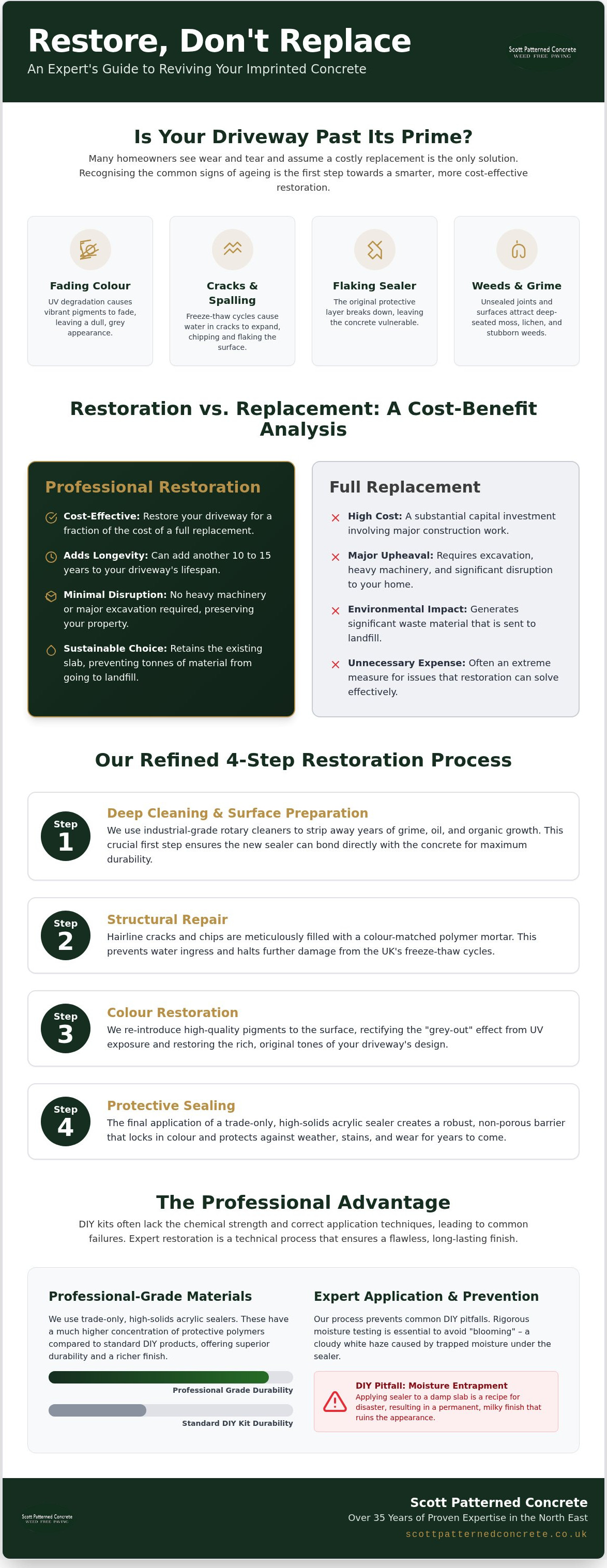
- Deep Cleaning: We use industrial-grade rotary cleaners that provide a consistent, high-pressure wash. This equipment removes lichen, oil, and deep-seated moss that has taken root in the pattern's joints.
- Structural Repair: Hairline cracks and chips are meticulously filled with colour-matched polymer mortar. This stage is vital for preventing water ingress and further freeze-thaw damage.
- Colour Tinting: We re-introduce high-quality pigments to the surface. This step rectifies the "grey-out" effect caused by UV exposure, bringing back the rich, original tones.
- Sealing: The final step involves applying trade-only high-solids acrylic sealers. These create a robust moisture barrier and lock the new pigments into the concrete.
The Importance of Surface Preparation
The success of a restoration hinges on what happens before the first drop of sealer is applied. We perform rigorous moisture testing because applying a solvent-based sealer to a damp slab is a recipe for disaster; it often leads to a cloudy, white finish known as "blooming." If your driveway has old, failing sealer that is peeling or flaky, we must "break it down" or strip it back entirely. This ensures the new coating can bond directly with the concrete rather than sitting on top of a dead layer. We also specialise in the professional removal of stubborn oil stains. If these aren't treated chemically, they will prevent the sealer from adhering, leading to premature failure in high-traffic areas.
Professional Colour Tinting Techniques
Achieving a natural look requires an eye for detail and an understanding of how pigments interact with porous concrete. Our specialists match the original antique or primary colours of your specific pattern, whether it's a classic Yorkshire stone or a modern slate finish. Unlike standard topical stains that sit on the surface, we use professional tinting systems that penetrate the concrete for a more durable finish. This precise tinting process effectively hides structural repairs to create a seamless, uniform appearance across the entire driveway. If you're unsure whether your surface is suitable for this treatment, you can always speak with our team for expert advice on the best course of action.
DIY Kits vs. Professional Driveway Restoration
While the shelves of high-street hardware stores are packed with products promising a "showroom finish," the reality of driveway restoration is far more technical. It's easy to see why a homeowner might consider a self-applied kit before deciding to replace old imprinted concrete driveway installations, but the chemical gap between retail and trade products is vast. Retail sealers are often diluted with higher solvent ratios to make them safer and easier for a novice to handle. In contrast, we utilise trade-only high-solids acrylic sealers. These contain a much higher resin content, creating a robust, long-lasting protective film that a standard DIY product simply cannot match.
The difference isn't just in the tin; it's in the tools and the technique. A basic pressure washer lacks the consistent power of our industrial rotary cleaners, which are designed to strip away deep-seated moss and lichen without etching the concrete. We also bring a "Master Craftsman" eye to the project, focusing on the nuance of colour blending. We don't just apply a flat tint; we use layering techniques to restore the natural variations in the pattern, ensuring your driveway looks like authentic stone rather than a painted slab.
The Risk of Incorrect Application
The most frequent DIY disaster we encounter is "blooming," which occurs when sealer is applied in damp conditions or too thickly. This traps moisture beneath the resin, resulting in cloudy white patches that ruin the aesthetic. Rectifying a failed DIY attempt is often more expensive than the original restoration, as it requires specialist chemicals to strip the failing layers back to bare concrete. Choosing a family-run business with 35 years of experience provides essential peace of mind. Our expertise ensures that moisture levels are tested and application thickness is precise, backed by the personal accountability that a large corporation or a DIY kit can't offer.
Long-Term Value and ROI
Viewing restoration as an investment in your property’s infrastructure is a smart financial move. A professional job typically maintains its integrity for 3 to 5 years, whereas a DIY application often begins to flake after just one or two winter cycles. This longevity means you spend less over the lifetime of the driveway. Beyond the cost savings, a revived driveway significantly enhances kerb appeal, which is a primary factor in property valuations. Instead of the massive outlay required to replace old imprinted concrete driveway areas, professional sealing returns your home’s entrance to its original lustre, protecting the structural integrity of the concrete for years to come.
Maintenance and Longevity: Protecting Your Investment
Once your driveway has been professionally restored, the focus shifts to long-term preservation. You've already avoided the massive disruption and expense required to replace old imprinted concrete driveway surfaces, so it's vital to maintain that new protective barrier. We generally recommend a professional reseal every 3 to 5 years. This timeframe varies depending on vehicle traffic and the property's exposure to the elements, but sticking to this cycle ensures the concrete remains waterproof and UV-resistant. Between these professional visits, a simple cleaning routine is your best defence. Regularly sweeping away grit and debris prevents fine particles from acting like sandpaper under car tyres, which can prematurely abrade the sealer's surface.
You don't need to be a specialist to spot the early signs of sealer wear. If the surface looks dull when wet or if water no longer "beads" on the concrete during a rain shower, the protective layer is likely thinning. Catching these issues early prevents moisture from reaching the porous concrete underneath. This is crucial because moisture ingress is where structural damage, such as hairline cracks and spalling, typically begins. By staying proactive, you ensure your driveway remains a durable asset rather than a maintenance burden.
Safety First: Slip Resistance Technology
A common concern with high-gloss finishes is the risk of slips during typical British wet weather. To counter this, we integrate micronised polymer beads into the final coat of our trade-strength sealer. These invisible particles provide a consistent, textured grip without dulling the visual lustre of the pattern. Opting for textured concrete finishes is particularly essential for sloped driveways in areas like County Durham and North Yorkshire, where ice and rain are frequent visitors. We strike a careful balance, delivering that sought-after "wet look" whilst ensuring the surface remains safe and functional for your family and visitors.
Winter Care for Patterned Concrete
The British winter presents specific challenges for any decorative surface. You should strictly avoid using rock salt or harsh de-icing chemicals; these substances can chemically attack the sealer and cause the concrete to flake or "spall." For safe snow removal, always use a plastic shovel rather than a metal one, as metal edges can scratch the decorative finish. For more inspiration on maintaining specific patterns and textures, you can explore our printed concrete guide.
The Scott Patterned Concrete Approach to Driveway Revival
At Scott Patterned Concrete, we don't just view a project as a simple maintenance job; it's a reflection of our 35-year heritage in high-end decorative concrete. When we arrive at a property in Stockton-on-Tees, Middlesbrough, or Darlington, we bring the "Master Craftsman" eye to every survey. This allows us to diagnose specific issues accurately, from sub-base settlement to chemical leaching that might be hidden beneath a faded surface. While some firms might push you to replace old imprinted concrete driveway installations regardless of their condition, we take pride in our straight-talking honesty. If a surface is structurally sound, we'll tell you. If it's beyond saving, we'll be equally transparent. Our goal is to provide a solution that offers the best long-term value for your home.
As a family-run business, our reputation is built on personal accountability and local trust across the North East. We don't use generic, high-street products. Instead, we utilise trade-exclusive, high-solids sealers that provide a superior, long-lasting finish capable of withstanding the heavy rainfall and freeze-thaw cycles common in our region. This commitment to quality ensures that your driveway doesn't just look better for a few months but remains protected and vibrant for years to come. We treat every project as if it were our own, ensuring the finer details of the pattern and colour are restored with precision.
Bespoke Restoration Plans
Every home has its own unique architectural character, which is why we never take a one-size-fits-all approach. We tailor our restoration plans to your specific property style, offering a choice of Matt, Silk, or Gloss finishes to complement your home's aesthetic. Our tinting process is equally bespoke, matching the original pigments of your pattern to ensure a natural, authentic look. We also understand that your time is valuable. Our team has refined a process that ensures minimal disruption to your daily routine, completing the work efficiently without compromising on the high standards shown on our concrete driveways gallery.
Get Your Expert Restoration Quote
Before you decide to replace old imprinted concrete driveway areas, it's essential to have a professional assessment. A site survey allows us to check moisture levels, surface porosity, and structural integrity, ensuring that a restoration is the right technical choice for your property. We provide transparent, no-obligation quotations for all restoration and sealing work, with no hidden costs or high-pressure sales tactics. We invite you to contact the Scott family today to discuss your project and discover how our expert revival services can transform your property's kerb appeal.
Secure the Future of Your Driveway Today
Choosing to professionally restore your surface is a smart decision that balances financial savvy with a commitment to quality. By opting for specialist sealing services, you avoid the extensive costs and disruption required to replace old imprinted concrete driveway installations, whilst still achieving a finish that looks brand new. We've detailed how our technical four-step process, trade-grade high-solids sealers, and precision colour tinting can revive even the most tired surfaces across the North East.
With over 35 years of industry experience, our family-run team brings personal accountability to every project we undertake. We don't just apply a standard coating; we provide a master craftsman's touch using high-performance materials that aren't available in high-street shops. This ensures your home benefits from durable protection against the British weather and a safe, slip-resistant finish that lasts for years.
We look forward to helping you rediscover the pride in your property's entrance with a driveway that stands the test of time.
Frequently Asked Questions
How much does it cost to restore an imprinted concrete driveway?
Restoration costs are calculated based on the total square meterage and the specific level of repair your surface requires. It's always a fraction of the price you'd pay to replace old imprinted concrete driveway areas entirely. We provide a bespoke, no-obligation quote after a site survey to ensure you only pay for the exact treatments your driveway needs to return to its original lustre.
Can cracks in my patterned concrete be repaired invisibly?
We use colour-matched polymer mortars to fill structural cracks and surface chips. By following these repairs with our specialist tinting process, we blend the fix into the surrounding pattern and texture. This technique makes structural repairs nearly impossible to spot from a standing position, restoring a uniform and seamless appearance across the entire slab.
How long does the restoration process take from start to finish?
A standard professional restoration typically takes two to three days of fair weather. The first day is dedicated to industrial deep cleaning and precision repairs. We then allow the concrete to dry thoroughly before returning on subsequent days to apply the colour tints and protective sealers. This methodical schedule ensures the chemicals bond correctly for a long-lasting finish.
Will resealing my driveway make it slippery when wet?
Professional sealing won't turn your driveway into a hazard if the correct additives are used. We integrate micronised anti-slip beads into the final resin coat to provide a consistent, grippy texture. This is essential for maintaining safety during the North East's wet winters whilst still achieving the high-quality, aesthetic finish you expect from a master craftsman.
Can I change the colour of my existing imprinted concrete driveway?
You can certainly update or intensify the shade during the restoration process. Our professional tinting systems allow us to darken faded surfaces or shift the tone to better suit your property's current style. It's a highly effective way to refresh your home's kerb appeal without the upheaval and cost required to replace old imprinted concrete driveway installations.
What is the best time of year to have my driveway resealed in the UK?
The ideal window for resealing in the UK is between April and September. We look for dry conditions and surface temperatures consistently above 10°C. Performing the work during these warmer months minimises the risk of rain interference and ensures the trade-grade sealer cures to its maximum hardness and durability.
How long do I need to wait before driving on a newly sealed surface?
You can usually walk on the surface after four to six hours, but we recommend keeping vehicles off for 24 to 48 hours. This waiting period allows the high-solids sealer to reach full chemical hardness. Driving on the resin too soon can leave tyre marks or compromise the protective moisture barrier we've applied to the concrete.
Is it possible to fix a driveway that has turned white or is peeling?
White patches or peeling are usually signs of "blooming" caused by moisture entrapment or a poor previous application. We can often rectify this by chemically stripping the failing sealer or using specialist solvents to re-set the resin. It's a technical fix that our team has perfected over 35 years, saving you from an unnecessary full replacement.