Skip to content
Concrete Driveway Cost UK: The 2026 Comprehensive Pricing & Value Guide
- by Scott Patterned Concrete
What if 70% of your concrete driveway cost is actually spent on things you will never see? It's a frustrating reality for many homeowners and commercial developers who find themselves staring at quotes that vary by thousands of pounds. You want a surface that looks beautiful today and stays that way for thirty years without the nightmare of cracks, weeds, or sinking. We believe that transparency is the foundation of any professional project, especially when you're trying to balance an initial investment with long-term durability and peace of mind.
This guide pulls back the curtain on modern pricing and the critical impact of the 2026 SUDS drainage regulations that now affect every UK installation. We'll help you navigate the choices between plain finishes, decorative patterned designs, and durable Stonecrete aggregate. You'll gain a clear understanding of m2 rates, the confidence to choose the right finish for your property, and a checklist to vet contractor quotes with the eye of a master craftsman.
Key Takeaways
- Understand the 2026 market rates for bespoke installations and why a simple average price rarely tells the whole story for your specific project.
- Discover how variables like site access, excavation, and waste removal impact your final concrete driveway cost before the first pour begins.
- Compare the visual appeal of pattern imprinted finishes with the heavy-duty durability of Stonecrete aggregate for multi-vehicle households.
- Navigate the mandatory 2026 SUDS drainage regulations to ensure your new driveway is legally compliant and protects your property from surface water.
- Learn the "Master Craftsman" approach to sub-base preparation to ensure your investment lasts for 30 years without cracking or sinking.
Understanding Concrete Driveway Cost per m2 in 2026
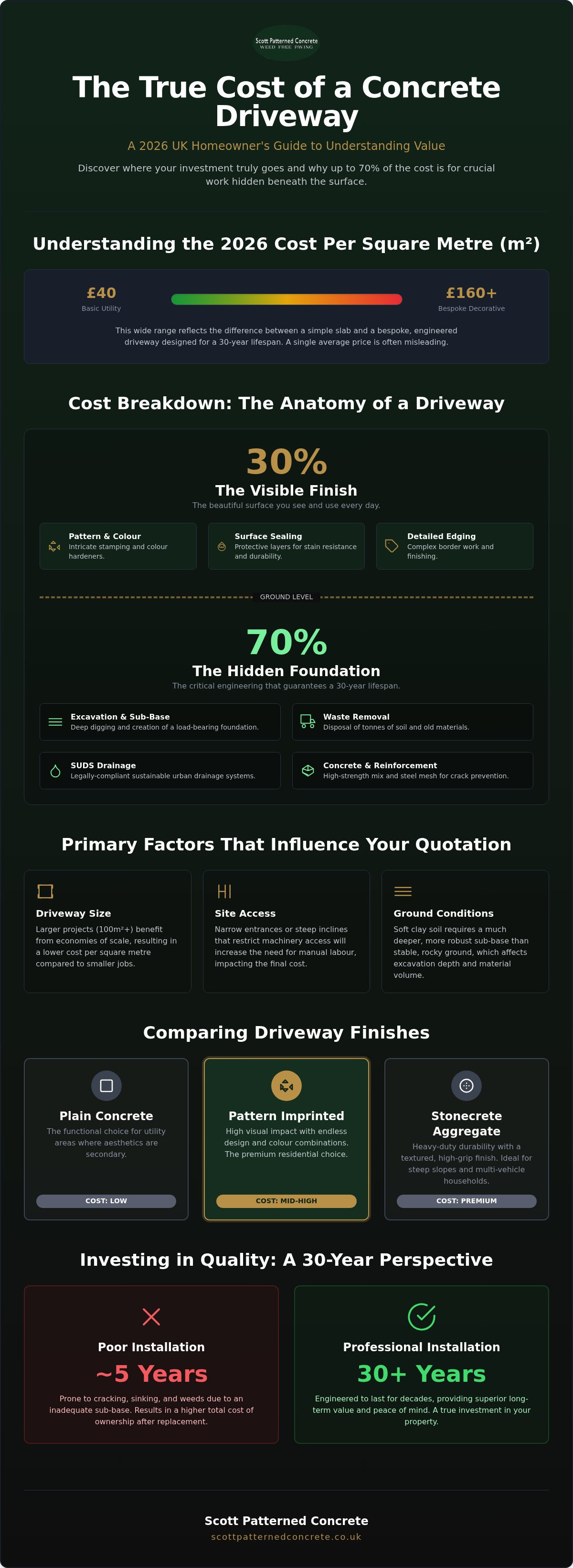
Determining a realistic concrete driveway cost requires looking beyond a simple square metre figure. In 2026, UK homeowners typically see quotes ranging from £40 to over £160 per m2. Whilst that window seems vast, it reflects the massive difference between a basic utility slab and a bespoke, hand-finished driveway designed to last three decades. Relying on a single average price is often misleading because it ignores the unique topography of your land and the engineering required beneath the surface.
A driveway isn't just a purchase; it's a structural investment. When you spread the initial outlay across a 30-year lifespan, the value becomes clear. A cheaper, poorly installed surface might fail in five years, whereas a professionally engineered concrete driveway offers a much lower total cost of ownership. You're paying for permanence and the peace of mind that comes with a job done right the first time.
The Baseline: Plain Concrete vs. Decorative Finishes
Plain concrete is often the go-to for industrial yards or utility paths where aesthetics take a backseat to pure function. It sits at the lower end of the pricing scale but lacks the visual warmth required for a family home. Whilst plain grey concrete is often seen as the budget-friendly choice, it can lead to higher maintenance costs over time if the finish isn't suited to the traffic it receives.
Moving into decorative imprinted concrete represents a significant step up in craft. This process is labour-intensive, requiring precision timing to stamp patterns and apply colour hardeners before the mix sets. For those looking at modern sustainable options, Pervious concrete provides a specialised technical solution for water management, though it requires a different installation approach compared to standard decorative slabs to ensure structural integrity remains high.
Economies of Scale: How Driveway Size Impacts the Quote
The size of your project fundamentally shifts the m2 rate. A small 20m2 parking bay will always cost more per unit than a sprawling 100m2 entrance. This is due to fixed overheads that don't change regardless of the area covered. Every project must account for mobilisation, plant hire, and minimum delivery charges from concrete plants.
Once these sunk costs are covered, larger areas allow for better efficiency and a more competitive rate per metre. We find that mid-to-large projects offer the best balance of value for money. If you're planning a project, our printed concrete guide offers deeper insights into how these variables play out for residential and commercial installations alike.
Primary Factors That Influence Your Driveway Quotation
The quote you receive for a new driveway is rarely about the concrete alone. In fact, a significant portion of your concrete driveway cost is dedicated to the engineering and logistics that happen before the first mixer truck even arrives. A master craftsman knows that the longevity of the finish depends entirely on the preparation of the ground beneath it. If the foundation is flawed, even the most beautiful pattern will eventually fail. We prioritise a "right first time" approach that addresses the specific challenges of your site.
Ground Conditions and Excavation Depth
The type of soil in your garden determines how deep we must dig. Soft clay requires a deeper sub-base to prevent the driveway from shifting, whereas rocky ground might be more stable but takes longer to excavate. We frequently encounter properties where old, thick tarmac or cracked paving must be removed first. It's vital that we never build on top of existing surfaces. Doing so might seem like a shortcut to save money, but it almost always leads to structural failure within a few years.
Excavation also brings the "hidden" expense of waste removal. Soil disposal and skip hire prices have risen, and a standard two-car driveway can easily generate several tonnes of spoil. When calculating your budget, ensure your contractor has accounted for these disposal fees and adheres to UK planning permission rules for driveways regarding how that land is managed. We also take into account site access. If your property has a narrow entrance or a steep incline that prevents easy access for machinery, the project will naturally require more manual labour hours.
Design Complexity and Border Detail
The final piece of the pricing puzzle involves the visual labour. Intricate patterns like Herringbone or European Cobblestone require more precise stamping and detailing than a simple London Cobble. Similarly, adding multi-tonal colours or bespoke borders and steps increases the time our team spends on-site. These details provide the "wow factor" and significant kerb appeal, but they do require a higher degree of skill and patience during the installation phase.
For modern multi-vehicle households, we also consider the weight of the vehicles. If you park heavy SUVs or vans on your drive, we increase the depth of the compacted aggregate sub-base and include steel reinforcement mesh. This mesh is non-negotiable for 30-year durability as it distributes loads and prevents the unsightly cracks that can ruin a decorative finish. These are the variables that dictate the final concrete driveway cost for your property. If you're unsure how your site's layout might affect your quote, it's always best to speak with an expert for a detailed assessment.
Comparing Finishes: Patterned Concrete vs. Stonecrete Aggregate
The surface finish is the most visible part of your investment, yet it's also where the technical requirements of your property meet your personal style. Whilst the engineering beneath the ground ensures stability, the choice of finish dictates the daily performance and long-term aesthetic of the installation. Understanding how finish choice impacts your concrete driveway cost is essential for balancing your budget with the specific needs of your household, such as multi-vehicle parking or steep gradients.
Patterned Imprinted Concrete: The Versatile Favourite
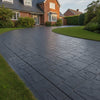
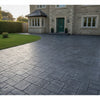
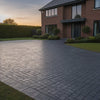
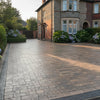
Patterned imprinted concrete remains the residential standard across the UK in 2026. Typically, industry rates for a professionally installed imprinted surface range from £85 to £150 per square metre. This finish offers an exceptional balance of cost and customisation, allowing homeowners to replicate the look of natural stone, slate, or cobbles without the maintenance headaches of individual blocks. Because the surface is a single, continuous pour, it's naturally weed-free and resists the sagging often seen in traditional paving.
This versatility makes it a favourite for those looking to enhance kerb appeal whilst keeping maintenance to a minimum. For a deeper dive into specific pricing models for this finish, our sibling guide on Patterned Concrete Driveway Cost UK: A Comprehensive Guide for 2026 provides a detailed breakdown of what to expect. It's an ideal solution for standard residential drives that require a clean, durable, and attractive entry point.
Stonecrete: The Investment in Luxury and Grip
Stonecrete, or exposed aggregate concrete, is often regarded as the ultimate premium finish. The process involves removing the top layer of cement paste to reveal the natural decorative stones within the mix. This technical method requires precise timing and expert handling, which naturally adds to the labour fee. However, the result is a "lifetime" surface that offers superior durability and a high-end architectural look that complements both modern and traditional properties. According to technical standards supported by The Concrete Society, the structural integrity of high-quality aggregate mixes makes them exceptionally resistant to heavy wear.
Beyond its visual appeal, Stonecrete provides practical benefits that other finishes can't match:
- Enhanced Slip-Resistance: The textured surface provides excellent grip, making it the preferred choice for steep inclines or areas prone to frost.
- Heavy-Duty Resilience: It's built for multi-vehicle households and commercial environments where heavy traffic is a daily reality.
- Seamless Durability: Like imprinted concrete, it avoids the weed growth and shifting associated with block paving.
Whilst the initial concrete driveway cost for Stonecrete is higher than standard finishes, its rugged nature ensures it remains pristine for decades. If you're looking for a surface that combines industrial-grade strength with a sophisticated aesthetic, exploring our Stonecrete surfaces will help you understand why this is considered the gold standard for luxury driveways.
The Critical Cost of Drainage and SUDS Compliance
Water management is the most overlooked component of a property renovation, yet it's arguably the most critical for long-term structural success. When calculating your final concrete driveway cost, it's vital to remember that water management isn't an optional extra; it's a legal obligation. Sustainable Urban Drainage Systems (SUDS) were first introduced into UK legislation in October 2008 to manage surface water runoff from domestic driveways and prevent local sewer systems from becoming overwhelmed.
As of 2026, the full implementation of Schedule 3 of the Flood and Water Management Act 2010 has changed the landscape for installers and homeowners alike. It's now mandatory for new developments to incorporate SUDS, removing the automatic right to connect surface water drainage to public sewers. Professional installers prioritise these systems in every quote because cutting corners can lead to significant fines and driveway failure. In 2025, over 15,000 enforcement notices were issued to UK homeowners whose driveways failed to meet these strict drainage standards.
Planning Permission and Permeability
If your front garden driveway exceeds five square metres, you'll generally require planning permission if you use a non-permeable surface like standard concrete without a proper drainage system. To avoid the expense and delay of a planning application, we design systems that direct rainwater to a permeable area, such as a lawn or a purpose-built soakaway within your property boundary. A soakaway must be located at least five metres from any building or road to remain compliant. Whilst installing Aco drains and soakaways adds to the initial concrete driveway cost, it is a far more efficient investment than the legal fees and potential enforcement action associated with non-compliant work.
Sub-base Integrity and Water Run-off
The engineering beneath your driveway is what facilitates this drainage. MOT Type 1 aggregate is the backbone of a high-quality sub-base, providing the stability needed for heavy vehicles whilst allowing for essential water filtration. We also meticulously calculate the "fall" or gradient of the slab. This ensures water naturally flows toward drainage channels rather than pooling on the surface. Pooling water is more than just an eyesore; it can penetrate the concrete over time, leading to freeze-thaw damage that compromises the entire installation. A master craftsman understands that managing water is just as important as the decorative finish itself.
Investing in Quality: The Scott Patterned Concrete Value
Choosing a contractor based solely on the lowest price is a gamble that rarely pays off in the long run. With over 35 years of experience, we've seen how a "cheap" concrete driveway cost often translates to a thin slab, an insufficient sub-base, or a lack of essential steel reinforcement. As a family-run business, we operate with a Master Craftsman's eye for detail. We believe in personal accountability for every square metre we pour. This means we apply the same rigorous commercial-grade standards to a residential driveway as we do for high-traffic theme parks and retail centres.
Our approach is built on transparency and permanence. We don't use high-pressure sales tactics because our 35-year reputation speaks for itself. When you invest in a professional installation, you're buying peace of mind. You're ensuring that the entrance to your property remains a source of pride rather than a maintenance headache. We treat every project as a partnership, guiding you from the initial design consultation through to the final hand-finished detail.
The True Cost of "Cheap" Concrete
The financial impact of a poor installation often surfaces within the first few winters. Surface scaling, structural cracking, and sinking are the hallmarks of contractors who skip vital preparation steps. A "buy once, buy right" strategy is the most sustainable financial choice you can make for your property. By investing in a high-quality installation from the start, you avoid the massive expense of ripping out and replacing a failed surface in five years. Our background as commercial concrete contractors has taught us that engineering for the heaviest loads is the only way to guarantee 30-year durability.
Long-term Maintenance and Sealing Costs
One of the greatest benefits of decorative concrete is its low-maintenance nature compared to block paving. You won't spend your weekends pulling weeds or buying expensive chemicals because the solid surface leaves nowhere for them to grow. To keep your driveway looking pristine and to maintain its structural warranty, we recommend resealing the surface every 3 to 5 years. For an average driveway, this service typically ranges from £280 to £900. This small periodic investment protects the colour from UV fading and prevents water ingress.
When you consider the total concrete driveway cost over three decades, the value of a weed-free, crack-resistant surface becomes undeniable. It's about more than just a place to park your car; it's an architectural improvement that adds genuine value to your home or business premises. If you're ready to discuss a project built on craftsmanship and integrity, we're here to help.
Contact Scott Patterned Concrete today for a free, no-obligation quotation and expert advice tailored to your specific project requirements.
Securing Your Property's Future with Expert Concrete Craftsmanship
Designing a new driveway is a significant decision that impacts both the kerb appeal and the structural integrity of your property. A transparent understanding of m2 rates and the 2026 SUDS regulations protects you from hidden expenses and legal pitfalls. By prioritising a master craftsman's approach to sub-base engineering, you ensure that your investment stands the test of time against heavy traffic and the changing British climate.
Whether you're drawn to the bespoke patterns of imprinted concrete or the rugged luxury of Stonecrete aggregate, the focus should always remain on long-term value. As a family-run business with 35 years of decorative concrete expertise, we bring national commercial-grade standards to every project we undertake. We take pride in balancing the initial concrete driveway cost with a finish that remains weed-free and structurally sound for decades to come.
We look forward to helping you transform your property with a surface that reflects the quality and care your project deserves.
Frequently Asked Questions
How much does a 2-car concrete driveway cost in the UK?
For a typical 60m2 area designed for two vehicles, the total investment depends on your choice of finish and site conditions. In 2026, standard utility finishes sit at the lower end of the spectrum, whilst decorative imprinted options represent a higher tier. Factors like the depth of the sub-base and the complexity of the drainage system also influence the final concrete driveway cost. It's always best to get a site-specific quote for accuracy.
Is a concrete driveway cheaper than block paving or resin?
Concrete is often more cost-effective over its 30-year lifespan than block paving or resin-bound surfaces. Block paving requires frequent weeding and can suffer from individual bricks sinking, whilst resin often carries a higher initial m2 rate. Because concrete is a solid, continuous slab, it eliminates the need for constant chemical treatments or re-sanding. This makes it a financially sustainable choice for homeowners who are prioritising durability and low upkeep over several decades.
Does a patterned concrete driveway add value to my house?
Yes, a professionally installed patterned concrete driveway significantly enhances kerb appeal and can increase a property's market value. First impressions are vital when selling a home, and a high-quality decorative finish creates an immediate sense of permanence and care. Estate agents often highlight low-maintenance features like weed-free surfaces as a major selling point for modern buyers. By investing in a durable material, you're protecting the property's equity whilst improving its aesthetic.
How long will a professional concrete driveway last before needing replacement?
A professionally engineered concrete driveway can easily last 25 to 30 years with minimal maintenance. Longevity is the primary benefit of this material. When the sub-base is prepared to Master Craftsman standards and the concrete is reinforced with steel mesh, the structure remains stable for decades. Regular resealing every few years protects the surface from UV damage and moisture ingress, ensuring the pattern stays crisp and the structural integrity remains high.
Can I pour concrete over my existing driveway to save on costs?
We strongly advise against pouring new concrete over an old surface as it lead to structural failure. Whilst it might seem like a way to reduce your concrete driveway cost, this is a false economy. Any cracks or movement in the old base will quickly reflect through to the new surface, ruining the decorative finish. We always recommend a full excavation to ensure the new sub-base is compacted correctly for a lasting result.
Do I need planning permission for a new concrete driveway in 2026?
You generally don't need planning permission if your driveway incorporates a compliant drainage system that manages water within your property. Under the 2026 SUDS regulations, any new driveway over five square metres must either be permeable or direct runoff to a lawn or soakaway. If you choose a non-permeable surface and don't install a professional drainage channel, you'll likely need to apply for planning permission from your local council before work begins.
How much does it cost to maintain and reseal an imprinted driveway?
Maintaining a decorative driveway typically involves a professional wash and reseal every three to five years. Periodic maintenance is straightforward and ensures your warranty remains valid. The cost for a professional reseal varies depending on the size of the area, but it's a small fraction of the original installation price. This process involves a deep clean to remove algae, followed by the application of a high-quality acrylic sealer to keep the colours vibrant.
What is the most durable concrete finish for a heavy-duty commercial drive?
Stonecrete, or exposed aggregate, is the most durable finish for high-traffic commercial environments and industrial premises. The process of exposing the natural aggregate creates a rugged surface that can withstand heavy loads without losing its aesthetic appeal. It's particularly effective for steep gradients where extra grip is essential for safety. This finish combines the structural strength of a thick concrete pour with a surface that hides daily wear and tear exceptionally well.