Skip to content
The Ultimate Guide to Concrete Patios: Design, Durability, and Installation in 2026
- by Scott Patterned Concrete
Why do we often accept that a beautiful new garden project will inevitably succumb to unsightly weeds and wobbly slabs within just a few seasons? For many property owners across the North East, from Stockton to Newcastle, the cycle of scrubbing paving joints and re-levelling shifted stones is a frustratingly familiar chore. It is a common struggle, but it doesn't have to be the standard for your outdoor living space. Investing in a high-quality concrete patio offers a permanent, engineered solution that eliminates these structural weaknesses while providing a completely bespoke finish.
At Scott Patterned Concrete, we've spent over 35 years refining the art of decorative surfaces to ensure your garden is as durable as it is beautiful. This guide will show you how modern installation techniques can transform your home or commercial premises into a weed-free, slip-resistant sanctuary that outperforms traditional paving. We'll walk you through the latest design trends for 2026, the essential building regulations you need to know, and why a continuous, professionally poured surface is the secret to a low-maintenance lifestyle that stands the test of time.
Key Takeaways
- Learn why a continuous concrete patio is the superior choice for a weed-free garden, eliminating the shifting and sinking issues often found with traditional paving slabs.
- Discover the design flexibility of imprinted patterns and Stonecrete aggregate, allowing you to achieve a bespoke aesthetic that mirrors natural stone or contemporary architectural styles.
- Understand how specialised air-entrained concrete provides essential durability against the British climate, offering high resistance to frost and freeze-thaw cycles.
- Identify key planning and drainage requirements to ensure your new outdoor space is fully compliant with local regulations while protecting your home’s damp-proof course.
- Follow the professional installation timeline to see how expert craftsmanship ensures a flawless finish during the critical pour and print phases of the project.
The Modern Concrete Patio: Why Continuous Surfaces Overtake Traditional Slabs
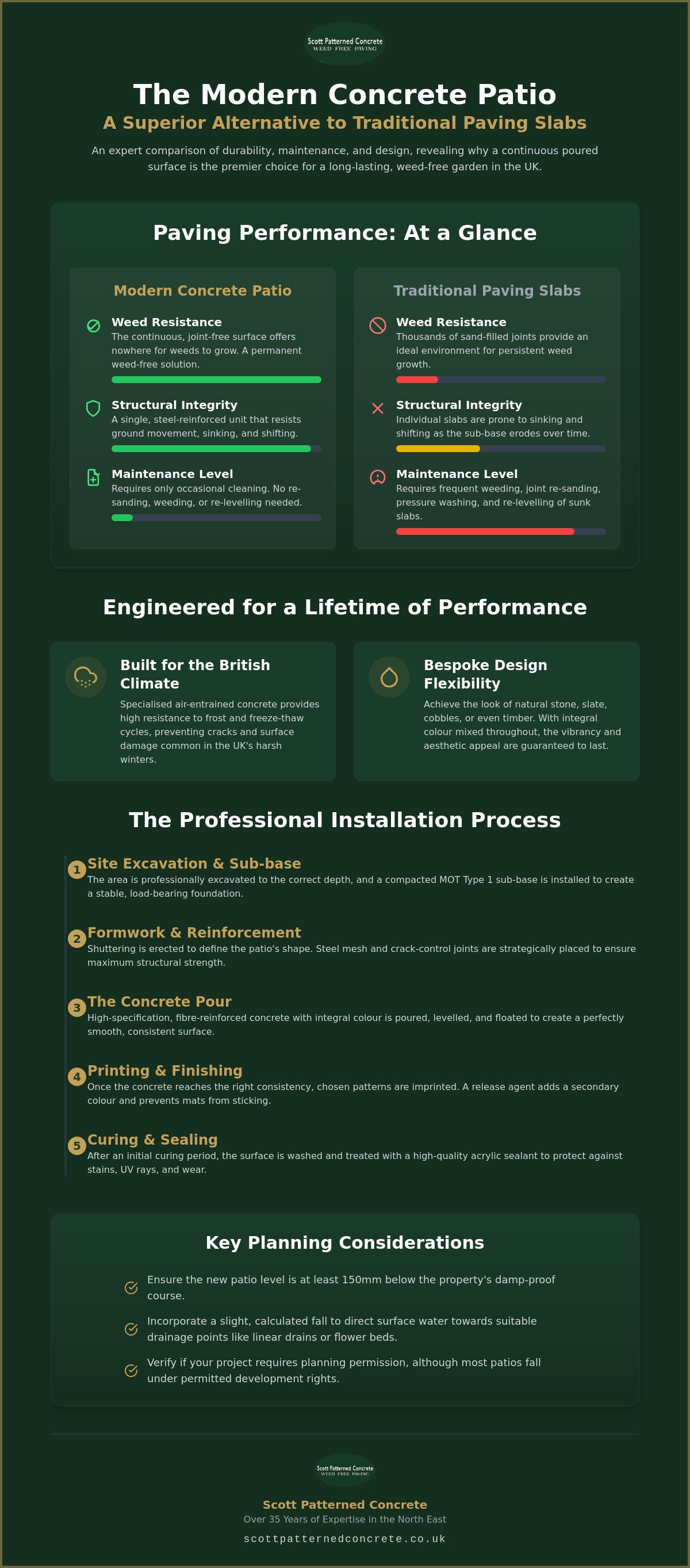
A modern concrete patio is a far cry from the dull, utilitarian slabs of the past. It's a precision-engineered, reinforced, poured-in-place surface that acts as a single, cohesive unit. Unlike traditional paving, which relies on hundreds of individual stones held together by sand or mortar, this continuous approach creates a platform with immense structural integrity. For homeowners in Middlesbrough or Darlington, this means moving away from a surface that inevitably shifts and towards one that remains perfectly level for decades. By treating the garden floor as a single engineered element, we eliminate the inherent weaknesses found in modular paving systems.
One of the most significant advantages we've seen over our 35 years in the trade is the absolute elimination of weeds. Traditional paving provides thousands of tiny gaps where seeds can take root; a continuous concrete surface removes this vulnerability entirely. You get the high-end look of intricate stonework without the back-breaking maintenance, whilst maintaining a bespoke aesthetic that complements any garden. This "weed-free" promise isn't just a marketing claim; it's a direct result of the material's physical properties. Without joints, there's simply nowhere for unwanted vegetation to grow.
Dispelling the 'Industrial' Concrete Myth
Many people still associate concrete with grey, cold industrial estates. However, modern decorative concrete techniques have completely redefined what's possible for residential landscapes. By using chemical dyes and specialised textures, we can recreate the appearance of natural slate, timber, or weathered cobbles with startling accuracy. We prioritise integral colour, where the pigment is mixed throughout the entire batch, rather than just tinted on the surface. This ensures the vibrancy remains even if the surface is chipped. It's why architects across North Yorkshire are increasingly specifying decorative concrete for luxury developments; it offers a level of bespoke detail that standard paving simply can't match.
The Structural Benefits of Joint-Free Outdoor Living
The "sinking slab" syndrome is the primary cause of patio failure in the UK. When water penetrates the joints of traditional paving, it erodes the sub-base, leading to uneven surfaces and trip hazards. Because a poured concrete patio is joint-free, it prevents water ingress and the subsequent freeze-thaw damage that often plagues British gardens in the winter. Structural concrete is the foundation for a 30-year patio lifespan, providing a stable, reinforced base that resists the natural movement of the ground. By investing in a single, solid pour, you're protecting your property from the common erosion issues that eventually destroy individual paving stones.
Comparing Decorative Finishes: Patterned, Imprinted, and Exposed Aggregate
Selecting the right finish for your concrete patio involves balancing visual appeal with practical performance. While traditional paving limits you to the shapes of the stones available, decorative concrete allows us to treat your garden as a blank canvas. The customisation options are virtually endless, enabling you to match the exact tones of your home's brickwork or the surrounding North East landscape. This bespoke approach ensures that your outdoor space feels like a natural extension of your property rather than a generic addition. It's about more than just a surface; it's about creating a durable floor that complements your lifestyle.
The choice of finish also dictates the mood and functionality of your outdoor space. Smooth, imprinted surfaces tend to reflect more natural light, which can make a smaller courtyard in Stockton or Hartlepool feel more spacious and airy. In contrast, the rugged, organic texture of exposed aggregate absorbs light, creating a sophisticated, grounded atmosphere that's perfect for larger, more traditional gardens. Beyond aesthetics, these finishes are engineered to meet rigorous concrete durability standards, ensuring they withstand the heavy rain and frost cycles common in County Durham and Sunderland.
Patterned and Imprinted Concrete: The Versatile Choice
This technique involves using precision-moulded mats to stamp intricate textures into wet concrete before it sets. It's a favourite for those who want the look of premium natural materials without the structural weaknesses of individual slabs. For 2026, we're seeing a high demand for patterns like Ashlar Slate, which offers a clean, geometric look, and Random Stone for a more rustic, hand-laid feel. London Cobble remains a timeless choice for traditional properties in Yarm or Billingham. You can explore our printed concrete patterns to find a style that perfectly aligns with your home's character.
Stonecrete: The Rise of Exposed Aggregate
Stonecrete represents the pinnacle of luxury outdoor flooring. The process involves removing the surface 'laitance', the top layer of cement paste, to reveal the beautiful natural stones and aggregates beneath. This creates a highly slip-resistant, textured surface that's incredibly hard-wearing. It's an ideal solution for hospitality venues, schools, or high-end residential projects where a premium, non-slip finish is paramount. If you're looking for a surface that feels as good as it looks, you can learn about Stonecrete surfaces and how they elevate standard garden designs. If you're unsure which texture would best suit your property, our team is always available to provide expert design advice.
Built for the British Climate: Durability and Performance Standards
The most common question we're asked by homeowners across the North East is whether a concrete patio will crack during a harsh British winter. It's a valid concern, especially given the damp and often freezing conditions in places like Sunderland and County Durham. The answer lies in the specific chemistry of the mix. We use air-entrained concrete, which contains billions of microscopic air bubbles. These tiny pockets act as internal pressure valves, giving the concrete the flexibility to expand and contract as water freezes and thaws within the material. Without this specialized engineering, standard concrete mixes often fail, but our Master Craftsman approach ensures your surface remains intact through the most volatile weather patterns.
To further enhance structural integrity, we've moved away from traditional steel mesh in favour of advanced fibre-mesh reinforcement. These high-strength fibres are distributed throughout the entire pour, creating a three-dimensional support network that's far more effective at controlling shrinkage and surface tension. This modern technology, combined with UV-stable pigments, ensures that your patio doesn't just stay strong; it keeps its vibrant colour amongst the changing seasons. Whether it's the intense sun of a rare British heatwave or the relentless rain of a typical November, the integral dyes we use are designed to resist fading and chemical degradation.
Preventing Surface Cracking and Sinking
While the concrete itself is incredibly strong, its longevity depends entirely on what's underneath. Sub-base compaction is the most critical step in a professional installation, as it provides the load-bearing strength that prevents the entire structure from settling unevenly. We also strategically place expansion joints to control natural movement. By cleverly hiding these joints within the lines of your chosen pattern, such as a slate or stone texture, we ensure they're virtually invisible to the naked eye. Professional concrete is engineered to move without visible damage, accounting for the natural expansion and contraction of the ground beneath your garden. Understanding these structural stresses is vital for any hard landscaping project; for instance, specialists at Bayside Pavers explain how similar ground movement and drainage factors can impact other garden structures like retaining walls.
Slip Resistance and Safety in Wet Weather
Safety is a priority, particularly during our wet winters in Middlesbrough and Stockton. Many modern materials like porcelain or timber become notoriously slippery when damp, but a textured concrete patio provides superior natural grip. We further enhance this safety by incorporating anti-slip additives into the final sealing process, creating a surface that's secure underfoot even in heavy downpours. Achieving proper patio drainage is also essential to prevent standing water, which can lead to algae growth and increased slip risks. For a deeper look at how we prioritise your safety, you can read The Ultimate Guide to Slip Resistant Patio Surfaces for UK Homes.
Planning Your Patio: Design, Drainage, and Regulations
Planning a concrete patio involves a careful balance between technical compliance and aesthetic harmony. For residents in Yarm or Stockton-on-Tees, understanding local regulations is the first step toward a successful installation. Under current Permitted Development rights, a ground-level patio in a rear garden typically doesn't require planning permission, provided it isn't raised more than 300mm above the ground. However, if you're paving a front garden over 5 square metres, you must ensure the surface is permeable or drains to a soakaway to comply with 2008 SUDS regulations. These rules are in place to prevent surface water runoff and local flooding, so getting the technical details right from the start is essential for peace of mind.
One of the most critical structural requirements is the 150mm rule. Your finished patio level must sit at least 150mm below the damp-proof course (DPC) of your house. We've seen many DIY projects fail because the paving bridges this line, leading to rising damp and expensive interior repairs. Our role as specialists is to ensure your new outdoor space is beautiful whilst remaining fully compliant with all building standards. By respecting these technical boundaries, we protect the structural health of your home for the long term.
Aesthetic Design and Colour Coordination
Choosing the right palette can completely change the feel of your property. If you have a north-facing garden that feels a little dark, opting for warm tones like buff or sandstone can help reflect light and create a brighter atmosphere. Conversely, cool greys and charcoals work exceptionally well with modern architectural styles found in newer developments across North Yorkshire. We often recommend using contrasting borders to define specific "outdoor rooms," such as a dedicated dining area or a fire pit zone. For more inspiration on creating a high-end look, you can read our guide on Bespoke Concrete Patio Designs: Luxury Outdoor Living in 2026.
Essential Drainage and DPC Compliance
Water management is the silent hero of a long-lasting installation. We calculate a precise "fall" or gradient to ensure that rainwater always runs away from your home and into a designated soakaway or drainage channel. To maintain the clean aesthetic of your concrete patio, we can integrate discrete "slot drains." These are narrow channels that sit flush with the surface, effectively managing high volumes of water without breaking the visual flow of your chosen pattern. It's this attention to the finer details of drainage that prevents standing water and protects your home's structural integrity.
Achieving a Professional Finish: The Expert Installation Process
The successful installation of a concrete patio is a carefully choreographed sequence of events that requires both technical precision and artistic intuition. It isn't a project that can be rushed or treated as a simple weekend task; rather, it's an engineered process that transforms raw materials into a permanent architectural feature. From the moment we break ground in your garden to the final application of the protective sealer, every stage is managed with the meticulous care of a master craftsman. This structured approach ensures that the finished surface doesn't just look exceptional on day one but remains structurally sound for decades to come.
Why 35 Years of Experience Matters
Our family-run team brings over 35 years of industry experience to every site, which is vital for identifying potential issues before they become permanent problems. Whether we're working on a residential project in Billingham or a large-scale commercial development in Newcastle, we know how to assess ground conditions and soil stability accurately. This "Master Craftsman" approach allows us to spot drainage complications or sub-base weaknesses that a less experienced contractor might overlook. Managing the logistics of a large-scale pour in a residential environment also requires specialised knowledge to ensure the concrete arrives at the perfect consistency for stamping. You can view our professional concrete patio services to see the standard of finish our decades of expertise provide.
From Excavation to Final Sealing
The foundation of a permanent installation begins with deep excavation and the laying of a 100mm to 150mm compacted Type 1 sub-base. This provides the load-bearing strength required to prevent the surface from cracking or sinking. Once the concrete is poured and levelled, timing becomes the most critical factor during the "print" phase. We apply a specialised "release agent" to the wet surface, which prevents our precision mats from sticking and ensures every detail of the pattern is crisp and well-defined. After the concrete has set, we return to wash the surface and apply a high-performance acrylic sealer. This final layer is essential as it locks in the integral colour and protects the surface from oil stains, algae, and UV degradation. Whilst your new patio will be ready for light foot traffic after 48 hours, the concrete continues to gain strength through a chemical curing process for up to 28 days. This methodical process ensures your outdoor space is delivered snag-free and ready for a lifetime of use.
Transforming Your Outdoor Space for the Decades Ahead
Choosing a permanent, engineered surface is the most effective way to ensure your garden remains a source of pride rather than a list of chores. By opting for a continuous concrete patio, you're investing in a platform that naturally resists the shifting, sinking, and weed growth that often plague traditional paving. We've explored how modern decorative finishes and advanced reinforcement techniques provide a level of durability and bespoke beauty that ensures your home remains safe and stylish through every British season.
While selecting the right surface is key, many homeowners also look for professional fencing to complete their garden's look; click here to see how specialists like Cleveland Fencing Ltd can assist with your wider garden improvement goals.
At Scott Patterned Concrete, our family-run values and over 35 years of industry expertise are at the heart of every project we undertake. We take personal responsibility for ensuring your design is perfectly tailored to your property whilst meeting the highest technical standards for drainage and structural integrity. Our commitment to quality means your project is in the hands of specialists who value craftsmanship above all else.
We look forward to helping you create an outdoor living space that you can enjoy with complete peace of mind for years to come.
Frequently Asked Questions
Is a concrete patio cheaper than block paving or slabs?
A decorative concrete surface is often more cost-effective over its entire lifecycle because it eliminates the ongoing expenses of weeding, re-sanding, and structural repairs. Whilst the initial investment is comparable to high-quality slabs, the long-term value is significantly higher. You won't need to pay for chemical weed killers or professional re-levelling, making it a smarter financial choice for property owners across the North East.
Will a patterned concrete patio crack during a UK winter?
No, a professionally installed concrete patio will not crack if it's engineered correctly for our climate. We use specialised air-entrained concrete mixes that allow for microscopic expansion during freeze-thaw cycles. By combining this with strategically placed expansion joints and fibre-mesh reinforcement, we ensure the surface remains structurally sound even during the harshest winters in County Durham or Northumberland.
How long does it take to install a professional concrete patio?
A typical installation usually takes between 5 to 10 working days, though this depends on the size of the area and the British weather. The process involves several distinct stages: excavation and sub-base preparation, the main pour and print, a curing period, and the final power wash and sealing. We manage the entire timeline to ensure minimal disruption to your daily routine whilst maintaining our high standards of craftsmanship.
Do I need planning permission for a new concrete patio in my garden?
Most rear garden projects fall under Permitted Development and don't require formal planning permission, provided they aren't raised more than 300mm above ground level. However, front garden installations over 5 square metres must comply with SUDS regulations regarding water runoff. We can provide expert guidance on these rules during your initial consultation to ensure your project is fully compliant with local Stockton or Middlesbrough council guidelines.
How do I clean and maintain an imprinted concrete patio?
Maintenance is remarkably simple and involves an occasional sweep or a light wash with a garden hose to remove surface debris. Because the surface is continuous and weed-free, you'll never have to spend your weekends digging vegetation out of joints. To maintain the vibrant colour and protective barrier, we recommend a professional reseal every 3 to 5 years, which keeps the surface looking as good as the day it was poured.
Is a concrete patio slippery when it rains?
Our patios are designed with safety in mind and are not slippery when wet. The imprinting process creates a natural texture that provides excellent grip underfoot, unlike smooth porcelain or wet timber decking. We also incorporate specialised anti-slip additives into the final sealant layer. This creates a secure, slip-resistant finish that's ideal for families, schools, and commercial venues throughout the North East.
Can I have a concrete patio if my garden has poor drainage?
Yes, poor drainage can be successfully managed through professional engineering and site preparation. We calculate precise gradients to ensure water flows away from your property into designated soakaways or discrete slot drains. Even in gardens with heavy clay soil, a correctly installed concrete patio provides a stable, dry surface by directing water exactly where it needs to go, preventing any pooling or damp issues.
What is the lifespan of a decorative concrete patio compared to timber decking?
A professionally installed decorative concrete surface can easily last 30 years or more with minimal maintenance. In contrast, even high-quality timber decking often begins to rot or warp within 10 to 15 years in the damp UK climate. Concrete offers a permanent, structural solution that doesn't suffer from wood-boring insects or fungal decay, providing far greater longevity and better value for your money.