Skip to content
Concrete Driveway Thickness for Cars: UK Standards and Best Practices 2026
- by Scott Patterned Concrete
Will a standard concrete slab actually survive the weight of a modern electric SUV through a harsh North East winter? It's a question we hear often at Scott Patterned Concrete, as many homeowners worry their new investment might buckle or flake after just a couple of seasons. You've likely felt the frustration of receiving conflicting advice from different contractors, leaving you uncertain about the actual concrete driveway thickness for cars required to prevent structural failure. It's a common concern, especially when you want a finish that looks as good in ten years as it does on the day it's poured.
We're here to clear up the confusion by providing the definitive 2026 UK standards for slab depth and sub-base preparation. You'll discover the exact specifications needed to keep your driveway durable for decades, regardless of whether you're parking a compact hatchback or a heavy 4x4. We'll also explain why the relationship between thickness and sub-base compaction is the secret to longevity. This guide gives you the technical knowledge to confidently vet potential installers, ensuring you choose a specialist who prioritises long-term value and pride in craftsmanship over quick shortcuts.
Key Takeaways
- Learn why 100mm is the established UK industry standard for light domestic use and how this depth provides the necessary structural integrity for standard family vehicles.
- Discover when you need to increase your concrete driveway thickness for cars to 125mm or 150mm to safely accommodate heavier SUVs and vans without risking surface cracks.
- Understand why even a thick slab cannot compensate for a poor foundation; we explain the critical role of sub-base compaction and drainage in preventing frost heave.
- Gain specific insights into how patterned and printed concrete finishes influence depth requirements to ensure your decorative driveway remains both beautiful and durable.
- Equip yourself with the knowledge to spot a quality contractor by their sub-base specifications and adherence to modern SuDS regulations.
Understanding Concrete Driveway Thickness for Cars
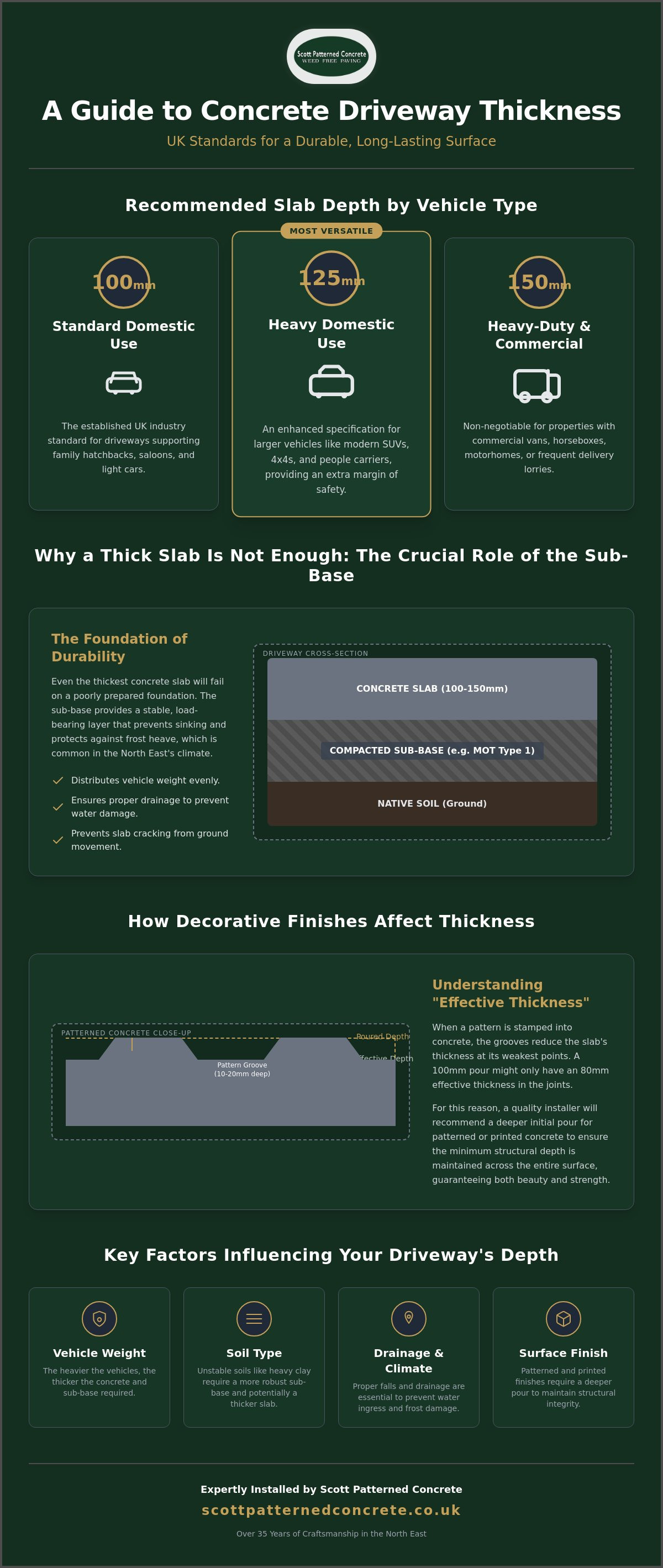
Before we dig into the specifics, it's vital to clarify what we mean by thickness. In the industry, we define this as the vertical depth of the poured concrete slab itself, measured from the top surface down to the top of the sub-base. It's a distinct measurement that doesn't include the hardcore or MOT Type 1 foundation underneath. While a basic understanding of What is a Driveway? covers the general purpose of these structures, the technical engineering required for a long-lasting installation is where the expertise of a master craftsman becomes essential.
The established UK industry standard for a concrete driveway thickness for cars used in light domestic settings is 100mm, or roughly four inches. This is the baseline we see most contractors quote for standard residential projects. However, after 35 years of installing driveways across Stockton-on-Tees and Middlesbrough, we often find that a "standard" depth isn't always the "best" depth. Choosing to increase that slab to 125mm or 150mm provides a significant margin of safety and peace of mind. While a thicker pour naturally increases the volume of material required and slightly raises the cost per square metre, it's a small price to pay for a surface that won't buckle under the pressure of modern life.
Why Slab Depth Matters for Long-Term Performance
Concrete acts as a rigid platform that distributes the weight of a stationary vehicle across the ground. A thicker slab spreads this load more effectively, preventing the weight from concentrating in one small area. If the slab is too thin, the pressure can cause the concrete to "punch" into the sub-base, leading to sinking or structural cracks. This is particularly relevant in the North East, where we often deal with heavy clay soils in areas like Darlington and Hartlepool.
Depth also plays a crucial role in managing thermal expansion. Concrete expands and contracts with the weather. In the UK, our temperature swings can cause "curling," where the edges of a slab lift slightly as they cool faster than the centre. A 150mm slab has the mass and weight to resist this movement far better than a 100mm slab, keeping the edges firmly seated and preventing the hairline fractures that allow water to penetrate and freeze.
The Difference Between Standard and Heavy-Duty Specifications
A "standard" 100mm specification is perfectly adequate for a household with a couple of family hatchbacks or small saloons. But our lifestyles have changed; many homes now have at least one heavy electric SUV or a commercial van parked up every night. If your property in County Durham or North Yorkshire regularly hosts heavier vehicles, horseboxes, or delivery lorries, you've moved into heavy-duty territory. In these cases, a 150mm slab is non-negotiable for ensuring the longevity of your concrete driveway. Compressive strength is the measure of how much pressure a concrete mix can withstand before it fails, and whilst the grade of the concrete is vital, a thicker slab provides the physical volume needed to resist these forces.
Recommended Thickness Standards for UK Driveways
When planning a new installation, it's easy to assume that a standard depth applies to every project. However, the choice between 100mm, 125mm, or 150mm depends entirely on how you intend to use the space and the specific finish you've chosen. For those opting for printed concrete, there's a technical detail often overlooked by less experienced contractors: the concept of "effective thickness." When we stamp a pattern into wet concrete to create the look of natural stone or cobbles, the depth of that imprint can be anywhere from 10mm to 20mm. At the base of these decorative joints, the slab is technically thinner. To ensure the concrete driveway thickness for cars remains structurally sound at its thinnest point, we always factor in this reduction during the initial pour.
Choosing a thicker specification for decorative work isn't about upselling; it's about engineering. A 100mm plain slab might be strong enough for a hatchback, but a 100mm printed slab only has an effective structural depth of 80mm at the bottom of the pattern grooves. This is why a master craftsman will typically start with a deeper pour for any patterned surface, ensuring the finished product has the mass required to resist cracking under heavy loads.
Thickness for Standard Passenger Cars
The 100mm rule remains the baseline for many UK homes, particularly those with small saloons or hatchbacks. This depth is usually sufficient if the driveway is built on firm, non-expansive ground like well-compacted gravel or rock. However, if your property in Middlesbrough or Stockton sits on softer clay, a 100mm slab carries a higher risk of shifting. At Scott Patterned Concrete, we've spent 35 years refining our standards, and we often find that a 115mm to 125mm pour offers the perfect balance of value and longevity for domestic projects. If you're worried about whether your ground can support a standard slab, you can always request a no-obligation quotation to get a professional assessment of your site.
Thickness for SUVs, Vans, and Electric Vehicles
Modern vehicle trends have forced a rethink of traditional driveway specs. The "EV Factor" is a significant consideration for 2026; electric vehicles are considerably heavier than internal combustion engines due to their dense battery packs. This increased weight puts more pressure on the slab, particularly at the "point-load" where the tyres rest. For households with large SUVs or heavy EVs, we recommend a minimum depth of 125mm. If your driveway also serves as a shared access road or handles frequent visits from heavy delivery vans, moving to 150mm is the only way to guarantee a crack-free finish for the next thirty years. It's a proactive step that protects your investment against the structural fatigue caused by modern, heavier transport.
Factors That Influence Your Driveway Depth Requirements
Whilst the concrete driveway thickness for cars is a physical measurement, its effectiveness is entirely dependent on what lies beneath. Ground conditions act as the silent partner in any successful installation, dictating whether a standard slab will thrive or fail over time. In our 35 years of experience across the North East, we've seen how the varied geology from Darlington to Hartlepool requires a tailored approach. If you intend for your driveway to remain pristine for 30 years or more, the initial specification must account for both the soil's load-bearing capacity and the local climate's impact on the material.
Drainage is another critical factor that often dictates the necessary depth. A slab that sits in water-logged ground is far more susceptible to frost heave, a process where freezing water underneath the concrete expands and pushes the slab upwards. By ensuring the correct thickness and incorporating a precision-engineered fall, we protect the structure from these subterranean pressures. This is especially vital when considering the weight of modern electric vehicles; a heavy EV parked on a thin slab over poorly drained ground is a recipe for structural failure within just a few winters.
Soil Type and Ground Stability
The type of soil on your property in Stockton-on-Tees or Middlesbrough significantly influences the required concrete volume. Clay soils are notorious for their "shrink-swell" behaviour, expanding when wet and contracting during dry spells. This constant movement can leave a thin 100mm slab unsupported in places, leading to "bridging" cracks. In contrast, sandy soils offer better natural drainage but may require more robust containment to prevent lateral shifting. Because of these complexities, high-end finishes like Stonecrete exposed aggregate require a thorough expert ground assessment. We need to ensure the sub-grade is stable enough to support the unique structural needs of an aggregate finish without the risk of sinking or shifting.
Concrete Mix Grades and Strength
The "mix" is just as vital as the "millimetres". In the UK, C35 is the standard grade for domestic driveways, offering a compressive strength of 35 Newtons per square millimetre. For projects involving heavier loads or commercial applications, we often step up to a C40 mix. This higher grade provides a denser, more resilient structure that can sometimes allow for a slightly leaner slab without sacrificing integrity. However, the master craftsman's choice usually involves a "belt and braces" approach; combining a generous 125mm-150mm depth with high-quality fibre reinforcement. We also utilise air-entrainment additives, which create microscopic bubbles within the mix. These tiny pockets act as relief valves for freezing water, ensuring your concrete driveway thickness for cars remains uncompromised by the harsh British winter.
Beyond the Pour: Sub-Base and Reinforcement Essentials
It's a common misconception that simply increasing the concrete driveway thickness for cars is enough to guarantee a lifetime of service. In reality, a 150mm slab poured over a soft, uncompacted foundation will fail far faster than a 100mm slab sitting on a perfectly engineered base. At Scott Patterned Concrete, we view the ground preparation as the most critical stage of the entire project. Before a single drop of mix leaves the truck, we ensure the site is excavated to the correct depth and cleared of any organic material that could rot and cause future voids. By pairing the correct concrete driveway thickness for cars with a properly compacted sub-base, we ensure your investment remains crack-free for decades.
A solid foundation is particularly important for our commercial clients in retail or industrial sectors across Sunderland and Newcastle. When we design concrete driveways, we're not just looking at the surface; we're building a multi-layered system designed to withstand the varied traffic of the North East. This methodical approach is what separates a master craftsman from a contractor looking for a quick turnaround.
The Role of MOT Type 1 Sub-Base
We typically specify a sub-base depth of 100mm to 150mm of MOT Type 1 crushed stone to complement the concrete slab. This isn't just loose gravel thrown into a hole. We use a heavy-duty vibrating plate compactor to lock the stones together, creating a rock-hard foundation that won't shift under the weight of a vehicle. This layer also serves as a vital drainage path. It allows water to dissipate naturally rather than pooling directly under your concrete, which protects the slab from the destructive forces of frost heave during a harsh British winter.
Reinforcement and Expansion Joints
For multi-car drives or areas with poor ground stability, we often incorporate A142 steel mesh reinforcement. Whilst many homeowners think steel prevents cracks entirely, its true purpose is to provide structural tie strength. Reinforcement does not stop concrete from cracking; instead, it holds the slab together to keep any hairline fractures incredibly tight and prevent them from opening up over time. We also strategically place expansion joints to give the thick slab room to breathe as it expands and contracts with the changing seasons. If you're unsure which reinforcement method is right for your property, you can contact our team for a site survey to discuss your specific needs.
Ensuring Value with Professional Installation
When you're investing in a new home improvement, it's natural to focus on the visual appeal of the finished surface. However, skimping on the concrete driveway thickness for cars is a classic example of a false economy that can haunt a homeowner for years. A slab that's just 20mm too thin might save a small amount on the initial quote, but it significantly increases the risk of structural failure. Replacing a cracked, sunken driveway is far more expensive than doing the job correctly the first time. By choosing a specification that accounts for modern vehicle weights and local ground conditions, you aren't just buying a driveway; you're protecting your property's value and ensuring peace of mind for decades to come.
Spotting a "cowboy" contractor often starts with their initial specification. If a tradesman offers a one-size-fits-all 100mm depth without asking about your specific vehicles or inspecting the soil quality in your part of County Durham or North Yorkshire, they aren't prioritising your long-term interests. A master craftsman understands that every site is unique. Whether we're working in Stockton-on-Tees, Middlesbrough, or Darlington, our approach is always rooted in 35 years of industry-leading experience and a commitment to "straight-talking" honesty about what your project actually requires to succeed.
The False Economy of Thin Concrete
The cost of adding an extra 25mm of concrete to a standard pour is relatively minor when compared to the total project budget. In contrast, the cost of a full replacement in five years because a thin slab couldn't handle the "point-load" of a heavy SUV is substantial. Professional specification adds tangible value to your home's resale price; savvy buyers and surveyors recognise the hallmark of a quality installation. For those currently in the budget-planning phase, our Patterned Concrete Driveway Cost UK guide provides a detailed breakdown of how material volumes and quality standards influence the final investment.
Why Experience Matters in Concrete Specification
At Scott Patterned Concrete, we assess every site individually to determine the perfect depth for your specific lifestyle. As a family-run business with over three decades of heritage, we take personal responsibility for every project we undertake. We know that a 125mm slab on a perfectly compacted MOT Type 1 base will outperform a 150mm slab on a poor foundation every time. Our expertise allows us to balance the concrete driveway thickness for cars with the aesthetic requirements of patterned and imprinted surfaces, ensuring a result that is as durable as it is beautiful. If you're ready to discuss your project with a specialist who values craftsmanship over shortcuts, contact Scott Patterned Concrete today for a free, no-obligation expert quotation and advice you can trust.
Investing in a Lifetime of Durability
Choosing the correct concrete driveway thickness for cars is the single most important decision you'll make for your property's exterior. It's clear that whilst the 100mm industry standard serves as a baseline, the specific needs of your vehicles and the unique ground conditions of your site often demand a more robust specification. By prioritising a high-quality sub-base and the right reinforcement, you're ensuring that your investment remains a source of pride rather than a maintenance headache. At Scott Patterned Concrete, we've spent over 35 years refining these technical details to deliver results that truly stand the test of time.
As a family-run business, we've built our reputation on quality and straight-talking advice. We specialise in durable, decorative solutions that don't just look spectacular but are engineered to handle the demands of modern life. If you're ready to start your project with a team that values craftsmanship above all else, request a free, no-obligation quotation from our expert team today. We're here to help you build a driveway that stays beautiful and crack-free for decades.
Frequently Asked Questions
Is 100mm of concrete enough for a driveway with two cars?
A 100mm depth is the established UK industry standard for standard passenger cars on stable ground. It's usually sufficient for two family hatchbacks if the sub-base is perfectly prepared and compacted. If you regularly park heavier vehicles or your property sits on soft clay, we often recommend 125mm to provide a safety margin. This extra depth ensures the slab remains level and structural through decades of use.
Do I need a thicker driveway for an electric vehicle (EV)?
We strongly suggest a minimum of 125mm for electric vehicles because their battery packs make them considerably heavier than traditional petrol cars. This increased weight puts more pressure on the tyres, which can cause a standard slab to fail over time. Increasing the concrete driveway thickness for cars to 125mm or 150mm ensures the surface can support these heavy point-loads without sinking or developing structural fatigue.
What happens if my concrete driveway is too thin?
A thin slab is likely to "punch" into the sub-base, leading to unsightly sinking and structural cracks. You'll often see the edges lift or the surface flake after a few harsh winters. These issues allow water to penetrate the slab, which then freezes and expands, causing rapid deterioration. Ultimately, a driveway that's too thin will require a costly full replacement much sooner than a professionally specified installation.
Does patterned concrete need to be thicker than plain concrete?
Yes, we typically pour patterned concrete deeper to account for the depth of the decorative imprint. Stamping a pattern can reduce the structural concrete by up to 20mm at the base of the grooves. By pouring a 125mm slab, we ensure the "effective thickness" remains at least 100mm. This protects the structural integrity of your concrete driveway thickness for cars against heavy vehicle weight while maintaining a beautiful, stamped finish.
Is steel mesh reinforcement necessary for a domestic driveway?
While not always mandatory, A142 steel mesh is highly recommended for multi-car drives or areas with poor ground stability. Reinforcement acts as a structural skeleton that holds the slab together. It doesn't stop concrete from shrinking, but it keeps any hairline fractures incredibly tight. This prevents them from opening up into major cracks that could ruin the look and strength of your driveway over time.
Can I pour new concrete over an existing driveway to increase thickness?
We almost never recommend pouring new concrete over an old driveway because the bond between the layers is rarely permanent. Any structural cracks in the original surface will quickly "reflect" through to the new concrete layer. For a result that lasts thirty years, the only reliable method is to excavate the old material and build a fresh foundation with the correct specifications from the ground up.
How deep should the sub-base be under the concrete?
You should have a sub-base of at least 100mm to 150mm of well-compacted MOT Type 1 hardcore. This layer provides the essential load-bearing foundation and allows for vital drainage beneath the slab. A slab is only as strong as what lies underneath it. Without a professional-grade sub-base, even the thickest concrete will eventually shift, sink, or crack under the constant weight of your vehicles.
Will a 150mm driveway prevent all cracking?
No thickness can entirely eliminate the risk of natural shrinkage cracks, but 150mm offers the highest level of resilience available. By combining this depth with strategically placed expansion joints and fibre reinforcement, we can effectively manage the concrete's movement. This approach ensures that any minor settling doesn't turn into a structural failure, keeping your driveway's surface looking pristine and professional for the long term.