Skip to content
Decorative Concrete for Public Spaces: 2026 Design Guide and Examples
- by Scott Patterned Concrete
A public square shouldn't feel like a cold, industrial loading bay just because it needs to withstand heavy footfall. For many developers and local authorities across the North East, from Stockton to Newcastle, the challenge is finding decorative concrete for public spaces that doesn't sacrifice soul for durability. You're likely worried about creating a "grey jungle" that becomes a slip hazard the second the British weather turns. We understand that concern; nobody wants a high-traffic zone that looks neglected after just a few years of use.
This 2026 guide will show you how modern installations bridge the gap between rugged engineering and architectural beauty. You'll discover how to transform functional areas into vibrant landscapes that meet strict UK safety and accessibility standards whilst offering a 30-year lifespan with minimal upkeep. We'll preview expert design examples, technical insights on the latest ASTM C94/C94M-26a standards, and the specific benefits of specialist finishes like Stonecrete for a surface that's as safe as it is striking.
Key Takeaways
- Discover why 2026 urban design is moving away from industrial "grey" finishes in favour of more welcoming, architecturally integrated surfaces.
- Compare the technical differences between imprinted patterns and Stonecrete exposed aggregate to choose the right texture for your specific project.
- Learn how to specify decorative concrete for public spaces that complies with UK safety standards, including essential slip-resistance (PTV) ratings.
- Explore how specialist installation techniques protect public landscapes against heavy footfall and the damaging effects of British freeze-thaw cycles.
- Understand the practical steps for implementing large-scale works, from navigating SuDS regulations to selecting a contractor with over 35 years of expertise.
Transforming the Urban Landscape: The Rise of Decorative Concrete
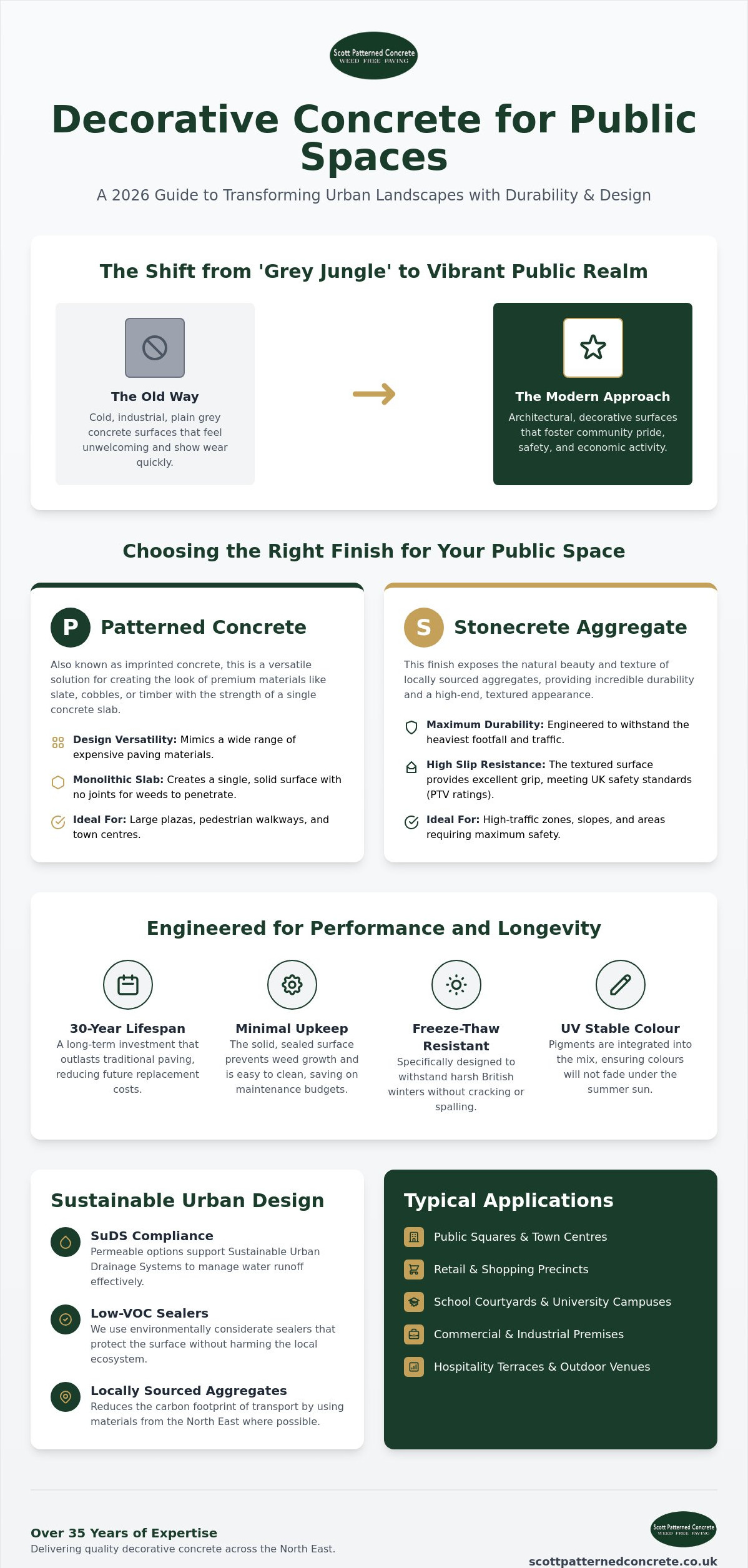
In 2026, the definition of the public realm has shifted. We've moved beyond the era where concrete was merely a structural necessity to be hidden or tolerated. Today, decorative concrete for public spaces is a primary medium for urban designers across the North East, from the redevelopment of Middlesbrough town centre to new educational courtyards in Darlington. This shift is driven by a desire to phase out the "grey jungle" aesthetic. Traditional, plain concrete often feels cold and industrial, which can inadvertently signal a lack of care in community spaces. By contrast, modern decorative concrete techniques allow us to treat walkways and plazas as architectural features that reflect local heritage and character.
The psychological impact of these spaces is significant. Research into urban environments suggests that aesthetically pleasing, well-maintained surfaces foster a sense of safety and community pride. When a public square in Stockton or a promenade in Redcar looks intentional and high-spec, people are more likely to respect and use the space. There's an economic reality to this too. High-quality commercial decorative concrete increases footfall and dwell time in retail zones. If a shopping precinct feels like a destination rather than a thoroughfare, local businesses reap the rewards. It's an investment in the long-term prosperity of a town centre.
Balancing Aesthetics with Public Utility
Creating a "destination" space requires more than just a pretty finish. It's about utility. We often integrate branding, logos, or wayfinding markers directly into the concrete pour. This ensures that navigation tools are permanent and won't peel or fade like traditional paint. Urban placemaking through textured concrete is the strategic design of public surfaces to foster a sense of identity and community belonging. It turns a simple path into a narrative. Whether it's a school playground in Sunderland or a hospitality terrace in Yarm, the surface should serve the specific needs of its users whilst looking spectacular.
The Shift Towards Sustainable Urban Design
Sustainability in 2026 isn't just about the mix design; it's about how long a surface lasts. Longevity is a core tenet of sustainable construction. A surface that requires replacement every ten years is a failure of design. With our 35 years of experience, we focus on installations that offer a 30-year lifespan with minimal upkeep. This includes the use of Stonecrete exposed aggregate, which provides incredible durability for high-traffic zones. We also prioritise:
- Permeable options that support Sustainable Urban Drainage Systems (SuDS) to manage water runoff.
- Low-VOC sealers that protect the environment whilst maintaining the surface's colour.
- The use of locally sourced aggregates to reduce the carbon footprint of transport across County Durham and North Yorkshire.
Choosing the Right Finish: Imprinted Concrete vs Stonecrete
Selecting the right material for decorative concrete for public spaces depends on the specific demands of the environment. In the North East, where we deal with everything from coastal winds in Hartlepool to heavy city centre footfall in Newcastle, the choice usually boils down to two main contenders: imprinted concrete and Stonecrete. Both offer superior UV stability and colour retention compared to traditional surfacing. Because the pigments are integrated during the pour, they won't flake or peel under the summer sun or during the harsh freeze-thaw cycles of a British winter. This permanence is what sets our work apart from cheaper, surface-level alternatives.
Patterned Concrete: Versatility in Design
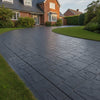
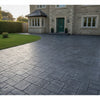
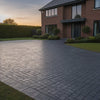
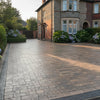
Patterned concrete, often referred to as imprinted or printed concrete, is a versatile solution for large plazas and walkways. It allows us to mimic the look of natural slate, cobbles, or even timber but with the structural integrity of a single, monolithic slab. This "single slab" approach is vital for public maintenance; it's virtually impossible for weeds to penetrate the surface because there are no open joints. This significantly reduces the long-term maintenance costs for local councils and private developers. You can explore our full range of textures and colours in our printed concrete guide to see how we replicate traditional materials at a fraction of the cost.
Stonecrete Exposed Aggregate: The Ultimate Durability
While imprinted concrete is excellent, Stonecrete surfaces represent the premium tier for high-traffic retail and leisure zones. Stonecrete is an exposed aggregate finish where the top layer of cement paste is carefully removed to reveal the natural stones beneath. This isn't just about the high-end aesthetic. The texture provides an inherent slip-resistance that is hard to beat, making it the safest choice for wet British weather. It meets rigorous safety expectations, often exceeding the benchmarks found in OSHA safety standards for ground surfaces. We've found that for shopping centres in Middlesbrough or public parks in Billingham, Stonecrete's rugged texture offers the best grip whilst maintaining a sophisticated look.
Load-bearing capacities must be tailored to the zone's specific purpose. For pedestrian walkways, a standard depth is sufficient, but for areas like delivery bays or taxi ranks in Darlington, we increase the reinforcement and concrete grade. This ensures the surface doesn't crack or sink under vehicular stress. If you're unsure which finish suits your specific site requirements, you can speak with our team for a technical consultation based on our 35 years of experience.
Meeting Safety and Durability Standards for High-Traffic Zones
Safety in the public realm is never an afterthought; it's a legal and moral duty of care. When specifying decorative concrete for public spaces, we prioritise technical performance as much as visual appeal. In high-traffic environments like Stockton High Street or the busy retail parks of Middlesbrough, surfaces must withstand constant pressure whilst remaining safe for every pedestrian. Achieving this balance requires a deep understanding of UK health and safety requirements, specifically regarding slip resistance and structural longevity. We don't just pour concrete; we engineer surfaces designed to protect the public for decades.
Slip Resistance and Accessibility (DDA Compliance)
Designing for accessibility is essential for any modern development. We ensure our surfaces are wheelchair and pram-friendly by carefully managing texture depth. A common benchmark in the industry is the Pendulum Test Value (PTV). Whilst many competitors aim for a standard rating, we focus on achieving PTV +45 in wet conditions, which is considered the gold standard for public safety. We reach these levels through specialist commercial concrete services that utilise techniques like acid etching or sandblasting to create a micro-texture. For wet play areas or sloped promenades in Redcar, we also incorporate non-slip sealants containing micronised clear grit to enhance grip without clouding the finish.
British winters present a unique challenge for public surfacing. The North East is prone to rapid freeze-thaw cycles that can shatter poorly installed concrete. To combat this, we use air-entrained concrete mixes. These contain microscopic bubbles that allow moisture to expand when it freezes, preventing the internal pressure from cracking the slab. It's a technical detail that many general builders overlook, but it's vital for a 30-year lifespan in our climate.
Structural Integrity and Long-Term Performance
The most common objection to concrete is the fear of cracking. Most surface failures aren't caused by the concrete itself, but by poor sub-base preparation. We spend a significant amount of time ensuring the ground is properly compacted and reinforced to prevent sinking or shifting. In modern public realm projects, we often recommend fibre reinforcement over traditional steel mesh. These high-performance fibres are distributed throughout the entire mix, providing three-dimensional strength that controls shrinkage cracks more effectively than mesh alone. This methodical approach to structural integrity ensures that your project remains a community asset rather than a maintenance liability. With over 35 years of experience in large-scale developments, we've refined these methods to ensure every pour meets the highest standard of craftsmanship.
Design Inspiration: Examples of Decorative Concrete in Public Spaces
Visualising the potential of a project is often the most exciting stage of urban development. When we discuss decorative concrete for public spaces, we aren't just talking about a flat surface; we're talking about a canvas that can be tailored to the specific identity of a town or organisation. From the rugged, natural look of Stonecrete in a North Yorkshire park to the intricate, heritage-style patterns in a Darlington market square, the versatility of this material allows for complete creative freedom. Our 35 years of experience, including work on major developments like theme parks, has taught us that the best designs are those that feel like a natural extension of their surroundings.
Urban Plazas and Civic Centres
Modern civic centres often use contrasting colours and textures to define different functional zones without the need for intrusive barriers. For instance, a smooth, charcoal-coloured imprinted border can neatly frame a lighter Stonecrete central plaza, guiding pedestrian flow whilst creating visual interest. For architectural designs that require light to reach lower levels through the pavement, you can learn more about Structural Glass Design Ltd and their specialist walk-on glass solutions. We can also incorporate bespoke public art, local crests, or company logos directly into the concrete pour. This technique was particularly effective in our theme park projects, where immersive environments require every square inch of surfacing to contribute to the story. These bespoke finishes are permanent, vibrant, and far more durable than surface-applied paints or resins.
Commercial Entrances and Forecourts
First impressions matter for corporate headquarters and retail developments in Middlesbrough and Sunderland. A high-spec entrance should provide a "wow" factor that reflects the quality of the business within. We often combine patterned concrete with traditional paving elements, such as natural stone kerbs or integrated lighting, to create a sophisticated, multi-textured look. This approach offers the aesthetic appeal of premium materials with the structural benefits of a monolithic concrete slab. If you're looking for detailed technical comparisons for interior or semi-enclosed areas, our commercial floor finishes guide provides further insights into professional specifications.
Educational institutions and public gardens also benefit from this design-led approach. In school courtyards across Newcastle and County Durham, we've installed low-maintenance playgrounds that use varying textures to create safe, engaging spaces for students. In public parks, Stonecrete excels by blending seamlessly with natural landscaping, providing the look of a traditional gravel path but without the constant need for raking or topping up. If you're ready to explore how these designs could work for your specific site, get in touch for expert design advice and a bespoke consultation.
Implementing Large-Scale Projects: The Professional Path
Delivering a large-scale project requires more than just pouring concrete; it's about logistical precision and a deep understanding of urban infrastructure. When you're commissioning decorative concrete for public spaces, you need a partner who understands the complexities of the North East's landscape. With over 35 years of industry experience, we've refined a process that balances technical excellence with site-specific needs. Whether it's a new retail development in Stockton or a public walkway in Hartlepool, the success of the build rests on thorough preparation and a masterly understanding of local ground conditions.
We recognise that public areas can't simply shut down for weeks. Phased installation is our preferred method for busy zones like Newcastle's city centre or Middlesbrough's shopping precincts. By dividing the site into manageable sections, we keep pedestrian flow moving whilst ensuring each pour is given the time it needs to cure correctly. This methodical approach minimises disruption and keeps the project on schedule without compromising the final finish. It's about being a conscientious partner who respects the daily life of the community.
Navigating planning permission and Sustainable Urban Drainage Systems (SuDS) is a critical part of the professional path. For many public surfacing projects across County Durham and North Yorkshire, SuDS compliance is a legal requirement to manage water runoff and prevent local flooding. We work closely with developers and local authorities to ensure our decorative solutions meet these environmental standards whilst providing an aesthetically superior result that stands the test of time.
Procurement and Project Management
When evaluating a commercial concreting tender, look beyond the initial quote. You're looking for a partner who takes personal responsibility for the final result. As a family-run business, we offer a level of personal accountability that larger corporations often lack. Every pour we undertake adheres strictly to British Standards (BS), ensuring the structural integrity of the slab matches its visual appeal. This commitment to quality is what allows us to confidently aim for a 30-year lifespan for our installations.
Future-Proofing Your Investment
Decorative concrete offers a compelling cost-benefit ratio when compared to materials like tarmac or block paving. Tarmac often softens in summer and cracks in winter, whilst block paving inevitably suffers from weed growth and shifting units. Our monolithic slabs remain stable and pristine. Maintenance is straightforward; a professional reseal every few years in high-traffic zones keeps the surface protected and the colour vibrant. This minimal upkeep represents a significant long-term saving for any public sector organisation or commercial client. It's an investment in permanence and pride of place.
If you're planning a large-scale development and need a partner you can trust to get the details right, contact Scott Patterned Concrete for expert commercial advice and a free, no-obligation quotation.
Investing in the Future of the Public Realm
Public landscapes across the North East deserve better than cold, industrial grey. By opting for decorative concrete for public spaces, you're choosing a surface that balances architectural beauty with the rugged durability required for high-traffic zones. We've explored how modern finishes like Stonecrete and imprinted patterns provide essential slip resistance whilst meeting strict UK safety standards. These aren't just paths and plazas; they're the foundation of community pride and commercial success in our town centres and parks.
With 35 years of Master Craftsman experience, our family-run team brings a level of personal accountability to every pour. Our portfolio includes everything from local educational courtyards to major UK theme parks, proving that no project is too complex for our specialists. We take pride in future-proofing your investment with surfaces designed to last 30 years or more with minimal upkeep. If you're ready to transform your site into a safe, striking, and sustainable landscape, we're here to guide you through every technical detail.
Request a free commercial quotation for your public space project and let's discuss how we can bring your vision to life with the reliability and expertise your project deserves. We look forward to helping you create a space that the community will enjoy for decades to come.
Frequently Asked Questions
Is decorative concrete too slippery for public walkways?
Decorative concrete is not too slippery when specified with the correct texture and finish. We achieve high levels of slip resistance by using Stonecrete exposed aggregate or by applying a micro-texture to the surface during the curing process. For wet public environments across the North East, we ensure our finishes meet or exceed a Pendulum Test Value (PTV) of +45, providing a safe grip for pedestrians in all weather conditions.
How long does a commercial decorative concrete surface last?
A professionally installed commercial surface typically lasts 30 years or more with minimal upkeep. Because it is a monolithic slab, it doesn't suffer from the shifting, sinking, or weed growth associated with individual paving units. This permanence makes it one of the most reliable choices for high-traffic public squares in cities like Newcastle, Sunderland, and Middlesbrough.
Can decorative concrete handle heavy vehicle traffic in public squares?
Yes, we can engineer decorative concrete for public spaces to withstand heavy vehicle traffic, including delivery lorries and buses. By increasing the slab depth and using high-performance fibre reinforcement, we ensure the surface maintains its structural integrity under stress. This is a standard requirement for multi-use plazas and taxi ranks in town centres like Stockton or Darlington.
How does the cost of decorative concrete compare to block paving for large areas?
While the initial installation is a strategic investment, decorative concrete is significantly more cost-effective than block paving over its total lifespan. Block paving requires frequent maintenance to manage weed growth and re-level shifted units, whereas a single-pour concrete surface eliminates these recurring costs. This provides much better long-term value for local authorities and private developers alike.
What maintenance is required for decorative concrete in a public setting?
Maintenance is remarkably simple and primarily involves regular sweeping and occasional power washing to remove surface debris. To maintain the vibrant colour and protective barrier, we recommend a professional reseal every three to five years depending on the level of footfall. This straightforward schedule ensures the surface remains pristine even in the busiest retail or hospitality zones.
Is decorative concrete sustainable for eco-friendly urban developments?
Decorative concrete supports sustainable urban design through its incredible longevity and low lifecycle impact. We also ensure our installations are SuDS compliant where necessary, managing surface water runoff to prevent local flooding. By choosing a material that doesn't require frequent replacement or repair, developers significantly reduce the total carbon footprint of their project over several decades.
Can you match specific brand colours or architectural styles in the concrete?
We can match almost any architectural style or brand identity using integral pigments and bespoke imprinting tools. Whether you require a heritage look to complement a historic town hall in Yarm or a modern, high-contrast design for a corporate forecourt in Durham, our Master Craftsmen can tailor the finish. This allows for a seamless integration with existing local stone or corporate branding.
How long does the installation process take for a large public space?
The timeline for a large-scale project depends on the square meterage and site complexity, but we always prioritise minimising community disruption. For busy public areas, we use a phased installation approach, allowing sections to be completed and reopened whilst work continues elsewhere. A typical large plaza might take several weeks from the initial sub-base preparation to the final application of the sealer.