Skip to content
Effective Patterned Concrete Driveway Drainage: A UK Homeowner’s Guide for 2026
- by Scott Patterned Concrete
Did you know that in 2025 alone, over 15,000 UK homeowners received enforcement notices for non-compliant driveway drainage? It's a stressful reality that highlights why so many people in the North East, from Stockton to Sunderland, worry about "cowboy" installers ignoring the law. You want a stunning entrance to your home, but you don't want the anxiety of standing water damaging your foundations or the council demanding a costly removal. Getting your patterned concrete driveway drainage right is the difference between a lifetime of pride and a legal nightmare.
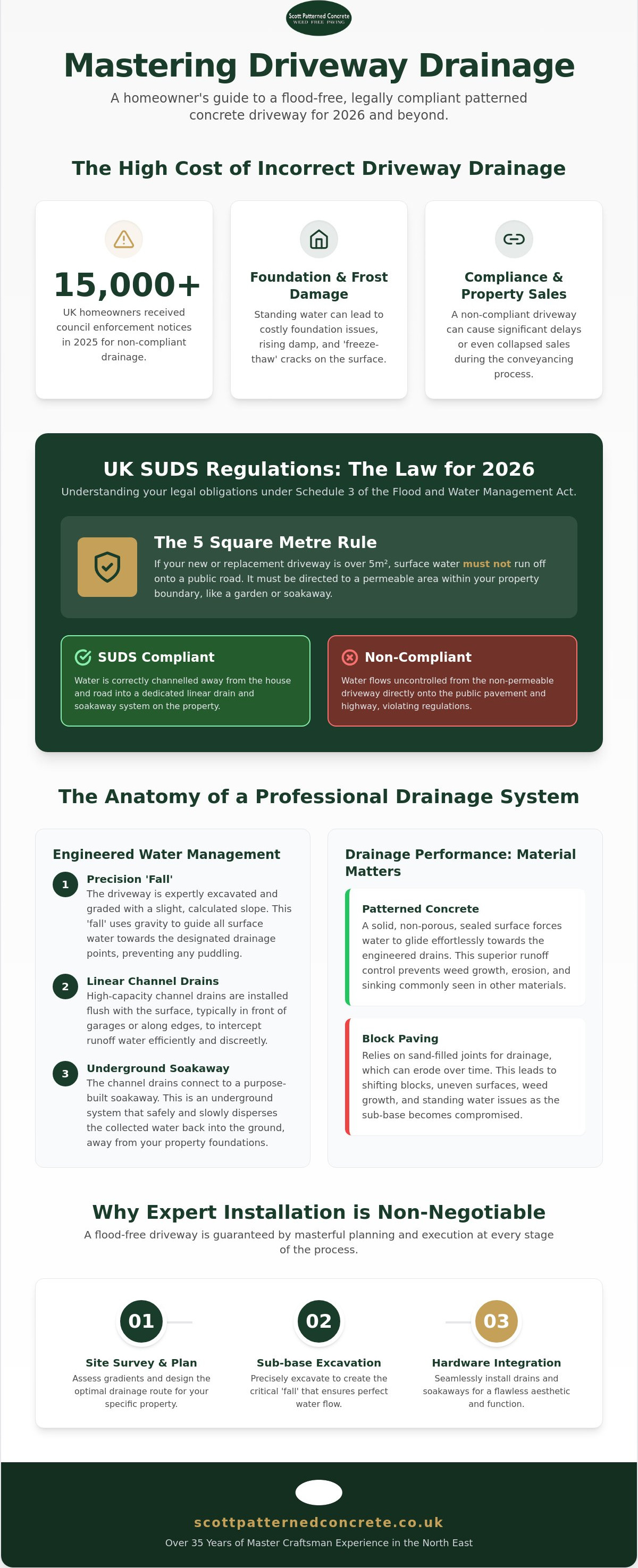
We're here to help you master these technicalities so your driveway remains beautiful, legal, and flood-free for over 30 years. With the mandatory Schedule 3 requirements now in full effect across England for 2026, understanding your obligations for any surface over five square metres is essential. This guide previews the latest SUDS compliance standards, explains how precision-engineered falls work, and shows you how professional drainage solutions ensure your home stays dry even during the heaviest British rainfall.
Key Takeaways
- Understand the updated 2026 SUDS regulations and the five-square-metre rule to ensure your installation remains fully compliant and avoids costly council enforcement.
- Learn why a precision-engineered "fall" is the foundation of effective patterned concrete driveway drainage, preventing standing water and protecting your home's structural integrity.
- Discover how professional hardware like linear channel drains and soakaways are integrated to handle heavy British rainfall without compromising on your driveway's aesthetic appeal.
- Compare the long-term drainage performance of decorative concrete against other materials to see how it prevents the common erosion and sinking issues found in block paving.
- Identify why a specialist installation process, backed by 35 years of Master Craftsman experience, is essential for a flood-free driveway that lasts for decades.
What is Patterned Concrete Driveway Drainage and Why is it Critical?
Effective patterned concrete driveway drainage is much more than just a plastic grate at the end of your drive. It is a precision-engineered system of gradients and hardware designed to capture and divert surface water into designated outlets before it can cause trouble. Without this system, water becomes a destructive force. It creates hydrostatic pressure, which is the weight of water pushing against your driveway slab from beneath. If this pressure isn't managed, it can lift concrete, cause shifting, or lead to unsightly surface cracks that ruin your investment. We've seen many concrete driveways in the North East fail prematurely simply because the installer didn't respect the power of water.
The British climate has changed, and 2026 rainfall patterns are far more intense than those we saw in the 1990s. Traditional installation methods often fail to account for the sheer volume of water we now experience in places like Middlesbrough, Darlington, and Stockton. Poor drainage doesn't just look bad; it leads to "freeze-thaw" damage. This happens when standing water enters tiny pores or joints, freezes in winter, and expands, literally popping the surface of the concrete. Our 35 years of experience has taught us that a driveway is only as good as the ground it's built on and the water it can move.
The Science of Surface Runoff
Imprinted concrete is a non-porous material. Unlike Permeable paving, which allows water to soak through the surface, patterned concrete is designed to be a solid, sealed barrier. This is actually a major benefit for durability and weed prevention, provided the water has somewhere to go. The high-quality sealant we use acts as a lubricant, helping water glide effortlessly toward your drainage channels. If you see puddling on a driveway, it's rarely a fault of the concrete itself. It's almost always a sign of poor sub-base preparation or incorrect levels. We take personal pride in the excavation stage because that's where the "invisible" work happens. Getting the fall exactly right ensures that gravity does the heavy lifting for you.
Protecting Your Property Foundations
A driveway that slopes toward your house is a recipe for disaster. Professional patterned concrete driveway drainage ensures that water stays well away from your property's Damp Proof Course (DPC). If water saturates the ground next to your walls, it can lead to rising damp or even structural subsidence over time. Managed drainage is the primary defence against driveway subsidence and long-term foundation damage. By installing a robust system, you're not just buying a beautiful entrance; you're protecting the very bones of your home and ensuring your property remains dry and stable for decades.
SUDS Regulations: Staying Compliant with UK Driveway Drainage Laws
Staying on the right side of the law is a major concern for our clients across the North East, from North Yorkshire to County Durham. In 2026, the regulations surrounding Sustainable Urban Drainage Systems (SUDS) are stricter than ever due to the full implementation of Schedule 3 of the Flood and Water Management Act. If your new or replacement driveway exceeds five square metres, you're legally required to ensure that surface water doesn't simply pour onto the public highway. Because imprinted concrete is a solid, non-permeable surface, it must be paired with a system that captures and directs runoff to a permeable area within your own property boundary. Following the UK government's SuDS standards isn't just about avoiding a fine; it's about being a responsible neighbour in an era of unpredictable weather.
The consequences of ignoring these rules are becoming increasingly severe. In 2025, over 15,000 enforcement notices were issued to UK homeowners for non-compliant drainage. Beyond the risk of a council fine, a lack of SUDS compliance can cause significant delays or even collapsed sales when you decide to move house. Solicitors now routinely check for drainage compliance certificates as part of the conveyancing process. We've spent 35 years perfecting our installation methods to ensure every project we undertake is fully compliant, giving you total peace of mind that your investment is legally sound.
Planning Permission Myths vs. Reality
A common misconception is that choosing a decorative finish like imprinted concrete automatically requires a lengthy battle with the planning department. That's simply a myth. You don't need planning permission if your patterned concrete driveway drainage is designed to keep water on your property. By using discreet channel drains and professionally sized soakaways, we ensure your project remains a "permitted development". Local councils are prioritising flood prevention in 2026 planning reviews, so having a certified, compliant system actually adds value to your home. If you're unsure whether your current plans meet these standards, our team is always happy to provide expert advice on compliance.
The Environmental Impact of Managed Drainage
Properly managed drainage does more than satisfy a legal checklist. It protects the UK's ageing Victorian sewer systems from being overwhelmed during flash floods, which are becoming more frequent. By directing water to garden borders or soakaways, you're allowing runoff to filter through natural soil. This process helps to remove pollutants before the water reaches the water table. If you're curious about how these technical choices fit into the wider design of your home, check out The Ultimate Guide to Patterned Concrete for a deeper look at the balance between beauty and environmental responsibility.
Professional Drainage Solutions: How Water is Diverted from Your Property
While many competitors label non-permeability as a disadvantage, we view it as a precision-engineering challenge that, when solved, creates a far more durable surface than porous alternatives. The foundation of effective patterned concrete driveway drainage is the "fall" or gradient. To move water efficiently, we typically implement a 1:60 or 1:80 slope. This means for every 60 or 80 units of length, the driveway drops by one unit. It's a subtle calculation that's invisible to the naked eye but essential for performance. We set these levels with laser precision long before the first skip of concrete arrives at your home in Darlington or Hartlepool.
Once the water is moving, it needs a place to go. Linear channel drains, often referred to as Aco drains, are the industry standard for collecting water across the full width of a driveway. These are usually installed at the lowest point of the fall, often where the driveway meets the public pavement or your garage threshold. Depending on your property's layout, we may also use gully pots and grates to manage water at specific corners or low points. These systems must comply with UK driveway drainage regulations, ensuring that every drop of runoff is managed onsite rather than flooding the street.
The Importance of the Sub-Base
True drainage starts 200mm below the surface. We've spent 35 years refining our excavation process because we know that a driveway is only as stable as its sub-base. We use a heavily compacted Type 1 MOT sub-base to create a rock-solid foundation. This prevents the "sinking" and "dishing" that causes water to pool in the middle of cheaper installations. For projects requiring even higher levels of stability and drainage performance, our Stonecrete Exposed Aggregate options provide an excellent alternative that prioritises structural integrity from the ground up.
Discreet and Decorative Drainage Hardware
You shouldn't have to sacrifice style for functionality. Modern drainage hardware has come a long way from the industrial-looking grates of the past. Slot drains are a favourite amongst our clients in Yarm and Wynyard who prefer a minimalist, modern look. These feature a very narrow opening that's almost invisible against the pattern of the concrete. We also offer a variety of drain covers in different colours and materials to complement your chosen design. Whether you opt for galvanised steel or high-density plastic, we ensure every component is installed "flush" to the surface. This eliminates trip hazards and makes it easy to keep your driveway clean with a simple sweep or wash.
Comparing Drainage Performance: Patterned Concrete vs. Other Surfaces
When choosing a new surface, homeowners often weigh up the "permeability vs. durability" debate. Whilst resin-bound surfaces are marketed as naturally porous, they face a significant 2026 challenge: clogging. Over time, silt, dust, and organic debris fill the tiny voids in resin, effectively turning it into a non-permeable surface that's incredibly difficult to clean. In contrast, patterned concrete driveway drainage relies on open, visible channels that you can easily maintain. It's a straight-talking solution that doesn't hide its mechanics beneath the surface. It stays clear, stays functional, and stays beautiful.
Block paving presents a different set of structural issues. Because it's made of thousands of individual bricks, water often erodes the sand joints over time. This leads to "potholing" and "dishing," where the surface sinks and creates deep puddles. Our imprinted concrete is a single, continuous slab. It doesn't have joints that can wash away, ensuring your levels remain perfect for decades. Even tarmac, which offers fast runoff, lacks the rigid structural integrity of concrete and can soften or crack during the increasingly hot UK summers, complicating your water management plans.
Why Weeds and Drainage are Linked
There's a direct connection between poor drainage and the constant battle against weeds. In block paving, standing water sits in the sand joints, creating the perfect damp environment for seeds to germinate. Because our concrete is a solid, non-porous barrier, there are no gaps for water to linger or for roots to take hold. This makes imprinted concrete the ultimate low-maintenance, weed-free option for busy homeowners in Newcastle and Sunderland. For a deeper look at how we achieve this, read our Weed-Free Driveway Options Guide.
Maintenance of Your Drainage System
Keeping your system in top shape is straightforward. We recommend a quick check of your channel drains after a heavy 2026 winter storm to ensure no stray leaves or debris are blocking the grates. You can simply lift the covers and sweep out any silt to keep the water flowing freely. A professional reseal every few years also helps maintain the water-shedding properties of the surface, ensuring runoff moves toward the drains as intended. If you're still undecided between materials, we can help you choose the best drainage layout for your property with a free, no-obligation consultation.
Why Expert Installation is the Key to a Flood-Free Driveway
Choosing the right contractor is just as important as choosing the right material. At Scott Patterned Concrete, our 35-year legacy is built on the principle that we never cut corners on site levels. As a family-run business, we take personal pride in the technical, often invisible work that happens beneath the decorative surface. Whilst a "cheap" quote might look attractive on paper, it often omits the complex patterned concrete driveway drainage systems required to meet 2026 UK building regulations. We don't believe in "good enough" because our reputation in the North East depends on every project lasting for decades. This is why we apply the same commercial-grade standards to every domestic project, whether we're working on a major development in Middlesbrough or a private family home in Billingham.
This commitment to engineering excellence is a philosophy shared by structural specialists like Composites Construction UK, who provide expert guidance on the technical aspects of structural concrete repair and maintenance.
Applying commercial rigour to your home ensures that your driveway can withstand the increasingly volatile British weather. By following these higher standards, we provide a level of structural integrity that "cowboy" installers simply cannot match. Our approach includes:
- Increased depth of sub-base to handle the weight of modern SUVs and electric vehicles.
- Higher-specification concrete mixes designed for superior weather resistance.
- Industrial-grade drainage hardware that won't buckle or crack under pressure.
- Full, certified compliance with Schedule 3 of the Flood and Water Management Act.
The Precision of Our Pour
We use advanced laser levels during the initial excavation and sub-base preparation to ensure that every millimetre of your driveway slopes exactly where it should. This precision is what prevents water from hanging around near your foundations and causing the long-term damp issues discussed in earlier sections. We also strategically design expansion joints that double as drainage control points. These joints allow the concrete to move naturally with temperature changes whilst directing surface water toward your Aco drains. It is a methodical approach that only comes with decades of hands-on experience. For more details on our technical process and design options, you can explore our Printed Concrete Guide.
Your Consultation and Quote
Every project begins with a thorough site survey where we act as a trusted specialist, not just a salesperson. We assess your existing soil type, local topography, and current drainage capacity before we even discuss patterns or colours. This honest, straight-talking approach ensures that all necessary groundworks and SUDS compliance are included in your initial quote, so there are no nasty surprises halfway through the build. We've spent over 35 years building trust in Stockton, Hartlepool, and across North Yorkshire by being transparent about what a high-quality installation actually requires. We're here to provide the peace of mind that your project is in safe, expert hands. Contact Scott Patterned Concrete for expert drainage advice and a free quotation.
Secure Your Investment with Professional Water Management
Achieving the perfect patterned concrete driveway drainage layout is about much more than just ticking a legal box for SUDS compliance. It's an essential investment in the structural health of your home and the long-term beauty of your property. By choosing a system that prioritises precision gradients and high-quality hardware, you're ensuring that your driveway remains weed-free, stable, and capable of handling the most intense British storms for decades to come. You've seen how poor planning leads to legal issues and foundation damage, but with the right technical approach, these risks are easily avoided.
With over 35 years of family-run expertise, we've refined a "Master Craftsman" approach that treats every residential project with the same rigour as our major commercial developments. We don't just pour concrete; we engineer a complete water management solution that protects your property and keeps you on the right side of UK building regulations. You deserve the peace of mind that comes from knowing your installation is built to last by specialists who truly care about the finer details.
If you're ready to transform your home with a stunning, flood-free entrance, our team is here to guide you through every technicality. Book your free site survey and expert drainage consultation today to start your project with confidence. We look forward to helping you create a beautiful, durable space that adds real value to your home for years to come.
Frequently Asked Questions
Does a patterned concrete driveway need a drain?
Yes, almost every installation requires an integrated drainage system. Because imprinted concrete is a solid, non-permeable surface, rainwater cannot soak through it. To prevent water from flowing onto the public highway or pooling against your house, we install professional channels or gullies. This ensures your property remains dry and fully compliant with UK building regulations regarding surface water management.
Do I need planning permission for an imprinted concrete driveway in 2026?
You don't usually need planning permission if your driveway manages all surface water within your property boundary. This is achieved by directing runoff into a soakaway, rain garden, or border. However, if your driveway is larger than five square metres and you intend to let water run onto a public road, you must apply for permission. We specialise in SUDS-compliant designs that typically fall under permitted development.
How do you stop water from pooling on a concrete driveway?
We prevent pooling through the use of precision-engineered "falls" or gradients. During the preparation stage, we use laser levels to ensure the sub-base and concrete have a subtle slope, typically between 1:60 and 1:80. This allows gravity to pull water towards your drainage channels. Correct site levels are the most critical part of the "Master Craftsman" approach, ensuring a perfectly flat-looking drive that sheds water effortlessly.
What is a soakaway and do I need one for my new driveway?
A soakaway is an underground pit filled with stone or modular crates that allows collected rainwater to percolate slowly back into the soil. You'll likely need one if your property doesn't have a natural permeable area to handle the runoff. It is a key component of Sustainable Urban Drainage Systems, helping to reduce the pressure on the UK's main sewer networks during heavy North East rainfall.
Can I install patterned concrete over an existing drainage manhole?
Yes, we can seamlessly integrate existing manholes into your new design using recessed "inset" covers. These specialist covers are filled with the same concrete mix and imprinted with your chosen pattern and colour. This ensures the manhole remains fully accessible for maintenance whilst becoming almost invisible to the naked eye. It's a far more aesthetic solution than leaving a traditional heavy iron lid in the middle of your new drive.
What happens if my driveway drainage is not SUDS compliant?
Non-compliance can lead to significant legal and financial headaches. Local councils have the power to issue enforcement notices, which may require you to rip up the driveway and start again at your own expense. Additionally, a lack of compliance certification can cause property sales to fall through during the conveyancing process. In 2025 alone, over 15,000 UK homeowners faced enforcement action for incorrect driveway drainage.
How often should I clean the channel drains on my driveway?
We recommend a quick inspection and clean at least twice a year, typically in the autumn and spring. Removing leaves, silt, and debris ensures your patterned concrete driveway drainage system continues to operate at its full capacity. It's a simple task that involves lifting the grates and sweeping out any trapped material, which takes only a few minutes but protects your home from flash-flood risks.
Is patterned concrete more likely to flood than block paving?
No, provided it is installed with professional falls. Whilst block paving is often seen as more porous, the sand joints can quickly clog with silt or weeds, leading to standing water and "dishing." A solid concrete slab is actually more predictable because the water flow is controlled by engineered gradients. It won't sink or create puddles over time, making it a highly reliable choice for managing heavy British weather.