Skip to content
The Ultimate Guide to Patterned Concrete: Beauty, Durability, and Design in 2026
- by Scott Patterned Concrete
Why spend your precious weekends on your hands and knees pulling weeds from paving joints when your driveway could look after itself? It's a common frustration for homeowners from Stockton to Sunderland who find that traditional block paving eventually shifts, sinks, or becomes a breeding ground for moss. If you're looking for a permanent solution that stays as level as the day it was poured, patterned concrete offers a revolutionary alternative. It combines the sophisticated aesthetic of natural stone with the uncompromising strength of a solid, reinforced structural slab.
We understand that your home or commercial premises is your most significant investment. You deserve a surface that reflects that pride without the constant maintenance or the cheap look of deteriorating tarmac. Much like how high-quality interior flooring from Surefit Carpets Ltd can elevate your indoor environment, this ultimate guide for 2026 will show you exactly how to achieve a weed-free, durable finish that won't soften in the summer heat. We'll walk you through the latest neutral colour trends, explain the technical installation standards we've mastered over 35 years, and help you discover why this material is the premier choice for driveways and patios across the UK.
Key Takeaways
- Learn how patterned concrete creates a monolithic, weed-free surface that outperforms traditional block paving in both durability and aesthetics.
- Discover why professional site preparation and the "pour window" are critical to ensuring your new driveway or patio remains level and crack-resistant for decades.
- Explore a variety of realistic textures and colours, from classic European Fan to modern slate, designed to complement your property’s unique architecture.
- Understand the industrial-strength benefits of reinforced concrete for commercial projects that require high load-bearing capacity for heavy traffic and HGVs.
- Get the facts on long-term care, including how the right acrylic sealants protect your investment from water ingress and colour fading.
What is Patterned Concrete? Defining the Modern Monolithic Surface
Patterned concrete is far more than just a decorative finish; it's a high-performance engineering solution for modern driveways and patios. Unlike traditional methods that rely on individual pieces, this approach uses a fibre-reinforced, monolithic pour to create a single, continuous surface across your property. During the installation, while the concrete is still in its plastic state, precision imprinting mats are used to create deep, realistic textures that mimic premium materials like slate, stone, or brick. To learn more about the history and technical evolution of this method, you might find it helpful to read about What is Stamped Concrete? as it explains the global standards for these decorative finishes.
What sets our process apart is the integration of UV-stable colour hardeners. These aren't simply painted onto the surface; they're chemically worked into the top layer of the wet concrete. This creates a durable, wear-resistant finish that stands up to the British weather and heavy vehicle use without fading or peeling. By treating the entire driveway as a "single slab," we eliminate the structural weaknesses inherent in surfaces made of thousands of individual units. For those looking for a comprehensive overview of the design possibilities, our printed concrete guide offers a deeper look at the aesthetic choices available.
The Structural Science of Decorative Concrete
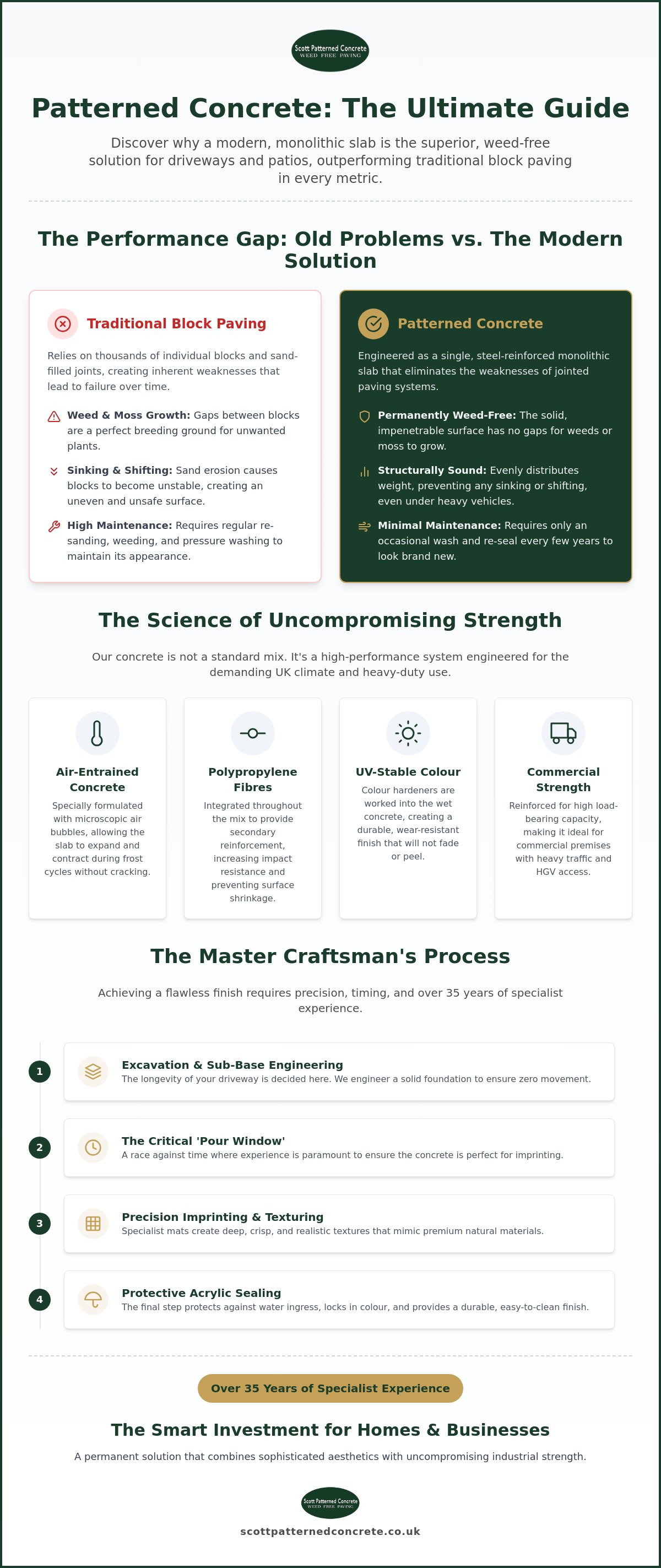
We use specific air-entrained concrete mixes that are specially formulated for the UK climate. These mixes contain microscopic bubbles that allow the concrete to expand and contract during North East frosts without cracking. To further enhance this durability, we incorporate polypropylene fibres throughout the mix. These fibres act as a secondary reinforcement, significantly reducing the risk of surface shrinkage and increasing the overall impact resistance of the slab. A monolithic slab is a continuous structural element that distributes weight evenly, ensuring that heavy loads don't cause the localised dipping often seen with other materials.
Patterned Concrete vs Block Paving: The Performance Gap
The primary reason block paving fails over time is its reliance on sand-filled joints. As rain washes the sand away, the individual blocks lose their lateral stability, leading to sinking and shifting. Patterned concrete removes this vulnerability entirely. Because there are no open gaps, there's nowhere for seeds to take root or for water to undermine the sub-base. When comparing weed free driveway options, a solid concrete slab is the only way to achieve total peace of mind. You're trading a high-maintenance surface for a structural engine that remains perfectly level for decades.
The Professional Installation Process: A Master Craftsman Approach
Achieving a flawless finish with patterned concrete isn't just about pouring wet material; it’s a race against time that requires decades of intuition. Our lead installer, Sean Scott, brings over 35 years of specialist experience to every project, personally overseeing what we call the "pour window." This is the critical period where the concrete is receptive enough to take a deep, crisp impression but firm enough to support the weight of the imprinting mats. If the timing is off by even thirty minutes, the pattern may appear shallow or inconsistent. This level of precision ensures that your driveway doesn't just look good on day one, but maintains its structural integrity for thirty years or more.
The technical complexity of the installation process begins long before the first mixer truck arrives. We focus on the chemistry of the materials and the specific environmental conditions of the day. Factors like the humidity in Middlesbrough or the wind speed on a coastal site in Redcar can drastically alter how the concrete sets. By managing these variables, we ensure the colour surface hardeners are correctly integrated into the slab, creating a surface that is significantly harder and more durable than standard concrete.
Step 1: Excavation and Sub-Base Engineering
Excavation is where the longevity of your project is decided. We never compromise on site preparation, ensuring a deep excavation to accommodate a high-grade MOT Type 1 sub-base. This material is non-negotiable for any driveway expected to carry vehicle loads without settlement. We also calculate the precise gradient required for patterned concrete driveway drainage, ensuring that surface water is directed away from your property foundations and into suitable soakaways. Industrial-grade compaction then creates a stable, vibration-free platform that prevents the "sinking" issues common with less rigorous installations.
Step 2: The Pour and Imprint Phase
Once the concrete is placed and levelled, we apply a powdered release agent across the surface. This serves two purposes: it prevents the imprinting mats from sticking and adds a secondary "antique" highlight to the textures, giving the finish its depth and character. Precision is paramount when laying the mats; our team works methodically to ensure every joint line is perfectly aligned, even on complex curves or steep inclines. This meticulous approach ensures a seamless transition between patterns that looks like genuine hand-laid masonry. If you're ready to discuss your specific site requirements, you can speak with our expert team for a consultation.
Design Versatility: From Classic Cobblestone to Stonecrete Aggregate
One of the most compelling reasons homeowners choose patterned concrete is the sheer level of bespoke control it offers. Unlike natural stone, where you're limited by what's available in the quarry, we can tailor every aspect of the finish to suit your property. Whether you're aiming for the heritage feel of European Fan or the structured, geometric look of Ashlar Slate, the possibilities are virtually limitless. When browsing through various stamped concrete patterns, we always advise our clients to think about the "grain" of their home. For instance, a London Cobble pattern works beautifully for traditional cottages in North Yorkshire, whilst a minimalist slate finish might better suit a contemporary new-build in Stockton-on-Tees.
Colour selection is equally vital to the final result. We don't just pick a shade; we look at the psychology of the space. Matching the primary tone of your driveway to the mortar or the secondary brickwork of your house creates a sense of architectural cohesion that "off-the-shelf" paving simply can't achieve. We use multi-tonal staining techniques to ensure the finish has depth, preventing it from looking flat or artificial. For those seeking the absolute pinnacle of textured design, we often recommend Stonecrete exposed aggregate surfaces. This premium finish moves away from imprinting and instead focuses on the raw, tactile beauty of the materials themselves.
Stonecrete: The Exposed Aggregate Revolution
Stonecrete represents a sophisticated shift in decorative surfaces. Instead of imprinting a texture onto the surface, we use a specialised process to reveal the natural, decorative stones within the concrete matrix. This results in a surface with superior slip resistance, making it the preferred choice for luxury concrete patios where safety and style are equally important. It's a high-end, contemporary aesthetic that feels incredibly solid and premium underfoot, offering a textured alternative to traditional patterned concrete.
Customising Your Patterned Concrete
The flexibility of a monolithic pour allows for customisation that would be difficult or expensive with other materials. We can integrate bespoke borders or central "mandalas" to create a truly unique entrance. Steps and ramps are cast as part of the same continuous pour, ensuring they'll never wobble or detach over time; this structural approach is mirrored in the premium pool construction and renovation work seen at rodcameronpools.com.au. By using contrasting colours for borders, we can define specific parking bays or walkways, adding both functional clarity and visual interest to your property. This level of detail is where our 35 years of experience really shines, allowing us to turn a standard driveway into a genuine design feature.
Commercial & Large-Scale Concrete: Industrial Strength for Public Spaces
While many homeowners recognise patterned concrete for its aesthetic charm, its true power lies in its industrial-grade durability. This material is the preferred choice for high-traffic environments across the globe, from the sprawling walkways of Euro Disney to busy retail centres throughout the UK. Large-scale commercial projects demand a surface that can withstand the relentless pressure of thousands of pedestrians and heavy vehicle movements without showing signs of fatigue. For developers and public sector organisations, our commercial concrete services provide a structural solution that balances this immense strength with a professional, decorative finish.
The load-bearing capacity of a reinforced concrete slab makes it uniquely suited for environments requiring HGV access. Unlike asphalt or individual paving units, which often rut or shift under the weight of heavy goods vehicles, a monolithic concrete pour distributes the load across a much wider area. Schools and hospitality venues frequently choose this method for its hygiene and "easy-clean" properties. Because the surface is non-porous and lacks the open joints found in block paving, it doesn't trap debris or allow for the growth of moss and weeds, making it simple to maintain with a basic pressure wash.
Safety and Compliance in Public Spaces
Public liability is a primary concern for any commercial client. We ensure all our installations meet strict slip-resistance standards by incorporating specific grit additives into the final sealant layers. This is particularly vital for outdoor dining areas, school playgrounds, and retail entrances where safety is paramount. Our installations also prioritise DDA compliance, creating smooth, trip-free transitions that are essential for wheelchairs, pushchairs, and those with limited mobility. The speed of installation for large-scale projects allows us to complete vast areas quickly, significantly reducing site downtime for businesses in Middlesbrough, Darlington, and the wider North East.
Durability Under Pressure: Industrial Applications
Patterned concrete consistently outperforms traditional asphalt in heavy-use industrial environments like loading bays and transport hubs. It offers superior resistance to oil spills, fuel leaks, and chemical staining, which would otherwise cause asphalt to soften and deteriorate. Our "Master Craftsman" standards ensure that every commercial slab is engineered with the correct reinforcement and depth to withstand multi-vehicle weight for decades without structural failure. This long-term reliability makes it a cost-effective investment for industrial premises where surface failure can lead to expensive operational delays. If you're planning a large-scale project, you can contact our team for a professional commercial consultation and quotation.
Longevity and Maintenance: Protecting Your Investment
A well-installed patterned concrete driveway is designed to last for 30 years or more, outliving almost every other surfacing option on the market. Whilst some competitors might claim these surfaces are "maintenance-free," we prefer to be honest with our clients. It's a low-maintenance solution, not a zero-maintenance one. By following a few simple steps, you can keep your property looking as vibrant as the day we finished the pour. This long-term durability is what makes the material such a sound financial choice, providing a surface that increases property value without the headache of constant repairs.
The secret to this longevity is the high-quality acrylic sealant we apply as the final step of the process. This barrier does more than just enhance the multi-tonal colours of the concrete; it creates a non-porous shield that prevents water ingress and protects the slab from UV fading. When you consider the long-term value, as detailed in our patterned concrete driveway cost guide, you'll see that a small investment in periodic maintenance significantly reduces the total cost of ownership over several decades. It's about protecting the structural engine we've built for your home.
The Sealing Cycle: When and How to Reseal
To maintain both the structural integrity and the aesthetic appeal of your driveway, you should plan to reseal the surface every 3 to 5 years. This timeframe varies depending on the level of vehicle traffic and the specific exposure to the elements in areas like Hartlepool or County Durham. You have the flexibility to choose between matt, satin, or high-gloss finishes depending on the look you want to achieve. A simple way to identify if your surface needs attention is the "water test." If water no longer beads on the surface or the pattern starts to look "thirsty" or dull, it's time for a fresh coat of protection.
Winter Care and General Cleaning
Winter in the North East can be harsh, but your patterned concrete is engineered to handle it. When clearing snow, we recommend using a plastic shovel rather than a metal one to avoid scratching the protective sealant layer. It's also vital to avoid using de-icing salts that contain ammonium nitrate or ammonium sulphate, as these chemicals can eventually attack the concrete surface. For general cleaning, a simple pressure wash once or twice a year is usually all that's required to remove surface dirt and keep the textures looking sharp. This straightforward routine ensures your driveway remains a standout feature of your property for decades to come.
Future-Proof Your Property with a Master Craftsman Finish
Investing in a new driveway or patio is about more than just kerb appeal; it's about choosing a surface that will perform for decades. You've seen how patterned concrete offers a monolithic, weed-free alternative to traditional paving, providing industrial-strength durability disguised as beautiful masonry. Whether you're a homeowner in Yarm looking for a classic cobblestone finish or a commercial developer in Middlesbrough requiring a high-traffic loading bay, the structural benefits of a reinforced slab are undeniable.
Our team brings over 35 years of specialist industry experience to every project. As a family-run business, we take personal pride in our craftsmanship, a commitment that has seen us deliver decorative surfaces for major UK theme parks and large-scale commercial developments. We don't just pour concrete; we build permanent solutions that increase property value and provide total peace of mind for our clients across the North East.
To further enhance your property's kerb appeal alongside a new driveway, SKR Specialists provides high-quality spray painting services that can revitalise the exterior of residential and commercial buildings.
If you are also looking to upgrade your home's interior with high-quality floor coverings, you can click here to learn more about specialist installation services.
Contact Scott Patterned Concrete today for a free, no-obligation quotation and expert advice on your project. We look forward to helping you create a space that remains pristine and maintenance-low for years to come.
Frequently Asked Questions
Does patterned concrete crack easily in the UK winter?
Patterned concrete doesn't crack easily in the UK winter provided it's installed to our Master Craftsman standards. We use air-entrained concrete mixes that allow for thermal expansion during North East frosts. By incorporating strategic expansion joints and polypropylene fibres, we ensure the slab remains structurally sound. This professional approach prevents the frost-shatter issues often found in DIY or substandard installations across County Durham and Teesside.
How long does it take to install a patterned concrete driveway?
A typical residential driveway takes between three to five working days to complete, though this depends on the weather and the scale of excavation. The process involves site preparation, the monolithic pour, imprinting, and finally the washing and sealing phases. We always prioritise a methodical pace to ensure the "pour window" is managed perfectly, giving you a result that lasts for decades rather than a rushed finish.
Is patterned concrete slippery when wet or icy?
Patterned concrete isn't naturally slippery when wet because we include anti-slip grit additives in the final acrylic sealant. These microscopic granules provide essential traction for both tyres and pedestrians without affecting the aesthetic finish. For areas requiring even higher levels of grip, such as steep slopes in North Yorkshire or public walkways, our Stonecrete exposed aggregate finish offers superior natural slip resistance.
Can I choose any colour or pattern for my property?
You have total freedom to choose from a vast range of colours and textures to complement your property’s masonry. We use precision imprinting mats to replicate everything from Ashlar Slate to London Cobble, paired with UV-stable colour hardeners. Our team often helps clients in Middlesbrough and Sunderland select bespoke shades that match their existing brickwork, ensuring the new surface feels like an integral part of the home's design.
Is patterned concrete more expensive than block paving?
The initial installation cost of patterned concrete is often similar to high-quality block paving, but it's significantly more cost-effective over its lifespan. Because it's a solid slab, you won't face the ongoing expenses of weed killing, re-sanding joints, or fixing sunken blocks. It's an investment in a structural surface that maintains its value and appearance with very little financial outlay for maintenance over thirty years.
How soon can I drive my car on a newly poured concrete driveway?
You can usually walk on the surface within 24 to 48 hours, but you should wait seven to ten days before driving a car on it. This period allows the concrete to reach sufficient compressive strength to handle vehicle loads without risk of marking or structural damage. We'll provide specific guidance based on the temperature and humidity at the time of your installation in Stockton-on-Tees or Newcastle.
What happens if the colour starts to fade over the years?
The colour won't disappear because it's chemically hardened into the top layer of the concrete, not just painted on. If the surface looks dull after several years, it's usually just the sealant wearing down. Applying a fresh coat of acrylic sealant every few years restores the original vibrancy and protects the multi-tonal finish. This simple maintenance task keeps your driveway looking brand new for the long term.
Do I need planning permission for a patterned concrete driveway?
Most homeowners don't need planning permission for a new driveway if they use a professional installer who understands drainage requirements. We ensure all projects comply with current regulations by directing surface water to soakaways or using managed drainage techniques. If your project is particularly large or complex, we'll advise you on the specific local authority guidelines for your area before we begin any work on site.