Skip to content
Crack Resistant Driveway Options UK: Sustainable Surfacing for 2026
- by Scott Patterned Concrete
Why do so many homeowners invest thousands in a new entrance only to see the first cracks and weeds appearing before the second winter? It's a common frustration for homeowners across the UK, where the unpredictable British weather and heavy vehicle loads test even the most expensive installations. When exploring crack resistant driveway options uk residents often find themselves torn between the aesthetic appeal of modern finishes and the practical necessity of long-term durability. You want a surface that stays pristine for decades; not one that requires a repair kit after every hard frost.
We know it's confusing to navigate the latest SUDS drainage regulations, especially with over 15,000 enforcement notices issued to UK homeowners last year for non-compliant surfaces. You'll learn how to choose a sustainable surfacing solution that satisfies local authorities whilst providing the high level of finish your home deserves. We will look at why Stonecrete and reinforced patterned concrete, like those offered by Scott Patterned Concrete, are leading the way for 2026, offering a heavy-duty alternative to traditional paving that simply cannot handle the modern demands of multi-vehicle households.
Key Takeaways
- Learn how to identify the most reliable crack resistant driveway options uk residents can invest in to combat the specific challenges of the British climate.
- Navigate the 2026 SUDS drainage regulations and the "5 square metre rule" to ensure your project is fully compliant with UK planning laws.
- Understand why material longevity is the truest form of sustainability, reducing the environmental and financial costs of frequent surface replacements.
- Explore modern design trends for 2026, including biophilic layouts that combine the permanence of Stonecrete with natural, high-end aesthetic borders.
- Discover how to achieve a completely weed-free, low-maintenance finish that maintains its structural integrity and beauty for over 30 years.
Understanding Crack Resistant and Sustainable Driveway Options
Sustainable surfacing isn't just a buzzword for 2026; it's a commitment to building something that lasts. True sustainability balances the environmental impact of raw materials with the actual longevity of the finished product. When investigating crack resistant driveway options uk homeowners often overlook the relationship between material density and ground movement. A surface that looks green on day one but fails by year five isn't an eco-friendly choice. It's a waste of resources.
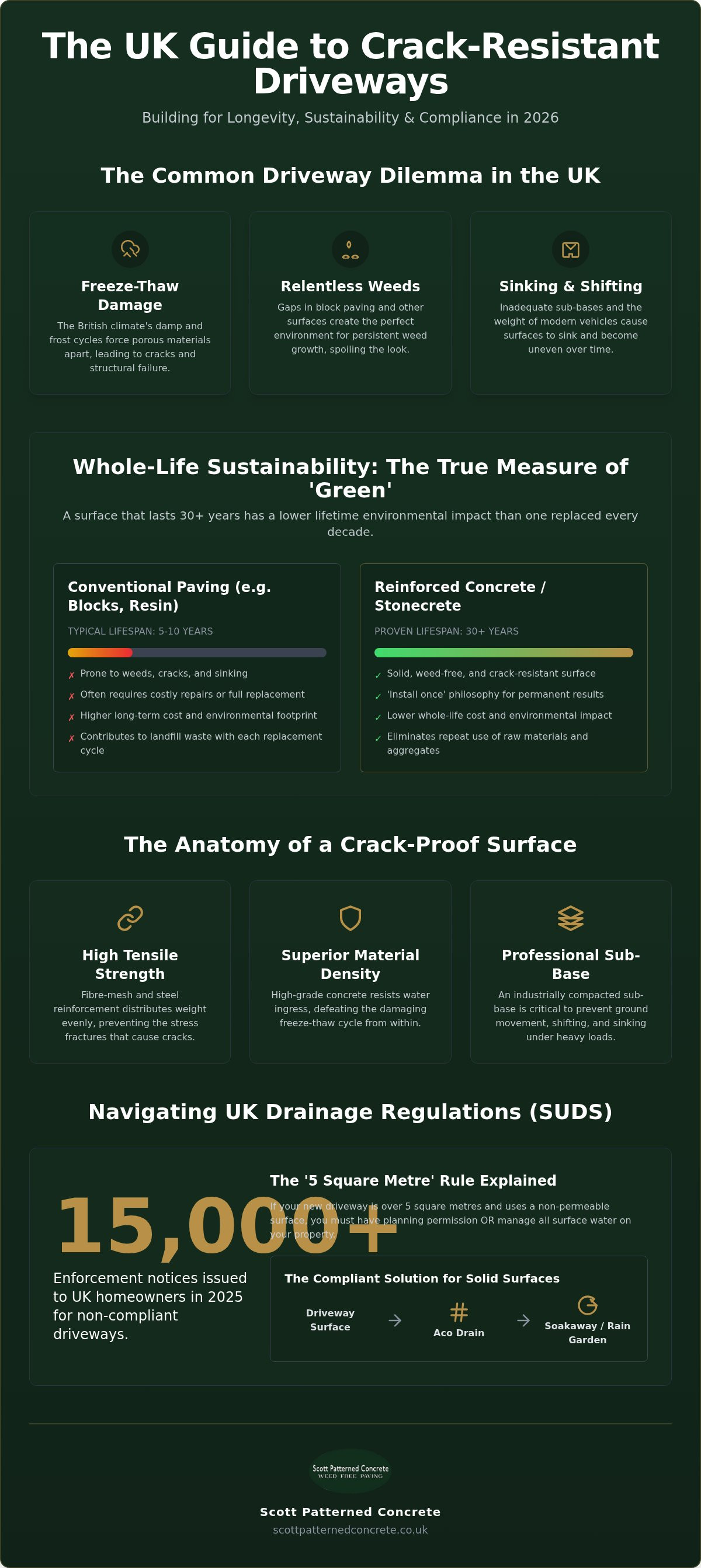
In the UK, the primary enemies of any driveway are freeze-thaw cycles and inadequate sub-bases. Our damp climate means water often enters small gaps in porous materials. When that water freezes, it expands and forces the material apart. Over time, these micro-fissures become significant structural failures. Poorly compacted sub-bases exacerbate this by allowing the surface to shift under the weight of modern vehicles. This leads to the "heaving" often seen with inferior installations.
Whole-life sustainability is a core principle in modern construction. It focuses on the total environmental cost over several decades rather than just the initial installation. A solid, crack-resistant surface naturally prevents weed growth. This eliminates the need for homeowners to use harsh chemical weed killers or acidic detergents that eventually wash into our local water systems. By choosing a permanent solution, you protect both your property and the local environment.
What Makes a Driveway Crack Resistant?
It starts with tensile strength. We utilise reinforced concrete driveways designed to distribute weight evenly across the entire surface. Material density is crucial; high-grade concrete resists water ingress far better than many porous alternatives. Professional installation ensures the sub-base is compacted to industrial standards to prevent the sinking that leads to surface failure. For those seeking the ultimate in permanence, Stonecrete offers a heavy-duty finish that handles heavy multi-vehicle loads without flinching.
The Environmental Benefit of Longevity
Consider the carbon footprint of a driveway that lasts 30 years compared to one that requires replacing every decade. Choosing a durable material significantly reduces the long-term demand for new aggregates and prevents tonnes of old material from heading to landfill. Our Master Craftsman approach focuses on "right first time" installation. While many focus solely on permeable paving systems to manage surface water, we ensure that drainage is integrated without sacrificing the structural density required for a crack-free finish. This methodical approach ensures your investment remains pristine whilst minimising its environmental impact over its entire lifespan.
Navigating UK Drainage Regulations and SUDS Compliance
Selecting crack resistant driveway options uk homeowners can rely on involves more than just picking a durable material; it requires a thorough understanding of Sustainable Drainage Systems (SUDS). Since 2008, UK law has strictly controlled how water flows from private property onto public roads to prevent local flooding and sewer overloads. If you're installing a new or replacement driveway larger than five square metres using a non-permeable material, you must obtain planning permission unless the water is managed on-site.
Non-compliance isn't just a minor oversight. In 2025, over 15,000 enforcement notices were issued to UK homeowners for non-compliant driveways. These legal actions often lead to significant fines or the requirement to dig up and replace the entire surface at the owner's expense. We focus on "grey-to-green" transitions, where we design your hard landscaping to work in harmony with the natural environment, ensuring your home contributes to flood prevention rather than adding to the problem.
Integrated Drainage for Solid Surfaces
A common misconception is that choosing printed concrete means you cannot comply with SUDS. By installing Aco drains and high-capacity soakaways, we can capture every drop of surface runoff. This water is then redirected to rain gardens or soft borders, which supports local biodiversity and keeps the soil healthy. This approach relies heavily on professional sub-base engineering. We don't just pour concrete; we create a managed water system. The sub-base must be engineered to handle both the weight of your cars and the volume of a heavy downpour. If you aren't sure how these rules apply to your specific plot, you can always get in touch for expert advice regarding your project.
Planning Permission: The 2026 Landscape
The core drainage regulations introduced in 2008 remain the standard in 2026, but the government's 2025 "National Standards for Sustainable Drainage Systems" have raised the bar. These standards introduce a "5mm interception requirement" to manage everyday rainfall. While some companies push only for fully porous surfaces, research on resilient permeable pavements shows that durability can sometimes be compromised in favour of permeability.
Choosing the right crack resistant driveway options uk suppliers offer means finding a partner who understands these nuances. Our solution ensures compliance by using natural soakaways or rain gardens as the destination for runoff. This qualifies your project for an exemption from planning permission, even if the primary surface is solid and reinforced. We handle the technical calculations to ensure your driveway meets all current UK standards, giving you peace of mind that your installation is both legal and built to last.
Durability vs. Permeability: The Life-Cycle Sustainability Debate
When assessing crack resistant driveway options uk homeowners often face a choice between the immediate drainage benefits of permeable materials and the long-term structural integrity of solid surfaces. While permeable systems like resin-bound gravel are frequently marketed as the eco-friendly choice, they often lack the density required to withstand the shifting clay soils common in the North East. If a surface delaminates or cracks after just five years, the carbon cost of its removal and replacement far outweighs its initial environmental benefits. Life-cycle sustainability is the total environmental impact of a material from installation to removal.
Choosing a high-density material like exposed agg concrete ensures that your driveway remains a permanent fixture of your home rather than a temporary fix. This material, often referred to as Stonecrete, is amongst the most durable options available today because it bonds the aesthetic of natural stone with the monolithic strength of a reinforced slab. By prioritising longevity, you reduce the long-term demand for new aggregates and the energy-intensive processes involved in frequent resurfacing.
Engineering for Crack Resistance
We achieve true durability through precise engineering rather than just material thickness. Expansion joints are a critical component of this process; they act as planned break points that allow the concrete to expand and contract during the UK's extreme temperature swings without causing unsightly surface fractures. We also utilise fibre-reinforced concrete, which incorporates thousands of microscopic fibres throughout the mix. These fibres act as a secondary reinforcement, preventing micro-cracks during the curing stage and ensuring the finish remains premium for decades. Stonecrete surfaces provide this level of superior strength whilst offering a sophisticated, natural look that rivals traditional stone sets.
Eliminating Maintenance Hazards
A sustainable driveway should also be a low-maintenance one. One of the greatest environmental hazards of traditional block paving is the constant battle against weeds growing through the joints, which often leads to the heavy use of chemical herbicides. A solid, crack-resistant concrete surface eliminates these gaps entirely, making it a naturally weed-free choice. Additionally, solid surfaces prevent the common issue of loose gravel migrating into local drains and causing blockages during heavy storms. Keeping your surface pristine becomes a matter of simple cleaning rather than chemical intervention, protecting your local ecosystem whilst maintaining your home's kerb appeal.
Top Sustainable Design Trends for Modern UK Driveways
Design trends in 2026 are shifting towards biophilic principles, where hard landscaping is crafted to feel like an extension of the natural world. Homeowners are moving away from stark, industrial aesthetics in favour of schemes that integrate greenery and organic textures. One of the most effective ways to achieve this is through the use of earth-toned colours. Selecting shades like warm buff, charcoal, or clay doesn't just improve kerb appeal; it actively combats the "urban heat island" effect by reflecting more solar radiation than traditional dark surfaces. When exploring crack resistant driveway options uk residents now prioritise materials that contribute to a cooler, more comfortable residential environment.
Smart drainage is also at the forefront of modern design. This approach hides functional water management within the decorative layout of the driveway. Instead of unsightly plastic grates, we use subtle gradients and decorative patterns to guide surface water towards rain gardens or hidden soakaways. This ensures your driveway remains a cohesive piece of architecture whilst performing its environmental duty. By combining high-strength materials with natural stone borders, you create a high-end aesthetic that feels grounded and permanent.
Stonecrete: The Premium Sustainable Choice
Stonecrete has emerged as the definitive choice for luxury sustainable homes across the North East. It provides the timeless aesthetic of natural stone without the maintenance headaches or instability associated with loose aggregates. By utilising textured concrete finishes, we can create surfaces that offer exceptional slip resistance and safety for families. This material represents the pinnacle of crack resistant driveway options uk because it maintains its structural integrity under heavy loads whilst providing a bespoke, hand-crafted look that complements both modern and traditional architecture.
Zoning and Hybrid Surfaces
Zoning is a clever design technique used to balance heavy-duty performance with environmental responsibility. We often design hybrid driveways that feature solid, reinforced concrete tracks for vehicle tyres whilst incorporating permeable central strips or borders. This layout ensures the areas under the most stress are built with maximum durability, whilst the permeable zones manage runoff and support local biodiversity. Integrating rain gardens directly into the driveway border allows for a seamless transition from the hard surface to the soft landscape. This hybrid approach allows you to enjoy the permanence of a reinforced slab whilst meeting the most stringent sustainability goals.
Why Decorative Concrete is a Sustainable Long-Term Investment
True sustainability in construction is measured by the passage of time. A surface that requires frequent excavation, new materials, and energy-intensive repairs every few years cannot be considered eco-friendly. When you evaluate crack resistant driveway options uk homeowners often find that reinforced decorative concrete offers the most responsible path forward. By choosing a material designed to remain structurally sound for thirty years or more, you are actively reducing the demand for new raw aggregates and minimising the waste sent to landfill. Permanence is the ultimate pillar of environmental responsibility.
Viewing your driveway as a multi-decade investment rather than a temporary aesthetic fix changes the value proposition entirely. A high-quality installation adds significant kerb appeal and functional value to your property that lasts as long as the house itself. It's about moving away from the "disposable" culture of cheaper surfacing and towards a standard of craftsmanship that respects both the property owner's budget and the planet's resources. Our goal is to provide a finished product that you can take pride in for half a lifetime.
The Scott Patterned Concrete Difference
Our family-run business brings over 35 years of industry experience to every project we undertake across the North East. This heritage is your guarantee of a "right first time" installation. We have refined our Master Craftsman approach through decades of hands-on work, ensuring that every sub-base is engineered to perfection and every expansion joint is placed with precision. Whether we are handling a domestic concrete driveway installation or acting as commercial concrete contractors for major developments, our commitment to quality remains identical. We understand the specific soil conditions in areas like Stockton, Middlesbrough, and County Durham, allowing us to tailor our reinforcement techniques to the local landscape.
Next Steps for Your Project
Every property has unique requirements when it comes to drainage, load-bearing capacity, and architectural style. The first step towards a permanent, weed-free surface is a professional site survey. During this consultation, our experienced team will assess your existing ground levels and discuss how to integrate SUDS-compliant drainage without compromising on the aesthetic you desire. We provide straightforward, honest advice based on thirty-five years of specialist knowledge, helping you navigate the technical aspects of crack resistant driveway options uk suppliers provide. We take personal responsibility for the final result, ensuring your project meets all current UK standards whilst exceeding your expectations for beauty and durability.
Future-Proof Your Entrance with Sustainable Surfacing
Choosing a new surface is an opportunity to move away from the cycle of constant repairs and weeding. As we move into 2026, the focus has shifted towards "Whole-Life Sustainability," where the environmental impact is minimised by installing a product that never needs replacing. Our Stonecrete and reinforced patterned concrete finishes stand out as the premier crack resistant driveway options uk homeowners can trust to handle heavy loads whilst remaining SUDS-compliant.
At Scott Patterned Concrete, we bring over 35 years of specialist industry experience to every project. As a family-run business with a reputation for reliability, we take pride in delivering a "Master Craftsman" finish for both premium residential homes and large-scale commercial developments. We ensure your installation meets every UK regulation, providing you with absolute peace of mind and a pristine finish that lasts for decades.
We look forward to helping you transform your property with a surface that is as durable as it is beautiful.
Frequently Asked Questions
Is concrete considered a sustainable driveway surfacing option?
Concrete is a sustainable choice when you prioritise whole-life value and longevity. A well-installed reinforced driveway can last over 30 years, which significantly reduces the environmental impact compared to materials that require replacement every decade. By choosing a permanent surface, you minimise the long-term demand for raw aggregates and reduce the amount of construction waste sent to landfill over the lifespan of your property.
What are the current SUDS regulations for UK driveways in 2026?
The current regulations state that any new or replacement driveway exceeding five square metres must either use a permeable material or manage surface water within the property boundaries. The 2025 National Standards for Sustainable Drainage Systems also introduced a "5mm interception requirement" to manage daily rainfall. Compliance is achieved by directing runoff into soakaways, rain gardens, or borders rather than allowing it to flow onto public highways.
How do you prevent cracks in a patterned concrete driveway?
Preventing cracks requires a combination of professional sub-base compaction and precise engineering of the surface slab. We install expansion joints at calculated intervals to manage the natural thermal movement caused by the UK's temperature swings. Additionally, we use fibre-reinforced concrete mixes that prevent micro-cracks from forming during the curing process, ensuring the structural integrity of the driveway remains intact even under heavy multi-vehicle loads.
Can I install a new driveway without planning permission?
You can install a new driveway without planning permission if the surface is less than five square metres or if you use an integrated drainage system. By capturing runoff in a soakaway or rain garden on your own land, you satisfy SUDS requirements. This allows you to choose high-density, durable materials whilst remaining fully compliant with UK planning laws, avoiding the need for a formal application to your local authority.
How does Stonecrete compare to resin-bound gravel for longevity?
Stonecrete offers superior longevity because it is a monolithic, reinforced slab that is chemically bonded to its aggregate. Unlike resin-bound gravel, which can sometimes delaminate or crack if the underlying sub-base shifts, Stonecrete is engineered to move as a single unit. This makes it far more resilient to the "heaving" caused by freeze-thaw cycles, providing a high-end natural stone aesthetic that doesn't sacrifice structural strength.
What is the most durable crack resistant driveway material in the UK?
Reinforced decorative concrete and Stonecrete are widely regarded as the most durable crack resistant driveway options uk homeowners can select. These materials provide the high tensile strength required to support heavy modern vehicles without sinking or fracturing. Their dense, non-porous nature also protects the surface from water ingress, which is the leading cause of structural failure in traditional paving during the winter months.
Do sustainable driveways require more maintenance than traditional ones?
Sustainable driveways actually tend to require significantly less maintenance than traditional options like block paving or gravel. Because solid surfaces like patterned concrete are jointless, they are naturally weed-free and don't require the frequent application of chemical herbicides. Maintenance is usually limited to a simple wash and an occasional reseal every few years to keep the colours vibrant and the surface protected from the elements.
What happens if my driveway does not comply with UK drainage laws?
Non-compliance can lead to serious legal and financial consequences from your local council. In 2025, over 15,000 enforcement notices were issued to UK homeowners who failed to meet drainage standards. If your driveway is found to be non-compliant, you may be fined or even ordered to remove and replace the entire surface at your own expense. Ensuring your project is designed correctly from the start is essential for your peace of mind.