Skip to content
Heavy Duty Concrete Driveways: The 2026 Structural Checklist for UK Properties
- by Scott Patterned Concrete
Why do some driveways begin to sink and crack within months, whilst others remain pristine even under the weight of heavy delivery vehicles and decades of unpredictable British weather? It's a common frustration for many UK homeowners who have watched expensive block paving succumb to weeds or tarmac lose its shape over time. You likely want a surface that looks premium but performs like an industrial-grade installation, providing total peace of mind that it won't fail when you need it most.
We understand that a driveway is more than just a place to park; it's a structural engineering project that safeguards your property's kerb appeal and value. This guide reveals the essential technical standards for heavy duty concrete driveways in 2026, moving beyond simple aesthetics to focus on the engineering that counts. From the latest BS EN 206-1:2026 concrete specifications to the mandatory SuDS drainage regulations that saw over 15,000 enforcement notices issued last year, we'll provide a clear checklist. You'll discover how the right sub-base and reinforcement can create a maintenance-free finish that stands the test of time.
Key Takeaways
- Learn why heavy duty concrete driveways require a specific C35/45 compressive strength mix to support motorhomes and heavy delivery vehicles safely.
- Understand the latest 2026 SuDS drainage regulations and why integrated systems are essential for legal compliance and effective water management.
- Discover the structural role of mesh reinforcement and deep excavation in preventing the frustrating issues of sinking and surface cracking.
- Explore how premium finishes like Stonecrete offer an industrial-strength surface whilst significantly enhancing your home's kerb appeal.
- Identify the critical installation markers that ensure your new driveway remains maintenance-free and structurally sound for decades to come.
What Defines a Heavy Duty Concrete Driveway?
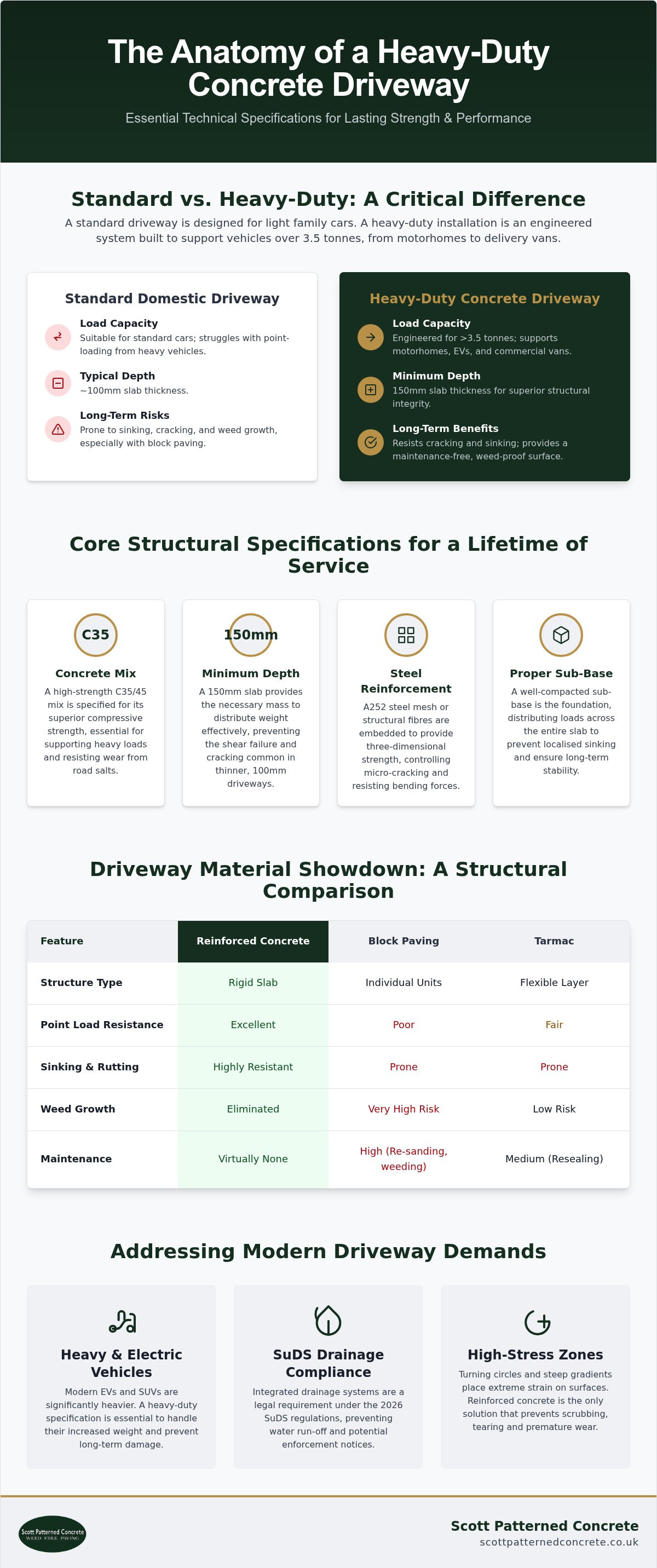
A heavy duty concrete driveway is far more than a simple aesthetic upgrade; it's a precision-engineered structural system. While a standard domestic driveway might be designed for a light family car, heavy duty concrete driveways are built to withstand loads exceeding 3.5 tonnes. This involves using high-compressive-strength concrete, typically reinforced with steel mesh, to ensure the surface doesn't buckle under pressure. Standard surfaces often fail because they can't handle 'point-loading', which occurs when a heavy vehicle, like a motorhome or a delivery van, concentrates all its weight on a few small contact points.
When looking at various Road surface types, the distinction between flexible and rigid pavements is crucial for longevity. Tarmac is a flexible surface that relies on the layers beneath it to stay in shape. Over time, heat and heavy loads cause it to rut, ripple, or sink. Concrete is a rigid structure. It acts as a single, solid plate that bridges minor gaps in the sub-grade. The sub-base plays a vital role here, acting as the foundation that distributes weight across the entire surface area to prevent structural failure and ensure the slab remains level.
When Should You Upgrade to Heavy Duty?
It's worth considering an upgrade if your property features 'high-stress' zones. Turning circles, where tyres scrub the surface, or steep gradients that place extra strain on the driveway during braking and acceleration, are prime candidates for a stronger build. You should also assess your current and future fleet. Modern electric vehicles (EVs) are significantly heavier than traditional petrol or diesel cars due to their dense battery packs. If you own a horsebox, a large SUV, or regularly have commercial deliveries, a standard domestic specification simply won't suffice for the long term.
The Science of Load Distribution
The secret to longevity lies in how the slab handles movement and weight. By using a reinforced slab, the driveway functions as a single unit. This prevents the localised sinking that often plagues block paving, where individual units can shift independently and allow weeds to take root. We focus on 'flexural strength', which is the concrete's ability to resist bending. This is essential during natural soil movement or frost heaves. Choosing patterned concrete provides a seamless, reinforced finish that offers superior longevity compared to individual blocks, ensuring your investment remains level and crack-free for decades.
The Structural Checklist: Technical Specifications for 2026
Building a driveway that survives the next thirty years requires moving beyond basic building supplies. For heavy duty concrete driveways, the engineering specifications must be precise. We've moved past the days where a generic GEN3 mix was considered sufficient. In 2026, we specify a C35/45 mix for heavy-load applications. This grade provides the high compressive strength necessary to resist the weight of modern SUVs and commercial vehicles whilst offering better resistance to the corrosive effects of road salts. It's a professional choice that prioritises long-term integrity over initial material costs.
Depth is your greatest ally against structural failure. Whilst a 100mm slab is common for light domestic use, heavy-duty performance demands a minimum of 150mm. You can find more detail in our guide on concrete driveway thickness for cars, but for industrial or high-traffic residential sites, that extra 50mm provides the necessary mass to prevent shear failure. Reinforcement is the final piece of the puzzle. We typically use A252 steel mesh or advanced macro-synthetic structural fibres. These fibres are distributed throughout the entire mix, providing three-dimensional reinforcement that controls micro-cracking far more effectively than traditional mesh alone.
Concrete Mix Design and Additives
The UK weather is notoriously brutal on external surfaces. We use air-entraining agents to create microscopic bubbles within the slab. These act as tiny expansion chambers when water freezes, preventing the surface from scaling or popping. We also maintain a strict water-cement ratio. A "wet" mix might be easier to pull into place, but it's significantly weaker once cured. By using modern plasticisers, we achieve a smooth, workable finish without diluting the strength of the C35/45 mix, ensuring a premium result that doesn't compromise on durability.
Sub-Base and Compaction Standards
A concrete slab is only as good as the ground it sits on. We use MOT Type 1 crushed aggregate as the gold standard for foundations. It's not enough to simply spread the stone; it must be laid in 75mm layers and vibrated to maximum density. We also install a heavy-duty geotextile membrane to prevent the sub-base from mixing with the underlying soil, which is a common cause of sinking. This foundation is also where we integrate drainage to comply with UK government guidance on permeable paving, ensuring your project meets all 2026 legal requirements. If you're planning a complex installation, speak with our technical team to ensure your foundation is built to last.
Aesthetics Meets Strength: Stonecrete and Patterned Finishes
A common misconception suggests that choosing heavy duty concrete driveways means settling for the drab, utilitarian appearance of a motorway hard shoulder. In reality, the engineering that makes a driveway durable also provides the perfect canvas for premium finishes. We use advanced colour-hardener technology, which is trowelled into the surface of the wet concrete during the installation process. This doesn't just add vibrant colour; it significantly increases the surface density. A denser surface is far more resistant to the abrasive wear of heavy tyres and the inevitable oil drips from larger vehicles, ensuring the finish remains intact for decades.
When adhering to British Standards for external paving, specifically the PAV1 and PAV2 designations, the surface texture is as critical as the internal mix. The deep textures found in imprinted concrete aren't merely decorative. They provide essential mechanical traction, which is vital when manoeuvring heavy motorhomes or delivery vans, especially in the wet North East winters. This combination of structural integrity and high-performance finishing ensures your driveway is as safe as it's beautiful.
Stonecrete: The Master Craftsman's Choice
We often recommend Stonecrete for projects that require commercial-grade durability with a high-end residential feel. This exposed agg concrete finish is created by removing the top layer of cement paste to reveal the natural decorative stones beneath. Because the aggregate is part of the monolithic slab, it can't be displaced like loose gravel. It offers exceptional slip resistance, making it the safest choice for steep, heavy-duty drives whilst effectively hiding minor wear and tear over years of use.
Bespoke Patterns for Commercial Loadings
Choosing the right pattern for heavy duty concrete driveways involves balancing style with practicality. We select patterns that facilitate easy cleaning and efficient water runoff, preventing the pooling that can damage a slab over time. A critical part of our craftsmanship is integrating structural expansion joints into the aesthetic design. By placing these joints along the lines of the pattern, we allow the slab to move naturally without unsightly cracks appearing. You can explore modern driveway design ideas to see how these heavy-duty layouts can be tailored to suit both contemporary and traditional UK properties.
The Installation Checklist: From Excavation to Curing
Installing heavy duty concrete driveways is a methodical engineering project that demands precision at every stage. We start with deep excavation, removing all organic matter to reach firm 'bearing' ground. If you leave soft topsoil or roots behind, they'll eventually decompose and create voids that lead to surface failure. Once the ground is prepared, we integrate the drainage systems to ensure full SuDS compliance. This prevents water pooling and protects your property from the risks of flooding or damp.
Precision formwork follows, where we set the levels for perfect water run-off. During the pour, we manage the set time with expert care to ensure the entire slab remains a monolithic structure. Avoiding 'cold joints' is essential; the slab must act as a single unit to handle the stress of heavy vehicles. Finally, we move into the curing and sealing phase. This is the vital waiting period that determines the ultimate lifespan of the installation.
Managing Drainage for Large Surface Areas
Large driveways generate a significant volume of surface water. We use high-capacity Aco drains and soakaways to manage this runoff effectively. A critical standard we follow is the 1:60 fall rule; this ensures a natural gravity slope that directs water away from your home's foundations. You can read more about our patterned concrete driveway installation process to understand how we balance these technical requirements with a premium finish.
The Curing Protocol for Heavy Loads
Patience is a virtue when it comes to concrete chemistry. Whilst you can usually walk on the surface within 24 hours, you shouldn't park a motorhome or a heavy SUV on it for at least 28 days. This is because of the chemical process of hydration. Concrete gains approximately 90% of its ultimate design strength in the first month. During this time, we apply high-solids sealants to protect the new surface from early chemical spills or tyre marks, ensuring the finish stays as pristine as the day it was poured.
Why Expert Installation is Non-Negotiable
Selecting the right partner for your project is the final, and perhaps most critical, step in this structural checklist. Inexperienced or 'cowboy' installers often cut corners that aren't immediately visible to the untrained eye. They might pour thin slabs that barely meet domestic standards, omit the essential mesh reinforcement, or fail to compact the sub-base with the necessary rigour. For heavy duty concrete driveways, these shortcuts are catastrophic. A slab designed for heavy loads will fail rapidly if the foundation is weak, leading to sinking and structural cracks that far outweigh any initial savings on labour costs.
Our 35-year legacy at Scott Patterned Concrete is built on doing things the right way, every time. We've spent decades refining our craft in commercial concrete, delivering high-specification surfacing for theme parks, schools, and public sector organisations. As a family-run business, we don't just see a driveway; we see a structural investment that reflects our personal reputation. Choosing a heavy-duty specification provides a significantly higher long-term ROI than a standard replacement, as the surface remains maintenance-free and structurally sound for decades, even under the weight of the heaviest modern vehicles.
Master Craftsman vs. General Builder
A heavy-duty pour requires specialised equipment and a deep understanding of material science that general builders often lack. We use professional-grade screeding tools and vibration equipment to ensure the C35/45 mix is perfectly consolidated without air pockets. We also account for the nuances of the British climate. Whether it's the high humidity of the North East coast or the hard frosts of County Durham, we adjust our additives and curing times to suit the local environment. This level of detail provides you with absolute peace of mind, knowing your project is in the hands of specialists who value transparency and craftsmanship above volume.
Your Next Steps for a Permanent Solution
If you're tired of sinking blocks or crumbling tarmac, it's time to move towards a permanent solution. Preparation is simple. Start by assessing your property's specific needs, such as the weight of your vehicles and any existing drainage issues. We recommend requesting a professional site survey, where we can assess your ground conditions and provide a detailed technical plan tailored to your property. This ensures that every element, from the sub-base to the final sealant, is engineered for your specific usage requirements.
For expert advice or to arrange a site survey, Contact Scott Patterned Concrete for a free, no-obligation quotation. We're ready to help you build a driveway that combines industrial strength with a premium aesthetic finish.
Investing in a Lifetime of Structural Excellence
Choosing heavy duty concrete driveways is about more than just a fresh look for your home; it's a commitment to engineering that lasts. By prioritising the correct C35/45 mix, ensuring a 150mm slab depth, and adhering to strict 2026 SuDS drainage standards, you prevent the sinking and cracking that plague standard installations. Whether you opt for the rugged elegance of Stonecrete or a bespoke patterned finish, the result is a surface that handles modern vehicle weights with ease.
As a family-run business with over 35 years of master craftsman experience, we take personal pride in every project. We've built our reputation on structural integrity, specialising in both premium domestic Stonecrete and large-scale commercial surfacing across the North East. We understand that your property deserves a foundation that's as reliable as it is beautiful.
We look forward to helping you transform your property with a surface built to withstand the decades. Our team is ready to provide the technical expertise and honest advice you need for a permanent, maintenance-free solution.
Frequently Asked Questions
How thick should a heavy duty concrete driveway be for a motorhome?
A heavy duty concrete driveway for a motorhome should be at least 150mm thick. While a standard 100mm slab suffices for family cars, the concentrated point-loading of a motorhome requires the extra mass and strength of a deeper pour. This depth, combined with a properly compacted MOT Type 1 sub-base, ensures the weight is distributed evenly, preventing the slab from tilting or cracking under sustained pressure.
Do I need planning permission for a heavy duty concrete driveway in the UK?
Planning permission isn't required if the driveway uses a permeable surface or directs rainwater to a lawn, border, or soakaway within your property. However, for impermeable surfaces over five square metres, you must obtain permission unless you install a compliant drainage system. With over 15,000 enforcement notices issued in 2025 for non-compliant driveways, ensuring your project meets SuDS regulations is essential to avoid legal issues and fines. For homeowners who may face a legal dispute or court hearing regarding property non-compliance, you can Find a McKenzie Friend to provide support and guidance through the legal process.
Can heavy duty concrete be decorative and patterned?
Yes, heavy duty concrete driveways can be both decorative and patterned without compromising their structural integrity. We specialise in Stonecrete and printed finishes that use colour-hardeners to increase the surface density. This means you get a premium, high-end look that is also tough enough to resist oil stains and the heavy abrasive wear typically associated with commercial or high-traffic residential areas.
What is the best concrete mix for a driveway with heavy vehicle traffic?
The best mix for heavy vehicle traffic is a C35/45 compressive strength concrete, as defined by the latest BS EN 206-1:2026 standards. This grade is specifically designed to withstand the stress of heavier loads, such as delivery vans or multiple SUVs. We always ensure the mix includes air-entraining agents to protect against the UK's freeze-thaw cycles and plasticisers to maintain a high strength-to-water ratio for maximum durability.
How long does a heavy duty concrete driveway last compared to tarmac?
A professionally installed heavy-duty concrete slab typically lasts over 30 years, significantly outperforming tarmac, which often requires major repairs after 10 to 15 years. Tarmac is a flexible surface prone to rutting and sinking under heavy weight, whereas concrete acts as a rigid, monolithic unit. This longevity makes concrete a far more sustainable and cost-effective investment for property owners looking for a permanent surfacing solution.
Will a heavy duty concrete driveway crack in the winter?
No, a correctly engineered driveway won't crack in the winter if it incorporates proper expansion joints and air-entrained concrete. We integrate these joints into the pattern design to allow the slab to move naturally during temperature fluctuations. By using air-entrainment, we create microscopic voids that allow internal moisture to freeze and expand without putting pressure on the concrete structure, ensuring the surface remains pristine year-round.
How much maintenance does a reinforced concrete driveway require?
Reinforced concrete driveways require very little maintenance compared to block paving or gravel. Because the surface is a solid slab, you won't have to deal with weed growth or shifting stones. A simple sweep and an occasional wash are usually sufficient to keep it looking new. We recommend applying a high-quality sealant every three to five years to maintain the colour and protect the surface from oil spills.
Is steel mesh or fibre reinforcement better for a heavy duty driveway?
Both steel mesh and macro-synthetic fibres are excellent for heavy duty concrete driveways, and we often use them in combination. Steel mesh, typically A252, provides traditional tensile strength to the bottom of the slab, whilst structural fibres offer three-dimensional reinforcement throughout the entire mix. This dual approach is highly effective at controlling micro-cracking and ensuring the slab remains structurally sound under the most demanding commercial and residential loadings.