Skip to content
Long Lasting Driveway Materials: A 2026 Guide to Maximum Durability
- by Scott Patterned Concrete
What if the "budget-friendly" driveway you're considering today actually costs you double in maintenance and repairs before the decade is even out? It's a frustrating reality for many UK property owners who find that choosing the wrong long lasting driveway materials leads to a relentless cycle of weeds, frost heaves, and unsightly surface cracking. You likely want a front entrance that stays as pristine as the day it was installed, without the constant headache of sinking blocks or frequent maintenance costs.
In this 2026 guide, we'll help you identify which surfaces truly stand the test of time in our unpredictable climate. Drawing on over 35 years of specialist experience, we'll move beyond simple aesthetics to explore the engineering behind maximum durability. We'll compare traditional paving against advanced solutions like Stonecrete and patterned concrete, giving you the clarity needed to choose a surface that offers genuine, long-term value for your residential or commercial project. By understanding how a monolithic structure resists the common pitfalls of shifting ground, you can ensure your investment remains a point of pride for decades.
Key Takeaways
- Learn why the UK climate requires materials specifically engineered to resist freeze-thaw cycles to achieve a service life of 25 to 35 years.
- Compare the lifecycle costs of popular surfaces to see why long lasting driveway materials like reinforced concrete provide superior value over traditional tarmac and block paving.
- Discover the structural advantages of monolithic imprinted concrete, which eliminates the gaps where weeds grow and prevents the surface from sinking or shifting over time.
- Understand the premium durability of Stonecrete, offering a high-performance, slip-resistant finish suitable for both residential homes and high-traffic commercial premises.
- Identify the essential maintenance routines, such as the 3-5 year sealing cycle, required to protect your investment from UV damage and permanent oil staining.
Defining Long Lasting Driveway Materials: What Does 'Durable' Really Mean?
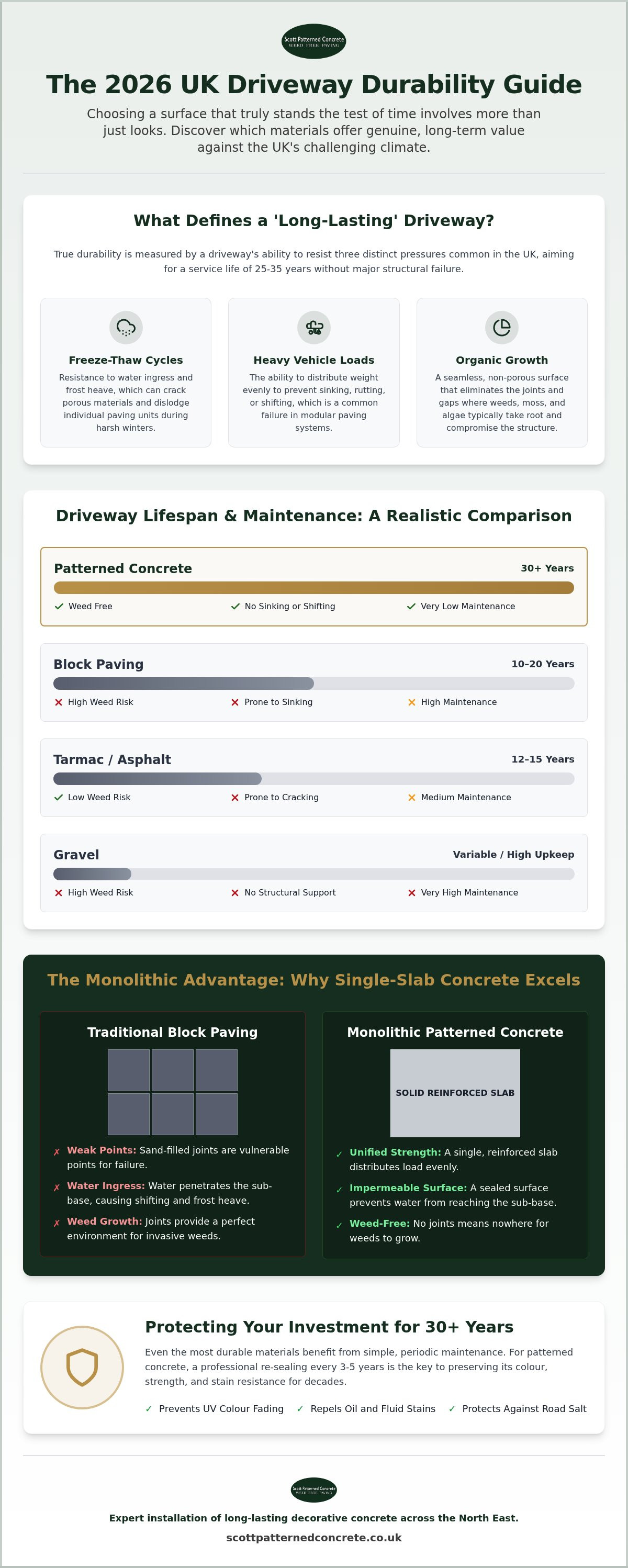
When we talk about long lasting driveway materials, we aren't just discussing how long the surface stays the right shade of charcoal or slate. True durability in the UK is measured by a driveway's ability to withstand three distinct pressures: relentless freeze-thaw cycles, the weight of heavy modern vehicles, and the persistent threat of invasive organic growth. A high-specification installation should offer a service life of 25 to 35 years without requiring structural intervention. To achieve this, you have to distinguish between "surface life", which is the aesthetic finish, and "structural life", which is the load-bearing integrity of the foundation. While many driveway materials look excellent for the first twelve months, structural failures often begin to appear shortly after the first hard winter if the underlying engineering is flawed.
At Scott Patterned Concrete, our 35 years of experience has shown that monolithic structures are vastly superior to individual paving units. By creating a single, reinforced slab for our concrete driveways, we eliminate the joints where weeds take root and where water can seep into the sub-base. This unified bond ensures that heavy vehicle loads are distributed evenly across the entire surface. It prevents the individual dips, shifting, and "puddling" that frequently plague traditional block paving installations over time.
The Role of the Sub-Base in Driveway Longevity
It's a trade secret that 90% of driveway failures actually happen below the surface. Longevity starts with expert excavation and the correct application of a Type 1 MOT sub-base. We ensure this layer is compacted to the highest standards, creating a stable platform that won't shift as the soil beneath it reacts to moisture changes. Without professional drainage planning to divert water away from this foundation, even the toughest surface material will eventually succumb to erosion and ground movement. A solid foundation is the silent partner in any driveway that claims to last for decades.
Weather Resistance and the UK Climate
British winters are notoriously harsh on porous surfaces. When rainwater enters small gaps and then freezes, it expands, causing "heave" that can crack tarmac or dislodge paving stones. We utilise specific concrete additives and UV-stable pigments to ensure our printed concrete remains non-porous and vibrant. By sealing the surface, we protect against the bleaching effects of the sun and the corrosive impact of road salt. This ensures the material remains structurally sound and visually striking regardless of the challenging UK weather conditions.
Comparing the Lifespan of Popular UK Driveway Surfaces
Selecting a new surface for your home involves a careful balance between initial cost and future durability. Whilst many homeowners are tempted by the lower entry price of tarmac or gravel, these options rarely qualify as the most long lasting driveway materials when you calculate the cost per year of service. Tarmac and asphalt are undeniably cost-effective at the point of installation, but they are prone to oxidation and softening during summer heatwaves. Over a 12 to 15 year period, this often results in surface "ravelling" or significant cracking that requires a full resurfacing. Gravel provides a classic look but offers virtually no structural support, requiring frequent replenishment and constant raking to manage the displacement caused by heavy vehicle tyres.
Block paving remains a staple of UK driveways, accounting for roughly 40% of the market. Whilst visually appealing, its lifespan is entirely dependent on the integrity of the sand-filled joints. Once these joints are compromised by wind-blown seeds or power washing, weeds take root and the individual blocks begin to shift. In contrast, long lasting driveway materials like reinforced printed concrete are widely considered the gold standard. When installed correctly, a single-slab concrete structure can comfortably exceed 30 years of service. It provides a permanent, weed-free solution that maintains its structural profile without the need for constant intervention.
Maintenance Requirements vs. Total Lifespan
The hidden cost of "cheaper" materials often reveals itself in the labour required to keep them functional. Block paving requires regular re-sanding and chemical weed treatments to prevent the sub-base from becoming waterlogged. We also see many homeowners across the North East struggling with resin-bound surfaces that have suffered from "reflective cracking". This happens when the underlying base moves, telegraphing cracks directly through the decorative resin layer. By opting for a single-pour concrete slab, you eliminate the joints entirely, removing the primary point of failure found in almost every other driveway system.
Load Bearing Capacities for Modern Multi-Vehicle Homes
Our 35 years of experience in the industry has coincided with a significant increase in vehicle weights. Modern Electric Vehicles (EVs) are considerably heavier than their petrol counterparts due to their battery packs, putting immense pressure on flexible paving systems. If you're parking heavy SUVs or multiple cars on a driveway, you need a material with high compression strength that won't "rut" or "groove" under stationary wheel loads. Reinforced concrete provides the rigidity needed to support these weights without the surface deformation common in tarmac or poorly laid paving. If you're unsure which material suits your specific property, we're always happy to offer expert advice on the best route forward for your project.
The Structural Superiority of Patterned and Imprinted Concrete
Imprinted concrete represents a significant leap forward for homeowners seeking long lasting driveway materials that require minimal intervention. Unlike traditional block paving, which relies on the friction between hundreds of individual units, this method creates a solid, reinforced slab that distributes vehicle weight evenly across the entire sub-base. This monolithic bond is the secret to preventing the "rutting" or localized sinking often seen where car tyres rest overnight. By eliminating the sand-filled joints found in other systems, we provide a surface that is naturally resistant to the structural shifts caused by heavy modern vehicles.
One of the most immediate benefits of this single-slab approach is the complete elimination of weed growth and moss. Seeds simply cannot take root because there are no gaps or soil-filled crevices to exploit. This isn't just an aesthetic advantage; it's a structural one. In traditional paving, root systems can eventually displace blocks and compromise the foundation, but a patterned concrete surface remains an impenetrable barrier. To ensure maximum tensile strength, we utilize advanced fibre-reinforced mixes that are specifically engineered to reduce drying shrinkage and enhance the overall toughness of the installation. You can explore a variety of textures and finishes in our printed concrete north east guide to see how this durability translates into high-end design.
Crack Control and Engineering Excellence
A common misconception is that concrete will always crack unpredictably. Whilst all concrete moves as it cures and reacts to temperature, we use our 35 years of experience to "organise" that movement through the strategic placement of expansion joints. These stress-relief cuts act as planned breaking points, ensuring that any microscopic movement happens where we want it to, rather than across the middle of a decorative pattern. Correct placement of these joints requires a deep understanding of site-specific geometry and ground conditions. For those who want to dive into the technicalities of how we achieve this balance, read our guide on patterned concrete for deeper technical insights.
Aesthetic Longevity: Colours That Don't Fade
The visual appeal of your driveway shouldn't be a temporary feature. We achieve permanent results by integrating colour-hardener powders into the wet concrete during the installation process. This creates an "integral" finish that is far more durable than surface-level paints or stains which can peel or flake over time. These pigments are UV-stable, meaning they won't bleach under the sun, even in south-facing North Yorkshire properties. By applying high-solids sealants every three to five years, you can maintain that "just installed" depth of colour whilst protecting the concrete from oil spills and road salts for decades to come.
Stonecrete and Exposed Aggregate: The Ultimate Premium Finish
Whilst patterned concrete offers incredible versatility in design, Stonecrete represents the pinnacle of performance for those seeking the most long lasting driveway materials available in 2026. This system combines the natural, tactile beauty of river shingle or crushed granite with the structural permanence of a reinforced concrete slab. It's an ideal choice for property owners who want a high-end, textured look without the maintenance pitfalls of loose materials. Because the aggregate is physically embedded into the wet concrete, it creates a highly slip-resistant surface. This makes it particularly effective for steep driveways in North Yorkshire or multi-use outdoor spaces where safety is as important as style. You can explore the full range of textures available through our Stonecrete services for a premium driveway upgrade.
The growing preference for this material isn't just about durability; it's about a shift towards sophisticated, architectural finishes. Recent industry trends suggest that Stonecrete is a luxury driveway finish in the UK that is rapidly becoming the standard for high-value renovations. It provides a timeless aesthetic that complements both modern developments and period homes across the North East whilst offering a lifespan that frequently exceeds three decades.
Why Stonecrete Outperforms Resin and Gravel
Many homeowners consider resin-bound systems for their seamless look, but these often suffer from peeling or delamination if the bond between the resin and the base fails. Stonecrete avoids this entirely because the stones aren't glued on top; they are an integral part of the concrete mix itself. Similarly, it solves the constant headache of gravel migration. With gravel, stones inevitably end up in the street, on your lawn, or inside your hallway. With Stonecrete, those same beautiful stones are locked permanently in place. Achieving this requires a "Master Craftsman" approach. We must time the exposure of the aggregate perfectly during the curing process, using specialised techniques to reveal the stone without compromising the strength of the slab.
Durability for Commercial and High-Traffic Applications
The extreme wear resistance of this material is why it's the preferred choice for high-traffic environments like theme parks, retail centres, and public walkways. These spaces face thousands of footfalls and heavy maintenance vehicles daily, yet they maintain their integrity for years. By applying these same commercial concrete solutions to a domestic setting, you're investing in a specification that far exceeds standard residential requirements. The long-term ROI is clear: you avoid the 10-year replacement cycle of tarmac or the annual weeding of block paving, resulting in a driveway that remains pristine for 30 years or more.
Protecting Your Investment: Maintenance for a 30-Year Driveway
Whilst choosing long lasting driveway materials is the most critical step in ensuring a permanent entrance, the longevity of your investment also relies on a proactive care programme. A well-constructed concrete driveway is remarkably low maintenance, but it isn't "no maintenance". Regular cleaning is the simplest way to preserve the surface finish; removing organic debris like damp leaves or mud prevents natural tannins from causing stubborn surface staining. We recommend a gentle wash with a garden hose or a low-pressure power wash once or twice a year to keep the texture clear of grit and grime.
During the winter months, avoid using harsh rock salt or corrosive chemical de-icers. These substances can eventually penetrate the surface and cause localised pitting or scaling. Instead, use plain sand for traction or specific concrete-safe de-icing products. A quick professional inspection every few years allows a specialist to check expansion joints and surface integrity, catching minor issues before they require structural intervention. This "Master Craftsman" approach to preventative care ensures that your driveway remains as stable and beautiful as the day it was poured.
The Importance of Resealing
The most vital part of your maintenance schedule is the 3-5 year sealing cycle. Think of the sealant as a sacrificial layer that takes the brunt of UV radiation, oil spills, and weather abrasion to protect the underlying colour and texture. You can choose between matt, silk, or gloss finishes depending on your personal aesthetic goals. Whilst DIY kits are widely available, they often lack the high-solids content of industrial-grade sealants. Professional application using industrial sprayers ensures an even, deep-penetrating coat that won't flake or turn cloudy, which is a common failure in amateur projects.
Future-Proofing Your Home's Kerb Appeal
A pristine, weed-free driveway does more than just function well; it adds significant tangible value to your property. Industry data indicates that a high-quality driveway can increase a home's value by up to 10%. The psychological impact on potential buyers is immediate. A clean entrance suggests the entire property has been cared for with the same level of detail. By following these simple steps, you ensure your front entrance remains a point of pride rather than a source of stress for decades to come.
Investing in a Decades-Long Entrance for Your Home
Choosing the right long lasting driveway materials is the most important decision you'll make for your property's kerb appeal and structural integrity. As we've explored, the secret to a 30-year lifespan lies in the monolithic bond of reinforced concrete and Stonecrete, which eliminates the sinking and weed growth common in traditional paving. By prioritising a single-slab structure and a professional sealing routine, you can ensure your investment remains as vibrant and stable as the day it was installed.
At Scott Patterned Concrete, we bring over 35 years of family-run expertise to every project. We specialise in Stonecrete aggregate and commercial-grade durability, ensuring that even domestic driveways meet the highest industrial standards. Whether you're in Stockton-on-Tees or North Yorkshire, our team is ready to help you create a beautiful, permanent space that stands the test of time. Request a free expert consultation and quotation for your new driveway.
We look forward to helping you transform your property with a surface built to last for generations.
Frequently Asked Questions
Which driveway material lasts the longest in the UK?
Natural stone and high-specification reinforced concrete are widely considered the most long lasting driveway materials available in the UK. Whilst natural stone can endure for over 60 years, it often requires significant maintenance of the joints to prevent structural failure. A monolithic concrete slab provides a similar multi-decade lifespan but with the added benefit of being completely weed-free. Choosing a material that resists our specific freeze-thaw cycles is essential for reaching these longevity milestones.
Is concrete more durable than block paving?
Concrete offers superior structural durability compared to block paving because it forms a single, reinforced slab. In block paving installations, individual units can shift, sink, or become loose as the sand-filled joints erode over time. This leads to uneven surfaces and unsightly puddling. A concrete driveway distributes vehicle weight across the entire sub-base, preventing the localised pressure points that often cause block paving to fail after a decade of heavy use.
How often should I seal my patterned concrete driveway to make it last?
You should aim to reseal your patterned concrete driveway every three to five years to maintain its protection and appearance. This sacrificial layer prevents water ingress and protects the integral colour from UV fading. Regular sealing also makes the surface resistant to oil stains and road salts. If you notice the surface looking dull or water no longer beading on the top, it's likely time for a professional reseal to safeguard the concrete structure.
What is the best material for a driveway with a steep slope?
Stonecrete, or exposed aggregate concrete, is the ideal choice for steep driveways due to its naturally high slip resistance. The process of revealing the internal stones during the cure creates a textured surface that provides excellent tyre traction in wet or icy conditions. Unlike smooth tarmac or resin-bound surfaces that can become slippery, the physical grip of Stonecrete ensures safety for both vehicles and pedestrians on challenging gradients without sacrificing any aesthetic appeal.
Can weeds grow through an imprinted concrete driveway?
Weeds cannot grow through a professionally installed imprinted concrete driveway because it is a solid, continuous slab. Unlike block paving or gravel, there are no sand-filled joints or loose areas where seeds can germinate. Whilst some surface moss might occasionally appear in shaded areas if debris is left to sit, it cannot take root within the structure itself. A simple wash is usually enough to keep the surface completely clear and maintenance-free.
How long does a Stonecrete driveway typically last?
A Stonecrete driveway typically lasts 30 years or more when installed with a correct sub-base and appropriate reinforcement. Because the decorative stones are an integral part of the concrete mix rather than a surface coating, they won't peel or delaminate. This commercial-grade durability makes it one of the most reliable long lasting driveway materials for residential properties, providing a permanent finish that withstands heavy multi-vehicle use throughout its entire service life.
Does a concrete driveway crack in the winter?
Concrete is designed to handle temperature fluctuations, provided that expansion joints are correctly placed to organise the movement. These joints act as planned stress-relief points that prevent random, unsightly cracks from forming during hard frosts. When installed by specialists with over 35 years of experience, a driveway is engineered to expand and contract safely. We also use specific additives in our mix to enhance frost resistance and overall slab toughness.
Is a long-lasting driveway material worth the extra initial cost?
Investing in a premium, long-lasting material offers significantly better value over time when you consider the total cost of ownership. Whilst materials like tarmac or gravel are cheaper initially, they often require replacement or major repairs every 12 years. By choosing a 30-year solution like patterned concrete or Stonecrete, you avoid these recurring costs and the labour-intensive maintenance of weeding and re-sanding, whilst also adding permanent value to your home.