Skip to content
Imprinted Concrete vs Tarmac: Which Driveway Surface is Best for 2026?
- by Scott Patterned Concrete
Choosing a new driveway is often a once-in-a-generation decision, yet many homeowners find themselves back at square one after just a few years because they prioritised a low initial price over structural integrity. When weighing up imprinted concrete vs tarmac, it's easy to focus solely on the immediate quote, but the real value lies in how that surface performs through biting UK winters and record-breaking summer heatwaves. If you're tired of battling stubborn weed growth in cracks or watching your driveway lose its shape under the weight of your car, understanding the fundamental differences between these materials is essential.
We understand that you want a home you can be proud of; one that offers a warm welcome without demanding constant maintenance or repairs. This guide provides a definitive comparison to help you choose the most durable and stylish surface for your property in 2026. We will explore the structural lifespans, aesthetic options, and the impact of the latest SUDS drainage regulations. By the end, you'll have the expert insight needed to invest in a driveway that stays weed-free and maintains its kerb appeal for thirty years or more.
Key Takeaways
- Learn why imprinted concrete offers a structural lifespan of up to 40 years, significantly outperforming the 12-15 years typically expected from traditional tarmac.
- Discover how a solid, fibre-reinforced concrete slab provides a permanent, weed-free barrier that eliminates the constant maintenance required by porous surfaces.
- Explore 2026 design trends like charcoal and neutral earth tones that transform a functional driveway into a high-value architectural feature.
- Analyse the long-term investment value of imprinted concrete vs tarmac to understand why the "premium" option often saves you money over two decades.
- Understand the latest SUDS regulations to ensure your new driveway project is fully compliant with 2026 UK flood management laws.
Understanding the Basics: Imprinted Concrete and Tarmac Compared
When you start planning a significant home improvement project, the technical jargon can quickly become overwhelming. The choice of imprinted concrete vs tarmac isn't merely a matter of choosing between grey and black; it's a decision between two entirely different engineering philosophies. One represents a rigid, structural investment, while the other provides a flexible, layered surfacing solution. Understanding how these materials are composed and installed is the first step in ensuring your project delivers long-term peace of mind.
What is Imprinted Concrete?
Often referred to as pattern imprinted concrete, this material is a high-strength, fibre-reinforced concrete slab. Unlike traditional paving which consists of individual units or layers, this is a single, monolithic structure poured across your entire driveway area. Our approach involves a meticulous "Master Craftsman" process where we apply a specialised surface colour hardener and a release agent to create visual depth. Whilst the concrete is still pliable, we stamp it with textured mats to mimic natural stone, slate, or cobbles. The inclusion of synthetic fibres throughout the mix is vital; it ensures the slab remains structurally sound and resists the heavy loads of modern family vehicles without the risk of individual sections shifting or sinking over time.
What is Tarmacadam?
Asphalt concrete (Tarmac) is a combination of crushed stone and a bitumen binding agent, typically laid whilst hot and compacted with a heavy roller to create a smooth finish. It has been a staple of UK infrastructure for decades, primarily used for public highways and large-scale commercial car parks because it's relatively quick to install over vast areas. However, it remains a "flexible" pavement. This means it relies heavily on the integrity of the sub-base beneath it and can be prone to softening or indenting during particularly warm British summers. Customisation is also quite limited; you are generally restricted to standard black or red finishes, which lack the bespoke architectural detail found in decorative concrete solutions.
Considering the diverse and often challenging weather conditions driveways must withstand across the country, from coastal winds to freezing winter temperatures, the architectural difference is clear. Tarmac is often selected for its lower initial cost on very large industrial spaces. Conversely, imprinted concrete is the preferred choice for homeowners who view their driveway as a permanent, architectural feature that should enhance their property's value for thirty years or more. By choosing a monolithic slab, you eliminate the structural vulnerabilities that often lead to the crumbling edges and surface "ravelling" seen in older tarmac installations.
Visual Appeal and Customisation: Creating a First Impression
Your driveway is the face of your home; it's the first thing visitors see and a major factor in your property's overall market value. In the ongoing comparison of imprinted concrete vs tarmac, aesthetic versatility is where the two materials diverge most sharply. Tarmac provides a clean, uniform finish that works well for functional, high-traffic areas, but it often carries an industrial or municipal feel that can lack warmth. Decorative concrete, however, serves as an architectural canvas, allowing you to tailor the entrance of your home to suit its specific character and era.
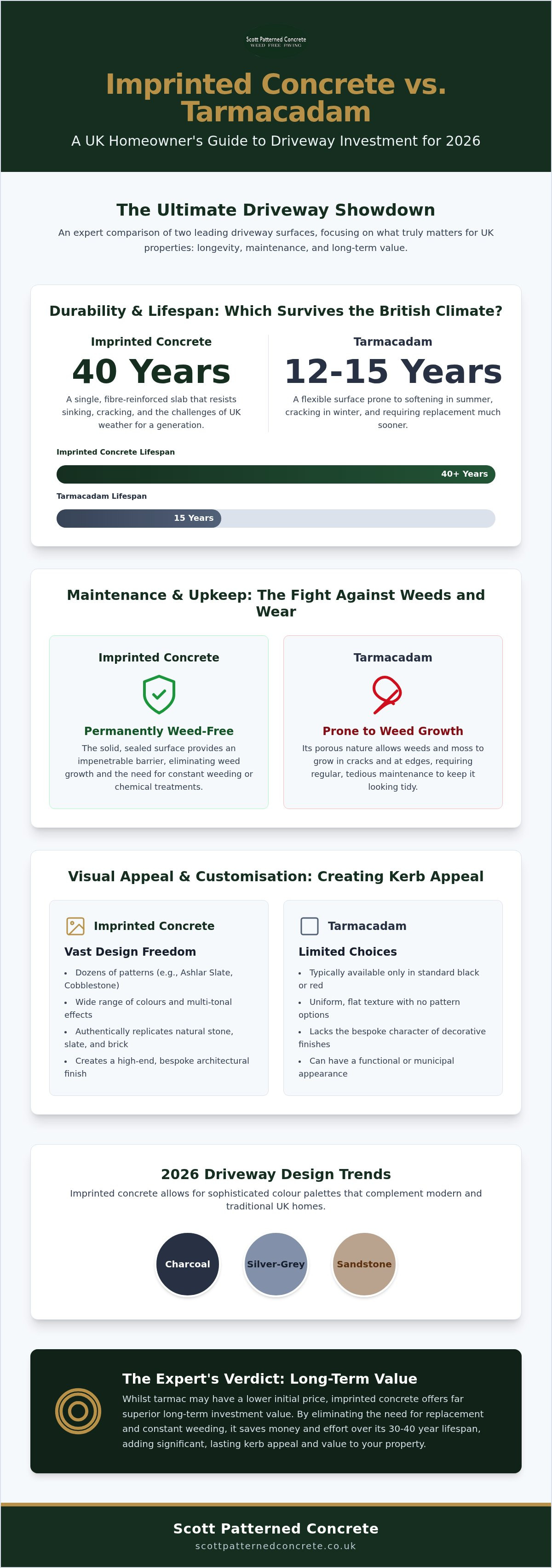
For 2026, we are seeing a significant shift in homeowner preferences. While traditional black tarmac remains a staple for larger commercial projects, residential clients are increasingly opting for sophisticated palettes of charcoal, silver-grey, and soft sandstone. These earth tones feel more integrated with the natural UK landscape and modern garden designs. By choosing a material that can be precisely coloured, you ensure the driveway complements your brickwork rather than clashing with it.
Bespoke Patterns and Colours
We use a specialised "Master Craftsman" process to achieve multi-tonal effects that replicate the authentic character of natural stone. Some of the most sought-after choices include bespoke imprinted concrete patterns such as Ashlar Slate, London Cobble, and Herringbone Brick. By applying a primary colour hardener followed by a contrasting release agent, we create realistic shadows and highlights within the stamped texture. This meticulous layering ensures your surface mimics expensive York stone or slate with remarkable accuracy, providing a premium look without the premium price tag of individual flagstones.
Design Flexibility for Modern Homes
One of the most significant advantages of a poured concrete slab is the ability to create fluid, organic shapes. Unlike tarmac, which typically requires a separate block-paving border to appear "finished", imprinted concrete can be formed into sweeping curves and intricate features as a single, seamless piece. This versatility allows it to transition perfectly into matching concrete patios, creating a unified aesthetic across your entire property. While a pavement durability study highlights how surface texture influences long-term wear, our decorative finishes are engineered to maintain their visual integrity even under heavy daily use. If you're looking for inspiration on how to blend these patterns with your existing landscaping, you can request a design consultation with our experienced team.
Durability and Lifespan: Which Surface Survives the British Climate?
The longevity of your driveway depends on its ability to withstand the relentless British freeze-thaw cycle. When comparing imprinted concrete vs tarmac, the difference in expected lifespan is stark. A professionally installed tarmac surface typically lasts between 12 and 15 years before the bitumen binder begins to fail. In contrast, a fibre-reinforced concrete slab is engineered as a 30 to 40-year investment. This durability isn't just about the surface; it's about the structural integrity of a monolithic slab that remains stable whilst other materials begin to crumble.
One often overlooked issue with tarmac is its reaction to summer temperatures. Because bitumen is a flexible binder, it can soften significantly in direct sunlight, leading to "rutting" where heavy vehicle tyres leave permanent indentations. Concrete doesn't suffer from this thermal softening. It maintains its rigid profile regardless of the thermometer, ensuring your driveway looks as flat and professional in July as it did in January.
Resistance to the Elements
UV rays act as a slow catalyst for tarmac degradation, stripping away the oils that keep the surface flexible and causing it to become brittle and grey. This brittleness eventually leads to surface cracks where water can penetrate and expand during frosts. Our patterned concrete installations include strategically placed expansion joints to manage natural thermal movement, preventing the uncontrolled cracking that plagues inferior surfaces. For property owners seeking the absolute pinnacle of wear-resistance, our Stonecrete surfaces offer even higher durability by incorporating exposed aggregates within the high-strength mix.
Structural Load and Sinking
Tarmac is a "flexible" pavement, which means it essentially follows the contours of the ground beneath it. If the sub-base settles even slightly, the tarmac will dip, creating "bird baths" or stagnant puddles that accelerate surface wear and look unsightly. A standard residential driveway requires a fibre-reinforced concrete slab between 100mm and 150mm thick to provide a structural load capacity that prevents sinking under heavy SUVs. This thickness allows the concrete to bridge minor voids in the sub-base that would cause tarmac to fail. By distributing the weight of your vehicle across the entire slab, we ensure your driveway remains perfectly level for decades, preventing the sinking common with traditional surfacing methods.
Maintenance and Long-Term Care: The Fight Against Weeds and Wear
The true cost of a driveway isn't found in the initial installation quote; it's hidden in the hours you'll spend maintaining it over the next decade. When comparing imprinted concrete vs tarmac, the maintenance requirements represent two very different lifestyles. Tarmac demands constant vigilance against moss and weeds that inevitably find purchase in its textured surface. Conversely, a high-quality decorative concrete surface offers a "sweep and go" experience that keeps your home's exterior looking pristine with minimal effort.
Repairing these surfaces also presents a significant contrast. If a tarmac driveway suffers a fuel spill or a deep gouge, the resulting repair is almost always visible. Bitumen is notoriously difficult to "blend" once it has aged, leaving homeowners with unsightly black patches that ruin the uniform look of the drive. Because imprinted concrete is a single, solid slab, it doesn't suffer from the same structural crumbling. If surface wear does occur after many years, a professional reseal can often restore the entire area to its original vibrancy without leaving a trace of the work.
The Myth of the Weed-Free Driveway
Many people assume that any solid surface will stop weeds, but tarmac is naturally porous. Over time, dust and organic matter settle into the small voids on the surface, creating a perfect seedbed for weeds and moss to take root. You can read more about this in our weed-free driveway options guide. Imprinted concrete solves this by creating a totally impenetrable barrier. The acrylic sealer we apply also acts as a protective shield against oil and petrol stains, which would otherwise soak into tarmac and cause the bitumen to dissolve.
Slip Resistance and Safety
A common concern amongst homeowners is whether a decorative finish becomes slippery when wet. We address this by incorporating specialist anti-slip additives into the final sealing coat, providing a "sandpaper" grip that remains invisible to the eye but highly effective underfoot. This makes the surface arguably safer than aged tarmac, which can become slick with moss growth in shaded areas. Ensuring your project has patterned concrete driveway drainage is also essential for preventing standing water and ice. To maintain this protection, we simply recommend a professional wash and reseal every three to five years.
Request a maintenance quote for your driveway
Making the Final Decision: Investment Value for UK Property Owners
When you reach the final stage of planning your project, the debate between imprinted concrete vs tarmac usually settles on one question: are you looking for a quick fix or a lifetime solution? Tarmac is often chosen for its rapid installation programme; it can typically be laid and driven upon within forty-eight hours. However, for UK property owners who intend to stay in their homes for a decade or more, the premium nature of decorative concrete offers a far more compelling financial narrative. It's an investment in your home's structural future rather than just a temporary surface layer.
Cost vs. Value Analysis
Whilst tarmac has a lower initial installation cost, its total cost of ownership over twenty-five years is often significantly higher. Because tarmac typically requires replacement or major restorative work every twelve to fifteen years, you'll likely pay for the same driveway twice in the time a single concrete slab remains pristine. There is also the "patchwork" problem to consider. When tarmac driveways inevitably crack or suffer from root damage, the resulting repairs leave visible scars that diminish your home's exterior appeal. At Scott Patterned Concrete, we provide free, no-obligation quotations to help you understand how this long-term durability offsets the initial expenditure.
Estate agents across the UK frequently categorise imprinted concrete as a premium feature that directly enhances a property's valuation. Unlike tarmac, which can feel industrial or dated, a well-chosen pattern adds a bespoke architectural character that makes your home stand out in a competitive market. The installation process is a genuine craft that takes slightly longer than tarmac, involving a methodical sequence of pouring, colouring, stamping, and sealing. This extra time on-site ensures every detail is perfect, from the precision of the borders to the depth of the multi-tonal finish.
Conclusion: The Master Craftsman’s Choice
Our final recommendation depends on your specific goals. Tarmac remains a functional choice for massive commercial areas or short-term budget fixes, but for a residential home where quality and kerb appeal are priorities, imprinted concrete is the clear winner. It provides a structural, weed-free, and aesthetically superior surface that won't soften in the sun or sink under the weight of your car. With over 35 years of industry experience, our family-run team takes personal responsibility for ensuring your new driveway becomes a permanent asset to your property.
If you're ready to transform your home with a surface that lasts a lifetime, we are here to help. Contact our specialists today for a professional consultation and discover the perfect decorative finish for your project.
Secure Your Home’s Kerb Appeal for Decades
Choosing between imprinted concrete vs tarmac is ultimately a choice between a temporary surface and a permanent architectural investment. Whilst tarmac offers a functional, low-cost entry point, it simply cannot match the structural integrity of a fibre-reinforced concrete slab. By opting for a decorative finish, you eliminate the perennial battle against weeds and the unsightly sinking that often plagues bitumen surfaces after a decade of British weather. Whether you prefer the timeless look of London Cobble or the modern elegance of Stonecrete, your choice should reflect the long-term value you wish to add to your property.
As a family-run business with over 35 years of specialist experience, we take immense pride in delivering craftsmanship that stands the test of time. Our expert installers are dedicated to providing a high-quality, reliable service that transforms your driveway into a stunning feature. We focus on the finer details to ensure your project provides peace of mind and lasting pride in your home's exterior.
We look forward to helping you create a beautiful, maintenance-free entrance that you can be proud of for thirty years or more.
Frequently Asked Questions
Is imprinted concrete more expensive than tarmac?
Yes, imprinted concrete typically requires a higher initial investment than tarmac. This cost reflects the intensive labour and high-grade materials needed to create a structural, fibre-reinforced slab. Whilst tarmac is cheaper to lay, it often requires replacement in half the time. Investing in the more premium surface provides better long-term value because you won't face the recurring costs of resurfacing every twelve years.
Does imprinted concrete crack more easily than tarmac?
No, professionally installed concrete doesn't crack more easily if expansion joints are used correctly. Whilst tarmac is flexible, it becomes brittle under UV exposure and eventually splits. We incorporate hidden control joints in our slabs to manage thermal movement safely. This engineering prevents the uncontrolled cracking that homeowners often fear, ensuring the surface remains stable through harsh UK winters and hot summers.
Can you lay imprinted concrete over an existing tarmac driveway?
No, you cannot lay a new concrete slab directly over old tarmac. A successful installation requires a fully compacted sub-base of MOT Type 1 stone to ensure structural stability. Laying over old tarmac would compromise the thickness and integrity of the concrete, likely leading to premature failure. We always recommend a full excavation to provide the 100mm to 150mm depth necessary for a long-lasting driveway.
How long does it take to install an imprinted concrete driveway compared to tarmac?
Tarmac is generally faster to install, often completed in just two to three days. An imprinted concrete driveway typically takes five to seven days depending on the weather. This longer timeline is necessary for the concrete to reach the correct pliable state for stamping and to allow for the curing process before the final sealer is applied. It's a process that prioritises craftsmanship and durability over speed.
Is tarmac or imprinted concrete better for steep driveways?
Both materials can work well on inclines, but they require different approaches. Tarmac has a naturally coarse texture that provides good traction. For concrete, we incorporate specialist anti-slip additives into the final sealer to ensure the surface remains safe in wet or icy conditions. When comparing imprinted concrete vs tarmac for steep drives, the decision often comes down to the required drainage and the desired aesthetic finish.
Why do weeds grow through tarmac but not imprinted concrete?
Weeds grow through tarmac because it is a porous material with tiny surface voids where seeds can settle. Over time, organic matter builds up in these gaps, allowing roots to take hold and eventually break the surface. Imprinted concrete is a solid, monolithic slab with an acrylic seal. There are no gaps or voids for seeds to enter, making it a truly weed-free solution for your property.
How often does an imprinted concrete driveway need resealing?
You should aim to reseal your driveway every three to five years. This maintenance step is straightforward and involves a professional wash followed by a fresh coat of high-grade acrylic sealer. This process protects the colour from UV fading and ensures the surface remains resistant to oil stains. Regular resealing is the key to maintaining the "as-new" look of your decorative surface for thirty years or more.
Which surface adds more value to my home?
Imprinted concrete generally adds more value to a UK home than a standard tarmac drive. Estate agents often view decorative concrete as a premium feature that enhances kerb appeal and suggests a well-maintained property. Whilst tarmac is functional, it can look industrial. A bespoke patterned surface creates a high-end architectural look that can make your home more attractive to potential buyers in the future.