Skip to content
Patterned Concrete vs Block Paving: The Ultimate 2026 Comparison Guide
- by Scott Patterned Concrete
Why do so many homeowners spend thousands on a new driveway only to find themselves kneeling on the ground pulling weeds just twelve months later? It's a common sight across the UK; beautiful homes let down by sinking blocks or moss-filled joints that require constant, back-breaking attention. When you're weighing up patterned concrete vs block paving, you aren't just picking a colour or a pattern. You're deciding how much of your future weekends you want to spend with a pressure washer and a bag of kiln-dried sand.
We understand that a driveway is a significant investment, and you deserve a surface that remains stable and pristine without the headache of annual repairs. It's frustrating when a surface that should last decades begins to dip or sprout vegetation within the first few seasons. This guide shares the definitive pros and cons of both materials to help you choose the most durable, weed-free solution for your property. We'll explore the structural integrity of a solid concrete slab compared to the modular nature of individual paving stones. By the end, you'll have the expert insight needed to select a surface that enhances your property value and stays perfectly level for years to come.
Key Takeaways
- Learn why a monolithic, fibre-reinforced slab provides superior structural integrity compared to modular paving systems that often shift under heavy vehicle loads.
- Discover how choosing a solid surface eliminates the constant maintenance of weeding and re-sanding thousands of paving joints.
- Compare the long-term durability of patterned concrete vs block paving and see which material offers the best resistance to sinking and dipping.
- Understand the 2026 SuDS compliance requirements and why integrated drainage is essential for any non-permeable driveway project.
- See how modern UV-stable sealants protect your driveway's appearance from oil spills and weather-related fading for years to come.
Understanding the Fundamental Differences: Patterned Concrete vs Block Paving
Choosing between patterned concrete vs block paving isn't just about aesthetics; it's a choice between two entirely different engineering philosophies. From our perspective as specialists with 35 years in the trade, we see it as a decision between a single, unified structure and a collection of thousands of individual parts. This fundamental distinction dictates how your driveway will behave under the weight of a family car and how it will stand up to the unpredictable British weather over the next decade. Your choice impacts your home's kerb appeal significantly. A monolithic slab offers a clean, architectural finish that maintains its original lines, whilst a modular surface is only as strong as its weakest joint.
The Anatomy of a Patterned Concrete Surface
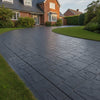
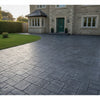
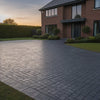
Patterned concrete is a monolithic structure, meaning it's poured as one continuous, fibre-reinforced slab. We typically install this at a depth of 100mm to 150mm to ensure it can handle heavy vehicle loads without flinching. During the installation, we apply specialist colour hardeners that bond with the wet concrete, creating a surface that's far harder and more wear-resistant than standard concrete mixes. Whilst the surface is still workable, our team uses professional imprinting mats to stamp deep, realistic textures into the material. You can explore the various styles available in our printed concrete guide. Because the finished result is a solid barrier, there are no gaps for weeds to penetrate, and the entire surface distributes weight evenly across the sub-base.
The Composition of Traditional Block Paving
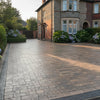
Traditional block paving is a modular system that relies on individual bricks laid in a specific pattern. The installation involves a multi-layered approach: a compacted sub-base is topped with a layer of sharp sand, which acts as the bedding for the blocks. These bricks are then locked into place using kiln-dried sand that's brushed into the joints to create friction. This friction-locking is what gives the driveway its strength, but it's inherently a flexible surface. To stop the blocks from spreading or shifting outwards over time, we must install robust edge restraints around the perimeter. Whilst this provides a classic look, the thousands of joints between the blocks represent thousands of potential entry points for moss and weeds, and the reliance on sand means the surface can be prone to minor movements if the jointing material isn't maintained.
Structural Integrity and Longevity: Which Surface Lasts Longer?
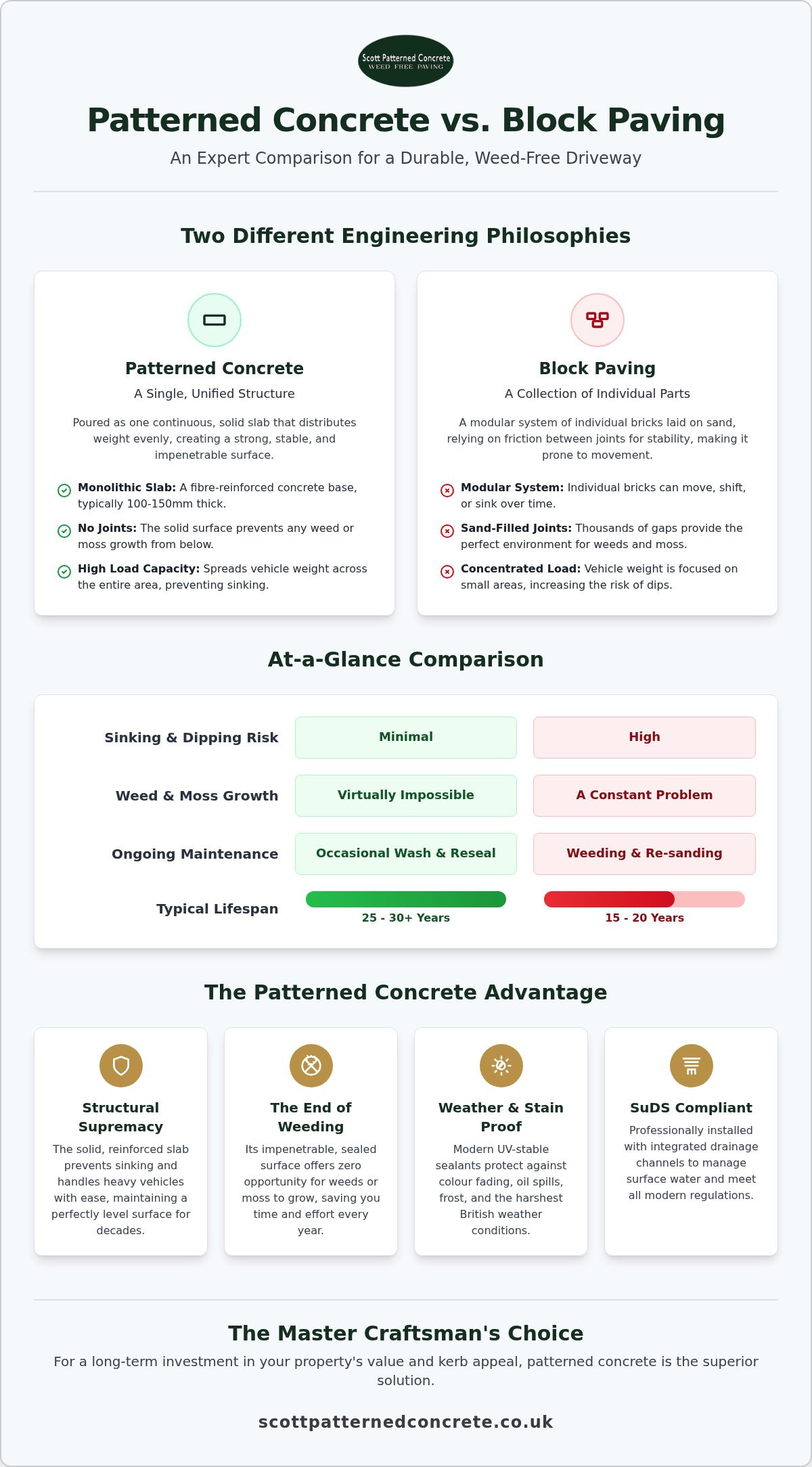
When comparing patterned concrete vs block paving, the real test isn't how the driveway looks on day one; it's how it stands up to two tonnes of metal parked on it daily. Structural integrity is where the two materials diverge most sharply. A professional installation of our concrete driveways involves a reinforced, monolithic slab between 100mm and 150mm thick. This single, unified structure acts as a massive bridge, distributing weight across the entire footprint of the driveway. In contrast, block paving is modular. It relies on the friction between individual bricks to stay in place, meaning the load is often concentrated on a much smaller area.
| Feature | Patterned Concrete | Block Paving |
|---|---|---|
| Load Capacity | High (Reinforced Monolithic Slab) | Moderate (Modular Friction) |
| Sinking Risk | Minimal (Solid Structural Base) | High (Individual Unit Movement) |
| Lifespan | 25 to 30+ Years | 15 to 20 Years |
The "Master Craftsman" secret to longevity lies in managing the natural movement of the earth. We use strategic expansion joints, placed at precise intervals, to allow the concrete to breathe without losing its structural form. This level of technical planning ensures the driveway remains stable even as temperatures fluctuate. If you're concerned about the specific ground conditions at your property, it's always best to request a professional site assessment for peace of mind.
Why Patterned Concrete Prevents Sinking
Dips and puddles are the enemies of any homeowner. Because patterned concrete is a solid slab, it's physically impossible for one small section to "sink" independently of the rest. We've spent 35 years refining our sub-base preparation to ensure that once the concrete is poured, it stays exactly where it's meant to be. Block paving often fails when the sand bedding underneath is washed away or compressed, causing individual blocks to drop and create trip hazards. Our monolithic approach eliminates this vulnerability entirely.
The Myth of the Cracking Concrete Driveway
A common objection we hear is that concrete driveways are destined to crack. In reality, unsightly cracking is almost always a symptom of poor installation or a lack of reinforcement rather than a fault of the material itself. We prevent this by using high-grade fibre reinforcement and pre-planned crack control joints. Crack control joints are pre-planned weak points that direct movement invisibly. By guiding the concrete to move exactly where we want it to, we maintain the aesthetic beauty of the pattern whilst ensuring the driveway's core remains unbreakable.
Maintenance Realities: Solving the Weed and Sinking Issues
Maintenance is where the honeymoon phase of a new driveway often ends for many homeowners. When comparing patterned concrete vs block paving, the true cost of ownership becomes clear once the first growing season arrives. Block paving, whilst traditional, presents a significant long-term challenge: thousands of linear metres of sand-filled joints that act as perfect seedbeds for airborne weeds. It's a relentless cycle of weeding and cleaning that can quickly become a burden on your time and wallet.
Cleaning these two surfaces also requires a completely different approach. Power washing a block driveway often blasts out the essential kiln-dried sand, which directly weakens the structural friction-lock we established during installation. Conversely, we protect our concrete surfaces with high-performance, UV-stable sealants. These don't just keep the colour vibrant; they create a non-porous shield that prevents oil stains and tyre marks from penetrating the surface. You can explore the technical side of this in our guide to weed-free driveway options.
The End of Driveway Weeds
A common misconception is that weeds only grow from the soil beneath a driveway. In reality, most weeds sprout from seeds that land in the joints between blocks. Because imprinted concrete is a monolithic slab, it creates a solid, impenetrable barrier. Whilst moss or algae can occasionally sit on any damp surface in the UK, it cannot root into the concrete. On a solid surface, any organic growth is easily swept away, whereas weeds in block paving actually anchor themselves into the sand joints, making them notoriously difficult to remove without chemicals.
Resealing vs Resanding: The Long-Term Cost
Maintaining the integrity of your driveway requires a logical, proactive approach. Patterned concrete typically needs a fresh coat of sealant every three to five years to maintain its lustre and protection. This is a straightforward process that refreshes the entire look of the property. Block paving requires frequent resanding to replace material lost to wind, rain, and routine cleaning. By following a professional imprinted concrete maintenance routine, you can protect your investment for 30 years or more. This structured care often proves far more cost-effective than the relentless, manual upkeep required by modular paving systems.
Drainage, Planning Permission, and SuDS Compliance in 2026
The legal landscape for UK driveways has changed significantly over the last few years. When deciding between patterned concrete vs block paving, you must look beyond the surface finish and consider the Sustainable Drainage Systems (SuDS) regulations. These laws were designed to prevent urban flooding by ensuring that new driveways don't overwhelm the public sewer system. In 2025, over 15,000 enforcement notices were issued to UK homeowners for non-compliant installations. This is why we take a "straight-talking" approach to compliance; it's about protecting your property and your wallet from future legal headaches.
Whilst some competitors suggest that concrete is problematic because it's non-permeable, this is a narrow view. Patterned concrete is made fully compliant through professionally engineered patterned concrete driveway drainage. In contrast, permeable block paving allows water to soak through specific joints, but these can often clog with silt and organic debris over time, reducing their effectiveness. By integrating high-capacity drainage channels into a concrete install, we provide a more robust, long-term solution for managing heavy rainfall.
Managing Water Runoff Professionally
Poor drainage is the leading cause of driveway failure in our damp climate. We prevent this by calculating the precise "fall" or gradient of your driveway to ensure water naturally flows away from your home's foundations. We use industrial-grade Aco drains and deep-fill soakaways to capture and manage runoff within your property boundary. This methodical approach ensures that even during a summer downpour, your driveway remains clear of standing water, which preserves the structural integrity of the sub-base for decades.
Planning Permission: What Homeowners Need to Know
You generally don't need planning permission if your new driveway uses a permeable surface or if the water is directed to a lawn or soakaway. However, if the area is larger than five square metres and you plan to let the water run onto a public road, you'll need to submit a formal application. You should also remember that a separate permit is required under the Highways Act 1980 if you need to drop a kerb for access. Use this checklist to verify your project's compliance before work begins:
- Is the total area larger than five square metres?
- Does your design include integrated drainage channels or a soakaway?
- Will the water be managed entirely within your property boundary?
- Have you confirmed the status of your dropped kerb with the local highways department?
Conclusion: Why Patterned Concrete is the Master Craftsman’s Choice
When you strip away the marketing jargon and look at the raw engineering, the choice between patterned concrete vs block paving becomes clear. For the homeowner who values their time and the long-term stability of their property, the monolithic concrete slab is the definitive winner. Over our 35 years as a family-run specialist, we've seen countless modular driveways fail due to the inherent weaknesses of individual units shifting over time. Patterned concrete doesn't just offer a surface; it provides a structural foundation that remains weed-free and perfectly level for decades.
The value proposition goes beyond mere durability. Whilst the initial installation costs are often comparable to high-quality paving, the 20-year value of concrete is significantly higher. You aren't paying for constant re-sanding, professional weed treatments, or the eventual lift-and-relay costs that modular systems often require. You also have access to an incredible range of aesthetic finishes. From deep-textured slate to rustic timber effects, our bespoke imprinted concrete patterns guide showcases how we can tailor a design to complement any architectural style perfectly.
Ideal Applications for Patterned Concrete
This material is particularly effective for expansive driveways and concrete patios where the visual impact of a seamless, high-end finish is most apparent. It's also the preferred choice for commercial environments that demand a surface capable of withstanding heavy, repetitive traffic without shifting or dipping. If you want a "set and forget" finish that maintains its kerb appeal with minimal annual effort, this is the Master Craftsman's recommendation. It allows you to achieve the look of traditional materials like cobble or stone without any of the associated maintenance headaches.
Taking the Next Step with Your Driveway Project
Choosing a specialist over a general builder is the most important decision you'll make for your project. A generalist might understand the basics of a pour, but a dedicated expert understands the nuances of colour hardeners, expansion joints, and precision imprinting. We invite you to browse our project galleries to see the level of craftsmanship we bring to every home. Our team is here to provide the straight-talking, honest advice you need to make an informed decision about your property investment.
Transform Your Property with a Master Craftsman’s Finish
Choosing the right surface is a long-term commitment to your home's kerb appeal and your own peace of mind. When you weigh up patterned concrete vs block paving, the decision often comes down to how much maintenance you're willing to accept. A monolithic reinforced slab offers a stable, weed-free environment that modular bricks simply cannot match over time. Our expert family-run team has spent over 35 years refining these installations to ensure they withstand the UK climate whilst looking spectacular. As specialists in durable, decorative concrete, we prioritise structural longevity so you can enjoy a pristine driveway without the constant need for re-sanding or weeding. It's about investing in a surface that stays level and remains beautiful for decades. We're ready to help you transform your property with a solution built by master craftsmen who take personal pride in every project.
We look forward to helping you create a lasting first impression for your home with a surface you can be proud of for years to come.
Frequently Asked Questions
Is patterned concrete more expensive than block paving in the UK?
Initial installation costs for both materials are often quite similar, though the total value over twenty years usually favours concrete. When you compare patterned concrete vs block paving, you've got to consider the recurring expenses of weed treatments and joint repairs required for modular systems. Patterned concrete represents a one-time structural investment that requires only periodic resealing. This makes it a highly cost-effective choice for homeowners looking to avoid the hidden maintenance costs of traditional bricks.
Does patterned concrete crack more easily than blocks?
Cracking is not an inherent flaw of the material but typically a result of poor installation or inadequate sub-base preparation. When we install these driveways, we use fibre-reinforced concrete and strategic crack control joints to manage natural ground movement. Unlike blocks, which can shift and dip individually, a professionally engineered slab remains a single unified structure. This technical approach ensures that any thermal expansion is directed invisibly without compromising the driveway's beautiful aesthetic finish.
Can I change the colour of my patterned concrete driveway later?
You can certainly refresh or subtly adjust the appearance of your driveway when it comes time for routine maintenance. During the resealing process, we can use tinted sealants to deepen the existing tones or restore any colour that has faded due to UV exposure. Whilst you cannot change a dark charcoal to a light cream, these specialist tints allow for significant aesthetic rejuvenation. This flexibility ensures your property's exterior remains vibrant and well-maintained throughout its long lifespan.
How long does it take to install patterned concrete vs block paving?
Laying a solid concrete slab is often a faster process than manually placing thousands of individual paving bricks. A typical residential project can often be poured and imprinted in a single day after the ground is prepared. However, concrete requires a curing period before it can bear the weight of vehicles. In contrast, block paving can be driven on immediately after the sand is compacted, but the manual labour involved in the installation takes significantly longer to complete.
Is block paving or patterned concrete better for steep driveways?
For properties with significant gradients, a monolithic concrete slab is usually the safer and more durable option. Individual paving blocks can suffer from "creep," where the units slowly shift downhill under the weight of braking cars. Because patterned concrete is a single, anchored structure, it cannot move or slide. We also apply a slip-resistant aggregate to the surface during the imprinting process, ensuring excellent traction for vehicles and pedestrians even on steeper inclines in wet weather.
Can you repair patterned concrete if it gets damaged?
Professional repairs can be carried out using colour-matched resins and specialist mortars if the surface suffers physical damage. Whilst it's harder to swap out a section compared to a single paving block, modern techniques allow us to blend repairs into the existing pattern effectively. Our thirty-five years of experience ensures that we understand the chemistry of the material, allowing for fixes that are both structurally sound and visually discreet. Most damage is entirely avoidable with correct care.
Which surface adds more value to a UK property?
A high-quality driveway can increase a property's market value by up to 10% according to 2026 industry data. When prospective buyers compare patterned concrete vs block paving, they are often drawn to the low-maintenance nature of a solid surface. A driveway that looks pristine and remains weed-free suggests a well-maintained home. This kerb appeal is a vital factor in the UK housing market, providing a professional finish that stands out during valuations and viewings by potential buyers.
Is patterned concrete slippery in the winter?
Modern decorative concrete is designed with safety in mind and is not inherently slippery. During the installation, the imprinting process creates deep textures that provide natural grip. We also mix a specialist fine aggregate into the final coat of sealant, which creates a slip-resistant finish even in wet or icy conditions. This makes it a reliable choice for the British winter, providing peace of mind for families and commercial clients who prioritise a safe walking surface for everyone.